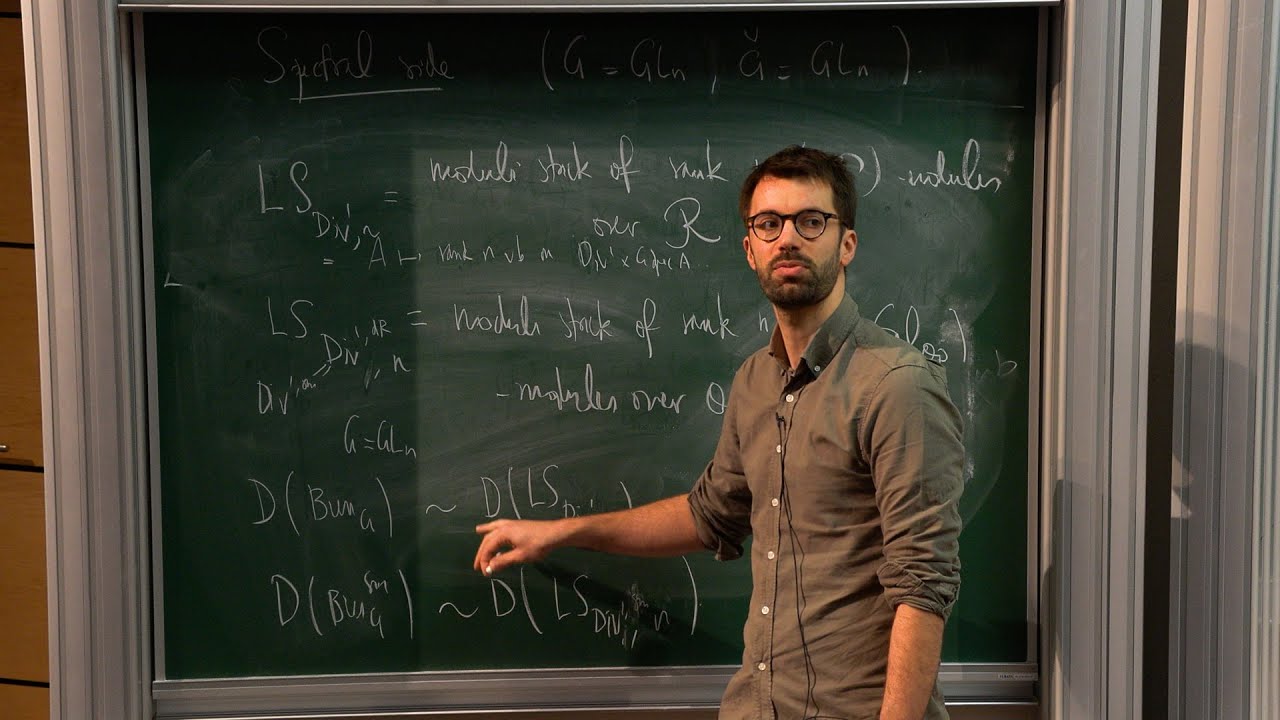
Geometric Aspects of the $p$-adic Locally Analytic Langlands Correspondence
Keywords
Summary
160 words
Critical Evaluation
The talk presents cutting-edge research in arithmetic geometry, specifically the geometrization of the p-adic Langlands program. The speaker, Arthur-César Le Bras, is a recognized expert, and the work is joint with Anschütz, Rodriguez Camargo, and Scholze, indicating high credibility. The content is highly technical, aimed at specialists, and assumes familiarity with advanced concepts such as Fargues-Scholze stacks, prismatic cohomology, and locally analytic representations. The presentation is rigorous, with careful statements of what is known and what remains conjectural. The speaker clearly distinguishes between established results and conjectural expectations, which is a sign of scientific honesty. The construction of the stack Bun_G via near-perfect rings and its embedding of locally analytic representations is a significant contribution. The discussion of the Hecke action, while incomplete, provides valuable insights into the expected structure. The examples, particularly the Lubin-Tate case, illustrate the abstract framework concretely. The talk does not overclaim; instead, it openly acknowledges the limitations and open questions, which is appropriate for ongoing research. The sources cited are primarily the speaker’s own work and related literature, which is standard for a research talk. The title accurately reflects the content. Overall, this is an excellent, high-level research presentation that contributes to the advancement of the field.
202 words
Title / Content Match
The title accurately reflects the content: the talk focuses on geometric aspects of the p-adic locally analytic Langlands correspondence, specifically the geometrization program.
Quality & Reliability
9/10
Talk by a leading expert (Université de Strasbourg) presenting recent joint work with Anschütz, Rodriguez Camargo, Scholze. The content is highly technical, based on established mathematical frameworks (Fargues-Scholze, prismatic cohomology). The presentation is rigorous, with clear caveats about conjectural aspects. No obvious errors or overclaims.
Key Moments
Markers derived by PSI from the transcript: the creator did not define chapters.
- Introduction and recap of previous talk: definition of Bun_G via near-perfect rings and Fargues-Fontaine curves.
- Discussion of the pullback description of Bun_G and the open immersion from the classifying stack of G(Q_p) into Bun_G.
- Fully faithful embedding of solid locally analytic representations into sheaves on Bun_G.
- Introduction of the spectral side: moduli stacks LS_{D1}^{GL_n} and its derived variant.
- Formulation of the conjectural locally analytic geometric Langlands equivalence.
- Discussion of the Hecke action as the fundamental structure connecting the two sides.
- First example of Hecke action: Lubin-Tate case for GL_2, minuscule cocharacter (1,0).
- Description of the Hecke stratum as the perfect analytic prismatization of P^1 modulo automorphisms.
- Discussion of open questions and limitations in defining the full Hecke stack.
Cited Sources
- Carmin.tv — Video platform for mathematics, hosting this talk and related content.
Concurring Sources
- Fargues-Scholze's geometrization of the local Langlands correspondence — Provides the foundational framework for the geometric Langlands program in the p-adic setting.
Contribution & Novelties
This talk presents recent progress in the geometrization of the p-adic locally analytic Langlands program, specifically the construction of the stack Bun_G and the embedding of locally analytic representations. It introduces a conjectural framework for a locally analytic geometric Langlands correspondence and discusses the Hecke action, providing concrete examples. The work is novel and at the forefront of research.
Pour aller plus loin :
- Fargues-Scholze’s geometrization of the local Langlands correspondence — Foundational work on the geometric side.
- Prismatic cohomology — Key technical tool used in the construction.
- Locally analytic representations — Background on the automorphic side.
97 words
Radar Profile
The radar profile shows very high scores in all dimensions, with a particularly strong technical level and information quality. This reflects a highly specialized research talk with substantial content and high reliability.