Artificial Intelligence in Bariatric Surgery: Current Status and Future Perspectives
Keywords
Summary
196 words
Critical Evaluation
Value of the Information & Strength of the Argument
The talk provides valuable insights into the practical applications of AI in bariatric surgery, drawing on the speaker’s extensive experience and leadership roles. The argumentation is coherent, moving from current challenges to specific AI solutions and future possibilities. The speaker effectively argues for AI’s potential to enhance personalized care, improve outcomes, and harmonize global guidelines. However, the argumentation is largely anecdotal and opinion-based, with limited quantitative evidence or detailed case studies. The speaker acknowledges the infancy of AI in this field and the need for further research, which adds credibility. The discussion of ethical and practical challenges, such as data ownership and access disparities, strengthens the argumentation by presenting a balanced view.
Scientific Rigor, Source Quality, Title Accuracy
The speaker demonstrates scientific rigor by referencing established databases (MBSAQIP, IFSO) and the 2022 ASMBS/IFSO guidelines, which are widely recognized. He also mentions specific studies and publications, such as the OMA position statement and a study on AI-generated empathetic responses. However, many references are mentioned without full citations, and the talk lacks a systematic review of literature. The title accurately reflects the content, and the speaker’s expertise adds credibility. The talk is not heavily source-cited, but the sources mentioned are relevant and authoritative. The adequacy between title and content is high, as the talk covers both current status and future perspectives as promised.
230 words
Title / Content Match
The title accurately reflects the content, covering current AI applications and future perspectives in bariatric surgery.
Quality & Reliability
7/10
The speaker is a recognized expert (past president of ASMBS) and provides a balanced overview of AI applications in bariatric surgery, referencing specific databases and guidelines. However, the talk is largely opinion-based with limited detailed data or citations, and some claims lack direct references.
Key Moments
Markers derived by PSI from the transcript: the creator did not define chapters.
- Introduction and disclosures; why AI matters in bariatric surgery.
- Discussion on value-based care and the need for AI to improve quality and reproducibility.
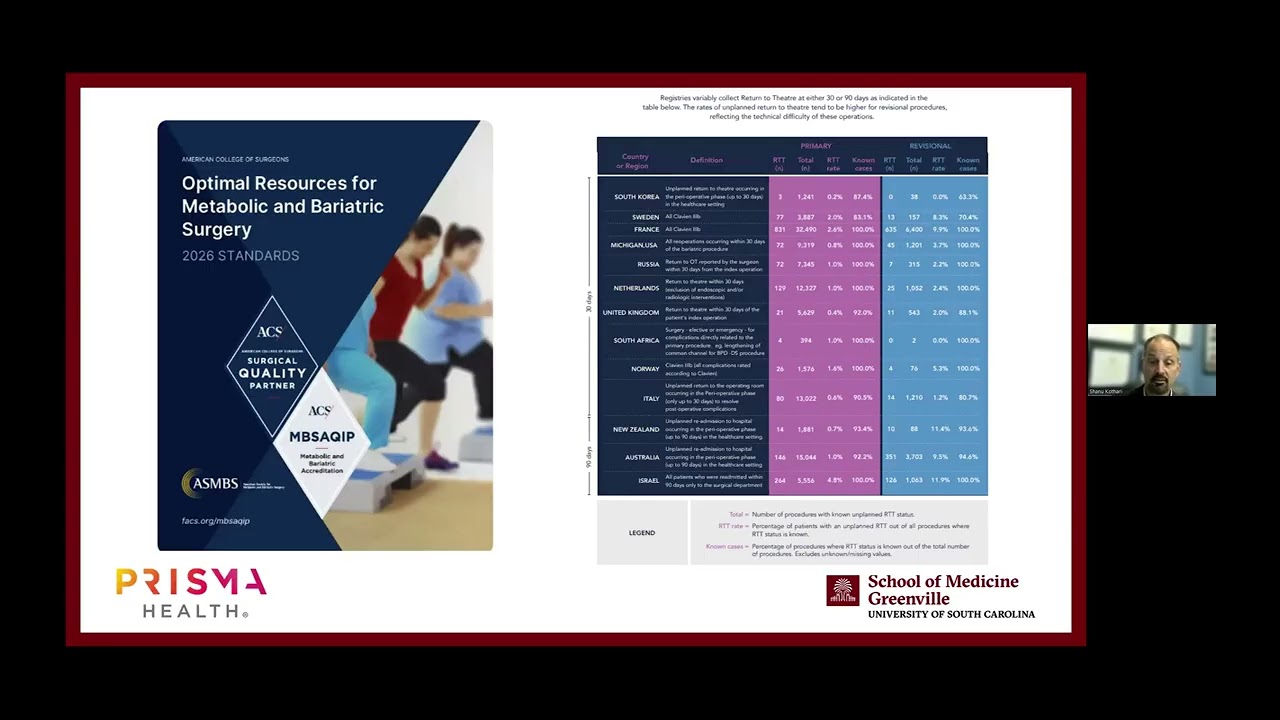
- Global collaboration: MBSAQIP and IFSO databases not communicating; AI as a solution.
- Guideline harmonization: 2022 ASMBS/IFSO guidelines, AI for real-time updates.
- Predictive modeling and personalized procedure selection; 'metabolically matching'.
- AI in the OR: video analysis for quality improvement, automated op notes.
- Remote monitoring, body composition analysis, and gamification for behavior change.
- Challenges: ethics, data ownership, hacking, and access disparities.
- AI in airway management and autonomous robotic surgery; cautionary tales.
- Conclusion: collaborative future, AI as a tool, and Geoffrey Hinton's warning.
Cited Sources
- MBSAQIP (Metabolic and Bariatric Surgery Accreditation and Quality Improvement Program) — Mentioned as the US registry for bariatric surgery outcomes.
- IFSO (International Federation for the Surgery of Obesity and Metabolic Disorders) — Mentioned as the international registry for bariatric surgery outcomes.
- ASMBS/IFSO Guidelines (2022) — Referenced as the updated guidelines adopted by 45 countries.
- OMA Position Statement on AI in Obesity Management — Mentioned as a position statement from the Obesity Medicine Association.
- Study on AI-generated empathetic responses — Referenced as a study where patients rated AI responses as more empathetic than human doctors.
Concurring Sources
Dissenting Sources
- None — No discordant sources were identified in the talk.
Contribution & Novelties
This talk provides a comprehensive overview of AI applications in bariatric surgery from a leading expert, highlighting the potential for AI to enhance personalized care, global collaboration, and guideline harmonization. It introduces the concept of ‘metabolically matching’ patients to procedures using AI, and discusses practical tools like video analysis for quality improvement and automated documentation. The talk also addresses ethical and practical challenges, offering a balanced perspective.
Pour aller plus loin :
- Artificial intelligence in surgery — Overview of AI applications in surgery.
- Machine learning in healthcare — General context for AI in medicine.
- Obesity and metabolic surgery — Background on bariatric surgery.
- Predictive analytics in healthcare — Relevance to predictive modeling.
- Ethics of artificial intelligence — Ethical considerations mentioned in the talk.
123 words
Radar Profile
The radar profile shows a balanced performance across all dimensions, with slightly higher scores in information quantity and quality, reflecting the speaker's expertise and comprehensive coverage. The technical level is moderate, suitable for a professional audience, and the overall reliability is solid, though not heavily source-cited.
💬 No comments were provided for analysis.