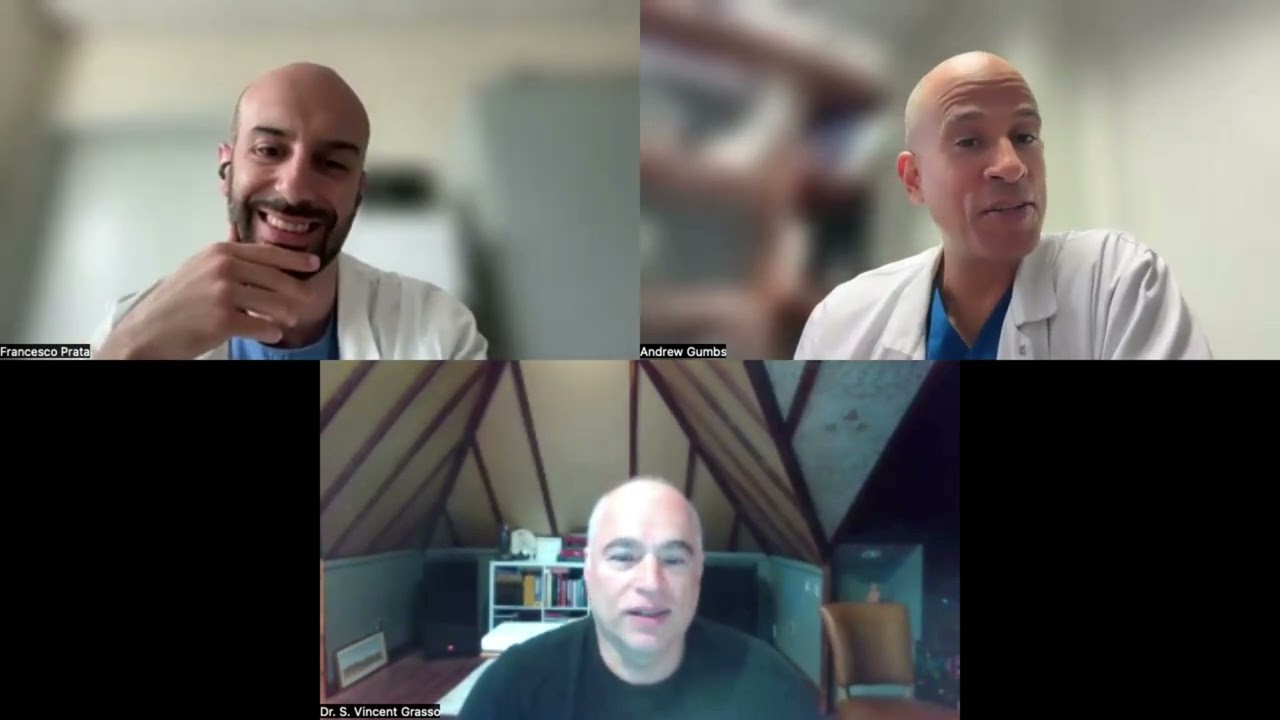
Episode 86: Interview of Dr. Francesco Prata
Keywords
Summary
209 words
Critical Evaluation
Value of the Information & Strength of the Argument
The interview provides valuable insights into the integration of AI and robotics in urology from a practitioner’s perspective. Dr. Prata’s firsthand experience with robotic platforms and AI tools lends credibility to his arguments. He argues convincingly that surgeons must embrace technology to remain relevant, using the metaphor of ‘small incision, big surgeon’ to illustrate the shift towards minimally invasive techniques. His discussion of the fear of AI replacement is balanced, acknowledging concerns while advocating for a supportive role for AI. The argumentation is coherent and grounded in his professional experience, though it lacks empirical data or references to specific studies.
Scientific Rigor, Source Quality, Title Accuracy
The interview does not cite specific scientific sources, but the speakers reference their own experiences and projects, such as the ORSI Academy and the Compass AI initiative. The title accurately reflects the content, which is an interview with Dr. Francesco Prata. The discussion is largely anecdotal, with no formal citations, but the speakers’ expertise in the field adds credibility. The lack of references to external literature is a limitation, but the conversational format is appropriate for a podcast.
193 words
Title / Content Match
The title accurately reflects the content, which is an interview with Dr. Francesco Prata.
Quality & Reliability
7/10
The interview features a practicing urologist with direct experience in AI and robotics, providing credible insights. However, it is largely anecdotal and lacks rigorous scientific evidence or citations.
Key Moments
Markers derived by PSI from the transcript: the creator did not define chapters.
- Introduction of the podcast and guest Dr. Francesco Prata.
- Dr. Prata discusses his background and training in urology.
- Discussion on the evolution of robotic platforms and the end of da Vinci's monopoly.
- Dr. Prata explains the importance of embracing AI and technology in surgery.
- Discussion on the shortage of surgical residents in Italy and its causes.
- Dr. Prata addresses the fear of AI replacing surgeons and advocates for a collaborative approach.
- Final thoughts on empowering surgeons with AI and the importance of staying in academics.
Contribution & Novelties
The interview offers a unique perspective from a young urologist actively integrating AI into surgical practice. It highlights the shift towards multi-platform robotic systems and the need for surgeons to become proficient in AI development. The discussion on the Italian residency bottleneck provides insight into systemic challenges.
Pour aller plus loin :
- Explainable AI — Relevant to the discussion on trust and transparency in AI tools.
- Robotic surgery — Provides background on the evolution of robotic platforms mentioned.
- Ambient clinical documentation — Related to the AI application for clinical documentation discussed.
91 words
Radar Profile
The radar profile shows moderate scores across all dimensions, indicating a balanced but not highly technical or deeply sourced discussion. The interview is informative but relies on anecdotal evidence rather than rigorous scientific data.