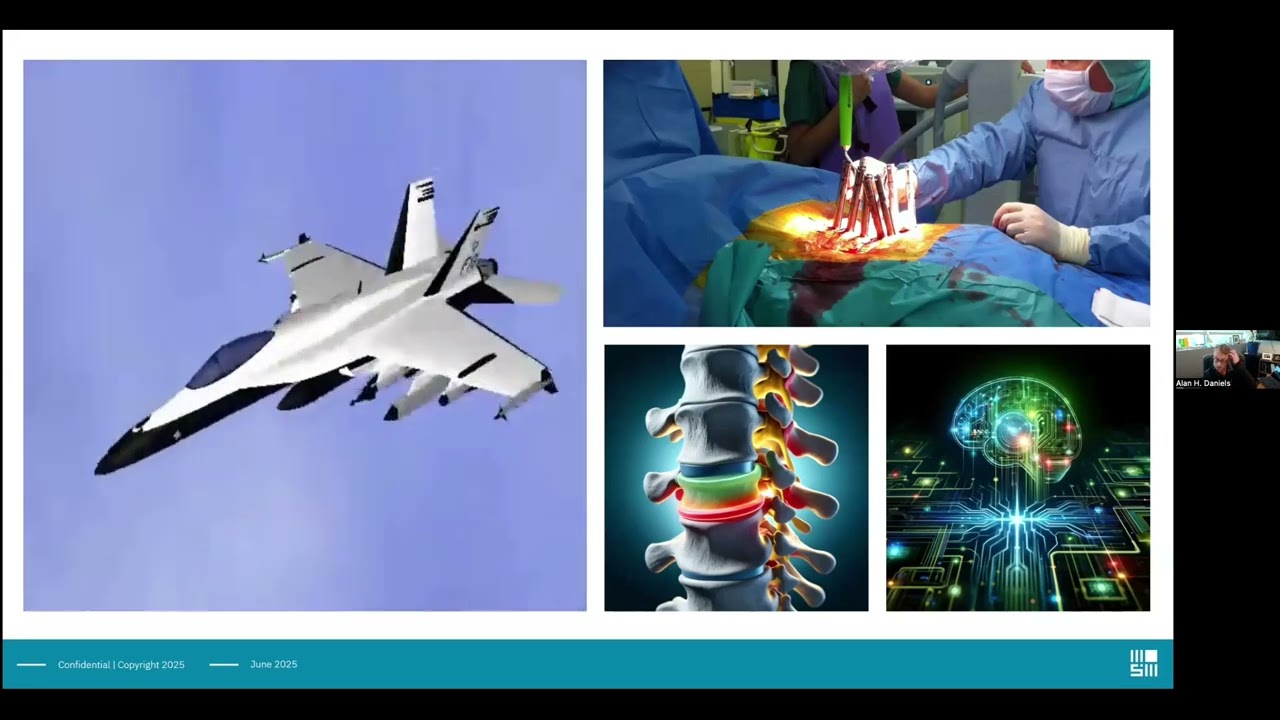
AI Tools for Efficiency & Accuracy in Spine Surgery: Office to OR
Keywords
Summary
184 words
Critical Evaluation
Value of the Information & Strength of the Argument
The presentation offers valuable insights into the current and potential applications of AI in spine surgery, grounded in the speaker’s clinical experience and research. He provides concrete examples, such as the use of digital twins to incorporate soft tissue data and the identification of confounding factors in AI-generated research summaries. His argumentation is balanced, acknowledging both the promise and the limitations of AI, and he advocates for rigorous validation before adoption. However, the talk is largely anecdotal, with limited detailed evidence for the claims made about specific tools.
97 words
Title / Content Match
The title accurately reflects the content, which covers AI applications from administrative tasks to surgical planning.
Quality & Reliability
7/10
The speaker is a practicing spine surgeon with peer-reviewed publications on AI in spine surgery. He presents a balanced view, acknowledging limitations and the need for validation. However, the talk is largely anecdotal and lacks detailed methodological descriptions.
Key Moments
Markers derived by PSI from the transcript: the creator did not define chapters.
- Introduction and disclosures
- Historical perspective on spinal alignment assessment
- Description of 2021 study using self-organizing maps
- Introduction of AI for documentation and coding
- Digital twins for surgical planning
- Incorporating soft tissue data and pain location
- Predicting rod strain and adjacent segment disease
- AI for research synthesis and limitations
- Study on AI-assisted writing in orthopedic literature
- Q&A on trust in AI planning tools
Cited Sources
- Nature Medicine — Quoted on the scarcity of evidence for AI's clinical value.
- Journal of Bone and Joint Surgery — Publication on AI-assisted writing in orthopedic research.
- Journal of Neurosurgery Spine — Follow-up study on AI-assisted writing in spine papers.
Concurring Sources
- Nature Medicine — Supports the need for more evidence on AI's clinical value.
Contribution & Novelties
The talk provides a practical overview of AI applications in spine surgery, emphasizing the integration of diverse patient data and the need for validation. It highlights the potential of digital twins and AI-driven documentation to improve efficiency and accuracy.
Pour aller plus loin :
- Digital twin — Concept of virtual replicas for personalized medicine.
- Finite element analysis — Used in biomechanics to model spinal constructs.
- Proximal junctional kyphosis — A complication of spinal fusion that AI may help predict.
79 words
Radar Profile
The radar profile shows balanced scores across information quantity, quality, technical level, and reliability, indicating a well-rounded presentation with moderate depth and credibility.