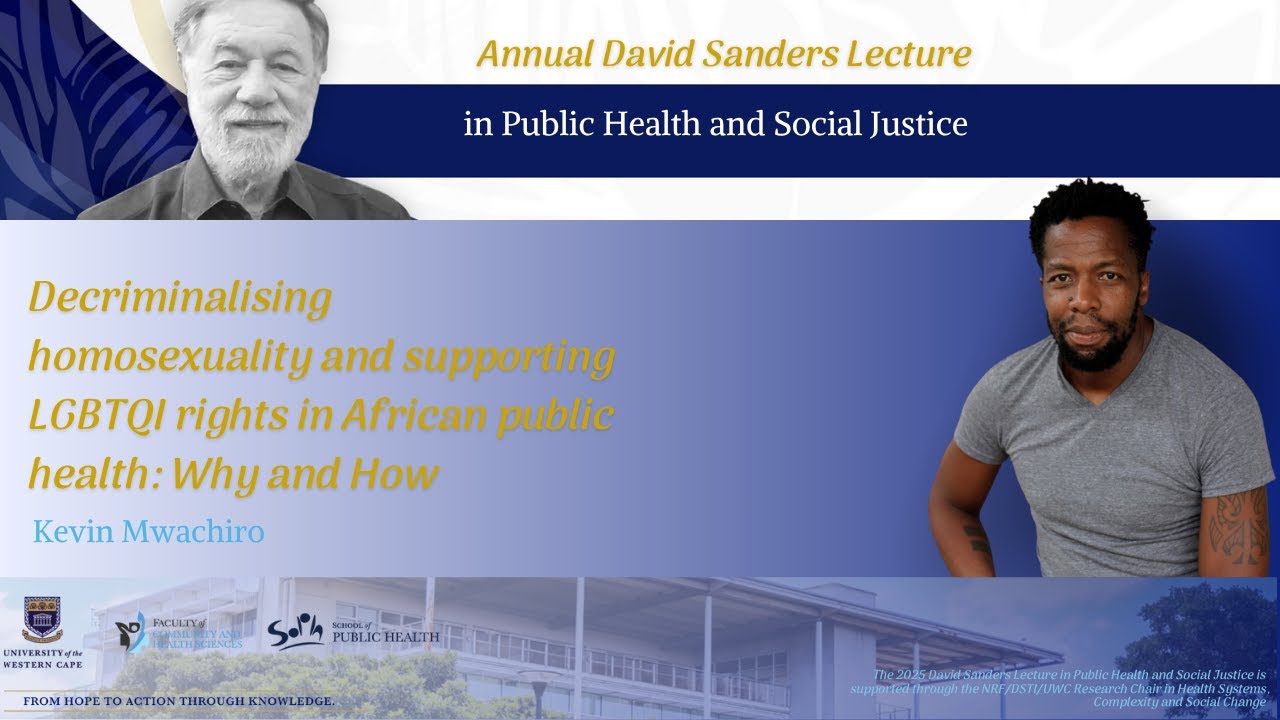
Annual David Sanders Lecture in Public Health and Social Justice 2025
Keywords
Summary
129 words
Critical Evaluation
Value of the Information & Strength of the Argument
The lecture provides valuable insights into the lived experiences of LGBTQI+ individuals in Africa, drawing on personal narratives and advocacy work. The argumentation is compelling, linking public health to broader social justice issues and emphasizing the need for systemic change. However, the presentation is more testimonial than analytical, with limited engagement with empirical data or theoretical frameworks. The strength lies in its humanizing approach and the call to action for public health professionals.
Scientific Rigor, Source Quality, Title Accuracy
The lecture references reports such as the Sudine report and legal cases, but does not systematically cite scientific literature. The title accurately reflects the content, which is a lecture on public health and social justice with a focus on LGBTQI+ rights. The event is well-structured, with introductions and remarks that contextualize the theme. The sources cited are primarily from advocacy and media, which are appropriate for the nature of the talk but limit its scientific rigor.
164 words
Title / Content Match
The title accurately reflects the content, which is a lecture in public health and social justice, focusing on LGBTQI+ rights in Africa.
Quality & Reliability
7/10
The lecture is an expert opinion based on personal experience and advocacy, with references to reports and legal cases, but lacks systematic citation of scientific literature.
Key Moments
Markers derived by PSI from the transcript: the creator did not define chapters.
- Introduction by Professor Asha George, welcoming attendees and setting the theme.
- Remarks by Vice Chancellor Robert Balfour on the importance of social justice and LGBTQI+ rights.
- Sue Faucus, David Sanders' wife, shares personal reflections and introduces the speaker.
- Kevin Mwachiro begins his lecture, sharing personal stories and setting the context.
- Discussion on the intersection of public health and LGBTQI+ rights in Africa.
- Mwachiro highlights challenges and calls for action from public health professionals.
- Q&A session and closing remarks.
Cited Sources
- Sudine report — Mentioned by Vice Chancellor Robert Balfour regarding violence in educational systems.
- Invisible: Stories from Kenya's Queer Community — Kevin Mwachiro's debut book, referenced in his introduction.
- We've Been Here — A collection of stories of LGBTQI+ Kenyans over 50, edited by Mwachiro.
- Boldly Queer: African Perspectives on Same-Sex Sexuality and Gender Diversity — A collection of essays and stories, part of Mwachiro's work.
Concurring Sources
- World Health Organization — WHO supports inclusive health systems and addresses discrimination in healthcare.
- Human Rights Watch — Documents human rights violations against LGBTQI+ individuals in Africa.
Dissenting Sources
- Anti-LGBTQI+ legislation in some African countries — Some African governments and religious groups oppose decriminalization, citing cultural and religious beliefs.
Contribution & Novelties
The lecture brings a unique perspective by centering LGBTQI+ rights within African public health discourse, using personal storytelling to humanize the issues. It emphasizes the need for public health systems to be inclusive and to address social determinants of health. The talk contributes to the growing body of advocacy for decriminalization and rights-based approaches.
Pour aller plus loin :
- Decriminalization of homosexuality in Africa — Overview of legal status and advocacy efforts.
- World Health Organization on sexual health — Framework for sexual health and rights.
- Human Rights Watch on LGBTQI+ rights — Reports and advocacy on LGBTQI+ issues globally.
99 words
Radar Profile
The radar profile shows high scores in qualitative information and global reliability, reflecting the lecture's strength in advocacy and personal testimony. However, the technical level is low, indicating a non-specialist audience. The balance between information quantity and quality is moderate, with a focus on narrative rather than empirical data.
💬 Sur les 0 commentaires analysés, aucune tendance n'a pu être dégagée.