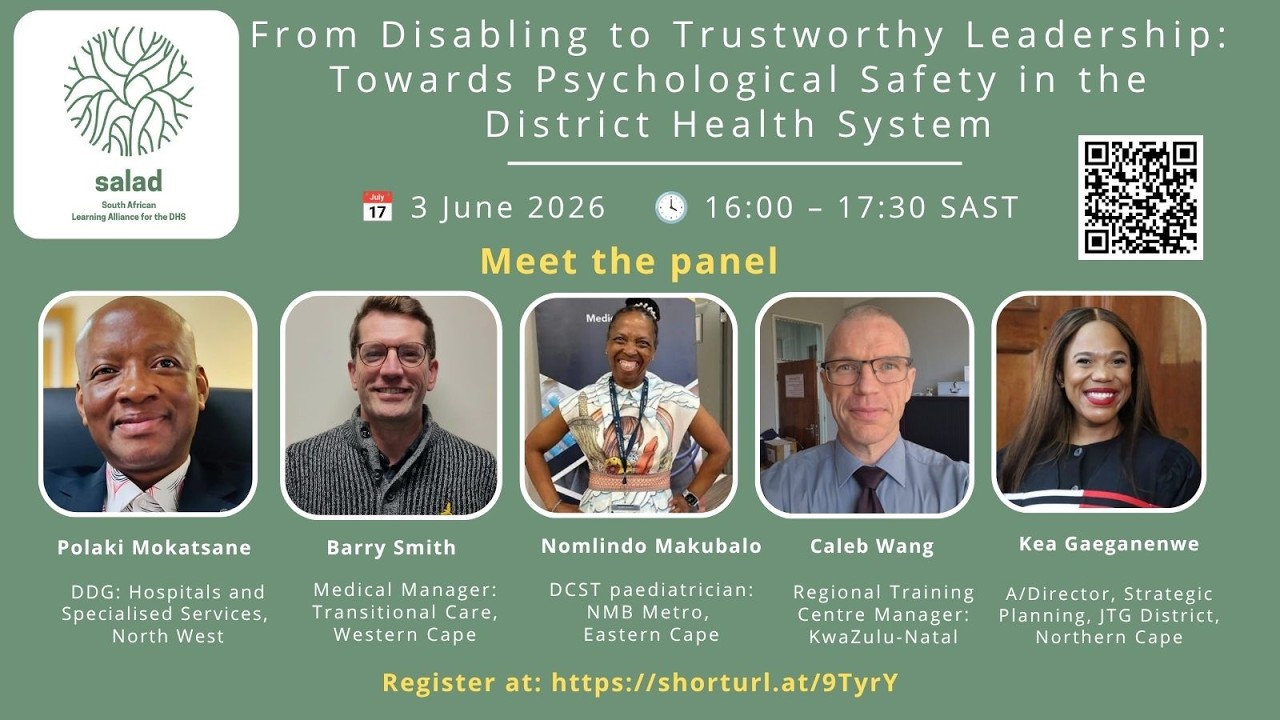
From Disabling to Trustworthy Leadership: Towards Psychological Safety in the District Health System
Keywords
Summary
197 words
Critical Evaluation
Value of the Information & Strength of the Argument
The webinar provides valuable insights into the practical application of trustworthy leadership in public health settings. The panelists’ stories illustrate real-world challenges and successes, offering concrete examples of how leaders can build trust and psychological safety. The argumentation is coherent, emphasizing that trust is built through competence, benevolence, transparency, and accountability. The discussion acknowledges the complexity of balancing control and compliance with relationships and responsiveness, and highlights the importance of addressing interpersonal conflicts directly. The value lies in the experiential knowledge shared by practitioners, which complements academic frameworks.
Scientific Rigor, Source Quality, Title Accuracy
The webinar demonstrates scientific rigor through its structured approach, referencing established concepts such as the core model of success by Daniel Kim and the definition of trust as competence and benevolence. The sources cited are primarily academic frameworks and personal experiences, which are appropriate for a discussion of this nature. The title accurately reflects the content, focusing on the transition from disabling to trustworthy leadership and the role of psychological safety. The session is well-organized, with clear objectives and a facilitated panel discussion. However, the lack of formal citations or references to specific studies limits the depth of scientific evidence presented.
204 words
Title / Content Match
The title accurately reflects the content, which focuses on the transition from disabling to trustworthy leadership and the role of psychological safety in district health systems.
Quality & Reliability
7/10
The webinar features experienced public health practitioners sharing personal stories and reflections on leadership and psychological safety. While not a formal study, the content is grounded in practical experience and references established frameworks (e.g., trust as competence and benevolence, the core model of success). The discussion is balanced and acknowledges complexity, but lacks rigorous empirical evidence or systematic review.
Chapters
Cited Sources
- Core Model of Success by Daniel Kim — Referenced by Sue Cleary to explain the link between relationships, collective thinking, action, and results.
Concurring Sources
- Psychological Safety at Work — Harvard Business Review article on psychological safety, aligning with the webinar's emphasis on creating safe spaces for dialogue.
Contribution & Novelties
The webinar contributes to the discourse on leadership in public health by providing a platform for practitioners to share experiential insights on building trust and psychological safety. It emphasizes the importance of intangible software in facility functioning, such as values, communication, relationships, and power dynamics. The discussion highlights practical strategies like transparency in budget allocation, supportive follow-up visits, and team-building exercises.
Pour aller plus loin :
- Psychological safety — Concept central to the webinar, defined by Amy Edmondson.
- Transformational leadership — Leadership style that inspires and motivates, relevant to the discussion.
- Health system governance — WHO resource on governance in health systems, providing context for district health system challenges.
109 words
Radar Profile
The radar profile shows high scores in quality of information and reliability, reflecting the expert panel and structured discussion. The moderate score in quantity of information and lower technical level indicate that the content is more qualitative and practice-oriented than quantitative or highly technical.