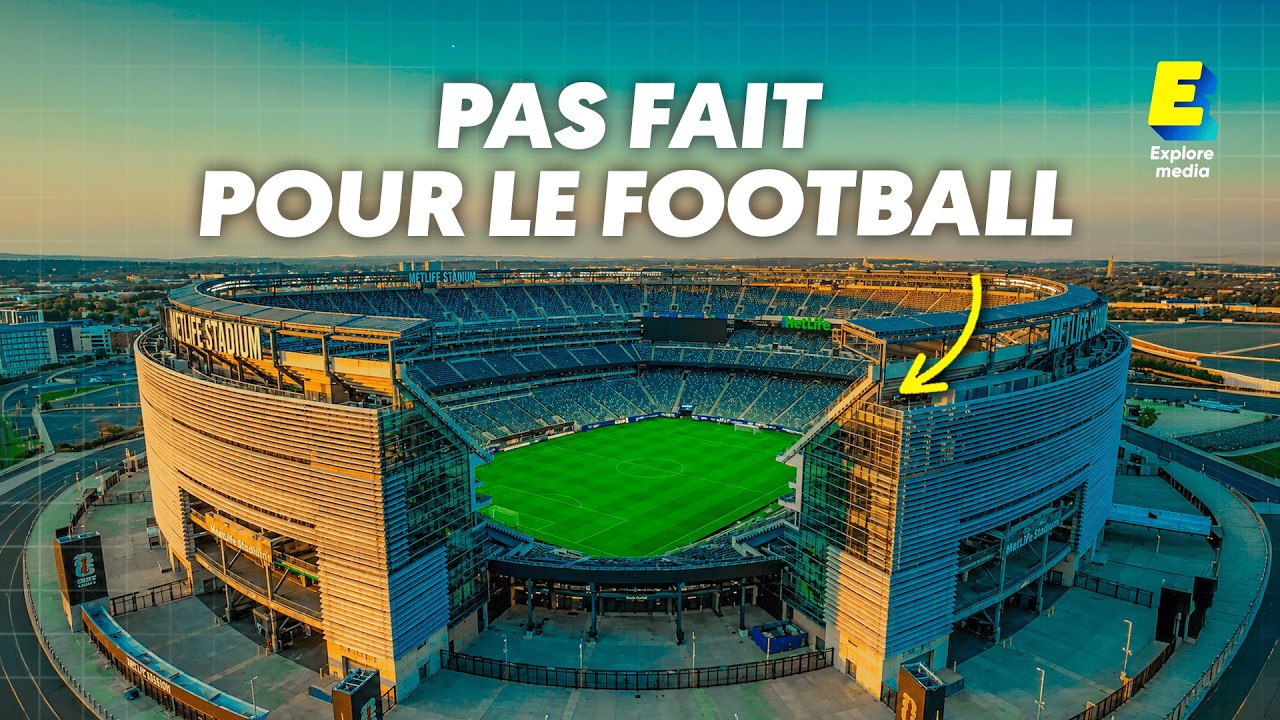
Les stades de foot US sont trop grands (et c'est un problème)
Keywords
Summary
154 words
Critical Evaluation
Value of the Information & Strength of the Argument
The video provides valuable insights into the intersection of architecture, sports, and broadcast technology. It effectively argues that the design of US stadiums, optimized for American football, is fundamentally incompatible with the needs of football broadcasting. The argument is supported by concrete examples, expert interviews, and references to official guidelines. The explanation of C-value and its application to stadium design is particularly illuminating. The video also highlights the economic consequences, such as seat removals and high ticket prices, adding depth to the analysis. The argumentation is solid, though it could benefit from more comparative data with European stadiums.
Scientific Rigor, Source Quality, Title Accuracy
The video demonstrates high scientific rigor by citing official FIFA stadium guidelines, an academic paper on stadium bowl design, and a news article from L’Équipe. The sources are credible and directly relevant. The title accurately reflects the content, and the video’s claims are well-supported. The inclusion of expert interviews adds credibility. However, the video does not provide a comprehensive list of all sources, and some claims, such as the exact number of seats removed, are based on estimates. Overall, the sourcing is strong and the title-content alignment is excellent.
202 words
Title / Content Match
The title accurately reflects the content, which focuses on the architectural challenges of US stadiums for football and the resulting seat removals.
Quality & Reliability
8/10
The video is well-researched, featuring interviews with architects and broadcast professionals, and references official FIFA guidelines and academic sources. The technical explanations are accurate and the production quality is high. Minor limitations include a lack of comprehensive data on seat removals and potential bias from the sponsorship segment.
Key Moments
Markers derived by PSI from the transcript: the creator did not define chapters.
- Introduction: France-Brazil match at Boston stadium and the broadcast issues.
- The hidden problem of American stadiums for football.
- Sponsorship segment with Rhinoshield.
- Why US stadiums are so different from European ones.
- The logic of American football and its impact on stadium design.
- How architects calculate visibility using C-value.
- Why football is disadvantaged in these stadiums.
- FIFA's broadcast requirements and camera angles.
- The challenge for TV directors in US stadiums.
- What happened in Boston: specific broadcast issues.
- Solutions for the 2026 World Cup: raising the pitch and removing seats.
- 400,000 tickets lost due to seat removals.
- Ticket prices exceeding $30,000 for the final.
- Conclusion and final thoughts.
Cited Sources
- FIFA Football Stadiums Guidelines - Stadium Bowl Design — Referenced for FIFA's C-value requirements and seat removal guidelines.
- L'Équipe - FIFA triples ticket prices for 2026 World Cup final — Referenced for the dramatic increase in ticket prices for the final.
- Scientific analysis of stadium bowl shape and visual consequences — Referenced for the academic analysis of bowl shape and its visual impact.
Concurring Sources
- FIFA Football Stadiums Guidelines — The video's claims about FIFA's C-value requirements and seat removals align with the official guidelines.
- L'Équipe article on ticket prices — The video's mention of $30,000 tickets for the final is consistent with this news report.
- Academic paper on stadium bowl design — The video's discussion of the visual consequences of bowl shape is supported by this academic research.
External References
Contribution & Novelties
The video offers a unique perspective on the architectural and broadcast challenges of hosting football in American stadiums, a topic rarely covered in mainstream media. It provides a detailed explanation of the C-value concept and its application to stadium design, making complex engineering principles accessible to a general audience. The video also highlights the economic implications of these challenges, such as seat removals and high ticket prices, adding a layer of socio-economic analysis.
Pour aller plus loin :
- FIFA Stadium Guidelines — Official FIFA guidelines on stadium design, including broadcast requirements.
- C-value in stadium design — Explanation of the C-value concept used in seating geometry.
- Stadium bowl design — Academic paper on the visual impact of bowl shapes.
- Broadcast camera angles in sports — Overview of the role of a TV director in sports broadcasting.
135 words
Radar Profile
The radar profile shows high scores in information quantity, quality, and technical level, indicating a well-researched and informative video. The reliability score is slightly lower, reflecting the reliance on estimates and the presence of a sponsorship segment, but overall the video is highly credible.
💬 Très positif. Sur les 30 commentaires analysés, la grande majorité exprime une admiration pour la qualité de l'enquête et la clarté des explications, avec quelques critiques sur le choix des États-Unis comme pays hôte et des remarques sur les différences culturelles entre le football et le football américain.