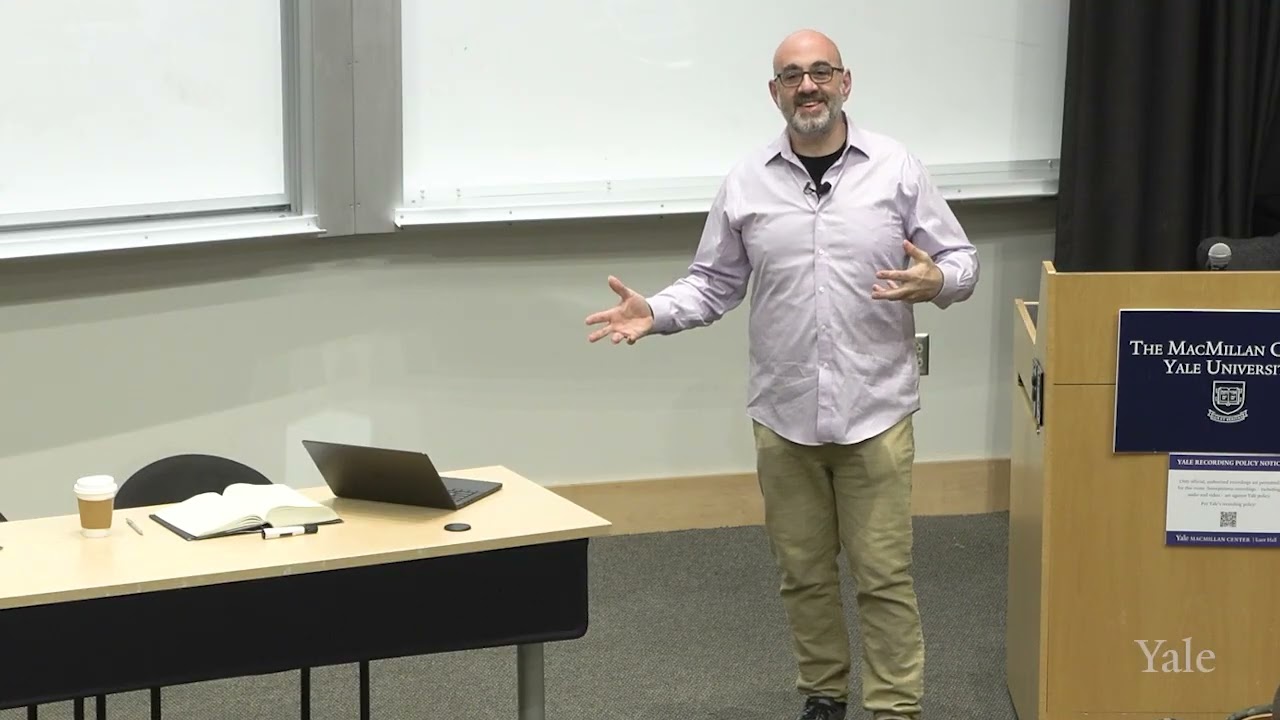
Class 19: Capital Ch. 24, So-Called Original Accumulation
Keywords
Summary
135 words
Critical Evaluation
The lecture provides a thorough and insightful analysis of Marx’s chapter on primitive accumulation. North demonstrates deep familiarity with the text, referencing specific pages and historical details. He effectively contextualizes the chapter within the broader argument of Capital, showing how historical processes are essential to understanding the capitalist system. The discussion of enclosure, consolidation, and clearing is well-supported with historical evidence, and North’s explanation of the transformation of peasants into wage laborers is clear and compelling. He also addresses the role of the state in facilitating these processes, which is a key aspect of Marx’s analysis. The lecture is academically rigorous, drawing on both Marx’s text and secondary literature, such as Rosa Luxemburg’s work. North’s teaching style is engaging, and he makes complex ideas accessible without oversimplifying. One minor weakness is that the lecture occasionally digresses, such as the comparison to ‘Middlemarch,’ which, while interesting, may distract from the main topic. Additionally, North’s reliance on Wikipedia for historical definitions, while acceptable for a lecture, might be seen as less rigorous in a formal academic setting. Overall, the lecture is a valuable resource for understanding Marx’s critique of capitalism and the historical origins of the system. It is well-structured, informative, and thought-provoking, making it suitable for both students and general audiences interested in political economy.
214 words
Title / Content Match
The title accurately reflects the content, which focuses on Chapter 24 of Capital, Volume 1, discussing primitive accumulation.
Quality & Reliability
8/10
The lecture is delivered by a Yale professor specializing in German literature and philosophy, with expertise in Marx. It provides a detailed exegesis of Capital, referencing specific pages and historical processes. The content is scholarly and aligns with established interpretations of Marx, though it is a lecture rather than peer-reviewed research.
Key Moments
Markers derived by PSI from the transcript: the creator did not define chapters.
- Introduction and comparison to Middlemarch
- Discussion of historical processes and unfreedom
- Explanation of enclosure and its effects
- Details on consolidation and clearing
- Conversion of peasants into wage workers
- Origins of capitalists and capitalist farmers
- Discussion of freedom and unfreedom
- Role of the state and legislation
- Colonization chapter and ongoing appropriation
- Conclusion and summary
Cited Sources
- Capital, Volume 1 (Princeton University Press) — The critical edition of Capital used in the course, co-edited by Paul North.
- Course Playlist — Playlist of all lectures in the course.
Concurring Sources
- Capital, Volume 1 (Penguin Classics) — A widely used English translation of Capital, consistent with the lecture's interpretation.
Dissenting Sources
- Critique of Marx's theory of primitive accumulation — Some scholars argue that Marx's historical account is oversimplified, but the lecture does not address these criticisms.
Contribution & Novelties
This lecture offers a detailed and accessible exegesis of Marx’s chapter on primitive accumulation, emphasizing the violent historical processes that underpin capitalism. It connects Marx’s analysis to contemporary issues, such as ongoing expropriation and the role of international institutions. The lecture also highlights Marx’s ironic treatment of freedom, providing a nuanced understanding of the concept.
Pour aller plus loin :
- Primitive accumulation (Wikipedia) — Provides an overview of the concept and its interpretations.
- Enclosure (Wikipedia) — Historical background on the enclosure movement in England.
- Rosa Luxemburg (Wikipedia) — Her work on accumulation and imperialism extends Marx’s analysis.
97 words
Radar Profile
The radar profile shows high scores in quantity and quality of information, indicating a dense and well-researched lecture. The technical level is moderate, suitable for an academic audience but not overly specialized. Overall reliability is strong, reflecting the expertise of the lecturer and the scholarly context.
💬 Sur les 123 commentaires analysés, les spectateurs apprécient la clarté de l'explication et la profondeur de l'analyse, certains demandant des ressources supplémentaires.