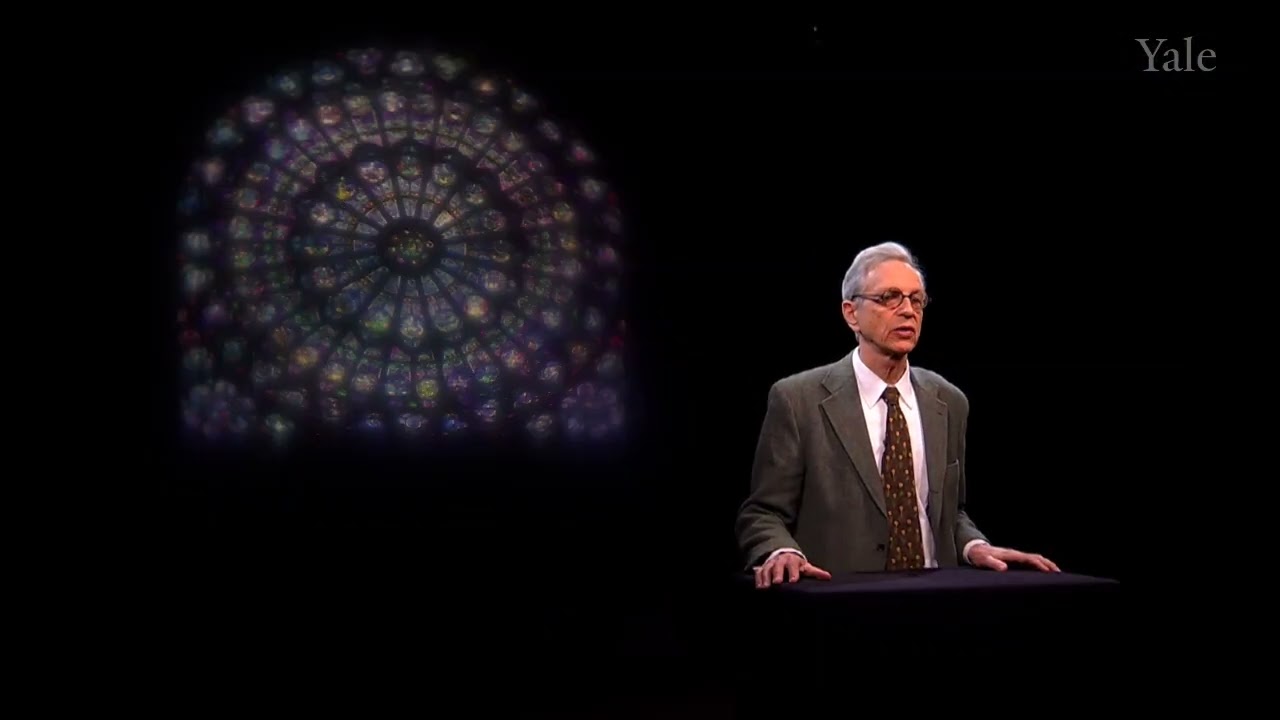
Architectural Innovations of the Gothic | The Age of Cathedrals with R. Howard Bloch
Keywords
Summary
155 words
Critical Evaluation
The lecture provides a comprehensive and well-structured overview of the key architectural innovations of Gothic cathedrals. Professor Bloch’s explanations are clear and accessible, effectively combining technical details with historical context. The use of visual aids, such as diagrams and photographs, enhances understanding. The argumentation is solid, grounded in established scholarship, with references to primary sources like the writings of Suger and to influential works like Panofsky’s. The discussion of the influence of Arabic mathematics is particularly valuable, highlighting the transmission of knowledge. However, the lecture is relatively brief and does not delve deeply into the debates surrounding the functional versus aesthetic role of ribs, nor does it address recent scholarly controversies. The sources cited are primarily from the 19th and 20th centuries, and while authoritative, they may not reflect the latest research. The adéquation between title and content is excellent, as the lecture directly addresses the architectural innovations of the Gothic period. Overall, the lecture is a reliable and informative introduction, suitable for students and enthusiasts, though it could benefit from more critical engagement with historiography.
176 words
Title / Content Match
The title accurately reflects the content, which focuses on the technical and architectural innovations of Gothic cathedrals.
Quality & Reliability
8/10
The video is an academic lecture by a Yale professor, part of a structured course. It presents well-established historical and architectural knowledge, with references to primary sources and scholarly works. The content is accurate and reliable, though it lacks direct citations to recent research.
Chapters
Cited Sources
- The Age of Cathedrals - Online Course — Course page providing access to lectures and materials.
- The Age of Cathedrals on Coursera — Coursera version of the course.
- YaleCourses YouTube Playlist — Playlist containing the full course videos.
Concurring Sources
- Gothic Architecture and Scholasticism by Erwin Panofsky — The lecture references Panofsky's thesis that Gothic architecture parallels scholastic philosophy.
Dissenting Sources
- Debate on the structural role of ribs — Some scholars argue that ribs are primarily aesthetic rather than structural, a debate the lecture mentions but does not resolve.
Contribution & Novelties
The lecture synthesizes well-known architectural history into a concise educational format, emphasizing the technical and mathematical aspects of Gothic construction. It highlights the often-overlooked influence of Arabic mathematics on European architecture.
Pour aller plus loin :
- Gothic architecture - Wikipedia — Overview of Gothic architecture, including structural elements.
- Flying buttress - Wikipedia — Detailed explanation of the flying buttress and its function.
- Rib vault - Wikipedia — Information on ribbed vaulting.
- Eugène Viollet-le-Duc - Wikipedia — Background on the architect whose drawings are used in the lecture.
- Erwin Panofsky - Wikipedia — Author of ‘Gothic Architecture and Scholasticism’.
98 words
Radar Profile
The radar profile shows high scores in quantity and quality of information, reflecting the lecture's dense but well-organized content. The technical level is moderate, suitable for a general audience, while reliability is high due to the academic context.