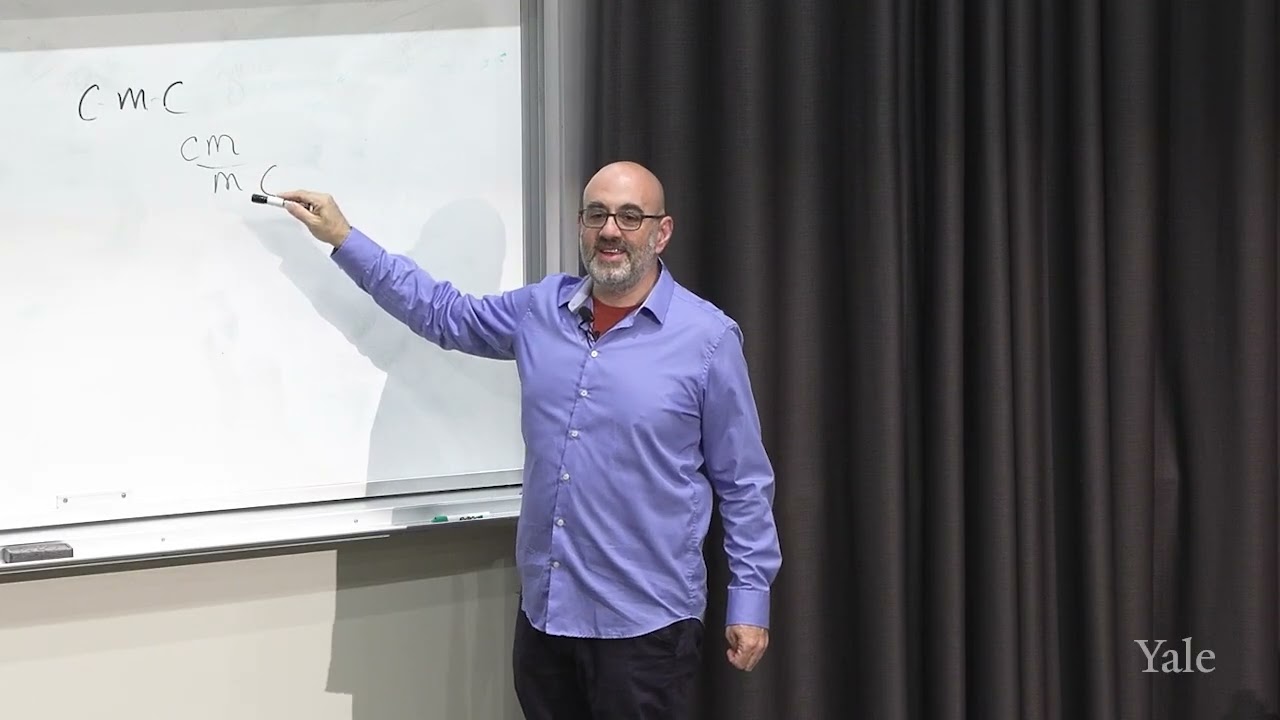
Class 4: Capital Chapters 2-4: Exchange, Money, Capital
Keywords
Summary
152 words
Critical Evaluation
The lecture provides a thorough and insightful analysis of Marx’s Capital, chapters 2-4, with a focus on the functions of money and the transition to capital. Paul North, as a professor and co-editor of a new critical edition, brings authoritative expertise. The explanation is rigorous, closely following Marx’s text and clarifying complex concepts such as the measure of value, means of circulation, and the contradiction in circulation. North effectively uses Marx’s own metaphors, like the ellipse, to illustrate abstract ideas. The lecture is well-structured, building from money’s functions to the formula for capital. However, it assumes a certain familiarity with Marx’s terminology and may be challenging for beginners. The content is highly accurate to Marx’s original work, and North’s interpretations are consistent with mainstream Marxist scholarship. The sources cited are limited to the course playlist and the Princeton University Press edition, which is appropriate. The lecture does not engage with alternative interpretations or criticisms of Marx, but within its scope, it is solid. The title accurately reflects the content. Overall, this is a high-quality educational resource for those studying Marx’s political economy.
182 words
Title / Content Match
The title accurately reflects the content, which covers chapters 2-4 of Capital, focusing on exchange, money, and capital.
Quality & Reliability
8/10
The lecture is given by a Yale professor and co-editor of a new critical edition of Capital, providing expert interpretation grounded in the text. The content is consistent with Marx's original work, though it is a single perspective and not peer-reviewed.
Key Moments
Markers derived by PSI from the transcript: the creator did not define chapters.
- Introduction to money's four functions
- Discussion of money as measure of value
- Explanation of standard of price
- Money as means of circulation and the ellipse metaphor
- The formula C-M-C and its significance
- Discussion of social metabolism and circulation
- Transition to capital and the M-C-M formula
- Commodity fetishism and concealment
- Summary and conclusion
Cited Sources
- Capital: Critique of Political Economy, Volume 1 (Princeton University Press) — The new English translation and critical edition co-edited by Paul North, referenced as the basis for the course.
- Course Playlist — Link to other videos in the course series.
Concurring Sources
- Capital: Critique of Political Economy, Volume 1 (Princeton University Press) — The primary text being studied; the lecture aligns with its content.
Contribution & Novelties
This lecture provides a detailed and accessible exposition of Marx’s analysis of money and its functions, clarifying the distinction between measure of value and standard of price, and explaining the contradiction in circulation. It offers a close reading of the text, making it valuable for students and enthusiasts. The lecture also highlights the transition from simple circulation to capital, setting the stage for understanding surplus value.
Pour aller plus loin :
- Commodity fetishism — Wikipedia article explaining the concept central to Marx’s critique.
- Labor theory of value — Wikipedia article on the theory underlying Marx’s analysis.
- Capital, Volume I — Wikipedia article providing an overview of the book and its chapters.
111 words
Radar Profile
The radar profile shows high scores in quantity, quality, and reliability, with a slightly lower technical level, indicating a lecture that is rich in content and trustworthy, but may require some background knowledge to fully grasp.