1.1 | Diving Into Medical Software: Your Course Introduction - Medical Software Course
Keywords
Summary
176 words
Critical Evaluation
This video serves as an effective introduction to the field of medical software, targeting an audience with some technical background. The instructor, presumably an expert in the field, presents the material in a clear and organized manner, using a logical progression from definitions to broader context. The content is scientifically sound, aligning with established knowledge about medical device regulation and software development processes. The mention of specific regulatory bodies (FDA, IMDRF, EU, etc.) and standards (ISO, IEC) adds credibility, though no specific sources are cited within the video itself. The argumentation is coherent, emphasizing the importance of regulatory compliance and quality management, which are indeed critical in this domain. The use of a guest expert’s anecdote effectively illustrates the practical realities of working in the industry. However, the video is introductory and does not delve into technical details, which is appropriate for its purpose. The adéquation between title and content is strong, as it explicitly promises an introduction and delivers exactly that. The video’s strength lies in its clarity and structure, making it accessible to beginners. Potential weaknesses include a lack of visual aids or diagrams to illustrate the V-model and life cycle, which could enhance understanding. Additionally, the video does not address potential controversies or debates within the field, such as the challenges of regulating AI-based software. Overall, the video provides a reliable foundation for learners, though it is not exhaustive. The production quality is typical of academic lectures, with a single speaker and slides. The content is up-to-date, reflecting current trends in digital health and AI. The instructor’s teaching style is engaging, and the pacing is appropriate. The video successfully sets the stage for the course, outlining clear learning objectives and expectations. It would be particularly valuable for students or professionals transitioning into the medical software industry. The mention of the cost of standards (e.g., ISO 9001 at $175) is a practical insight. The video does not contain any obvious biases or misinformation. The reliance on regulatory documents over standards is a pragmatic choice, though it may limit exposure to industry-specific practices. Overall, this is a high-quality introductory resource that fulfills its stated purpose.
356 words
Title / Content Match
The title accurately reflects the content: it is an introduction to a medical software course, covering the scope and objectives.
Quality & Reliability
8/10
The video is an introductory lecture from a Yale course, presented by an academic instructor. It provides a clear overview of medical software, its regulatory environment, and the software life cycle. The content is well-structured and aligns with established knowledge in the field. The instructor references a textbook and mentions regulatory bodies (FDA, IMDRF, ISO, IEC) and standards, indicating a solid foundation. However, as an introductory overview, it lacks depth and does not provide citations for specific claims. The information is reliable but not exhaustive.
Key Moments
Markers derived by PSI from the transcript: the creator did not define chapters.
- Welcome and overview of the course structure
- Introduction to medical software examples: radiation machine, software as a medical device, mobile app
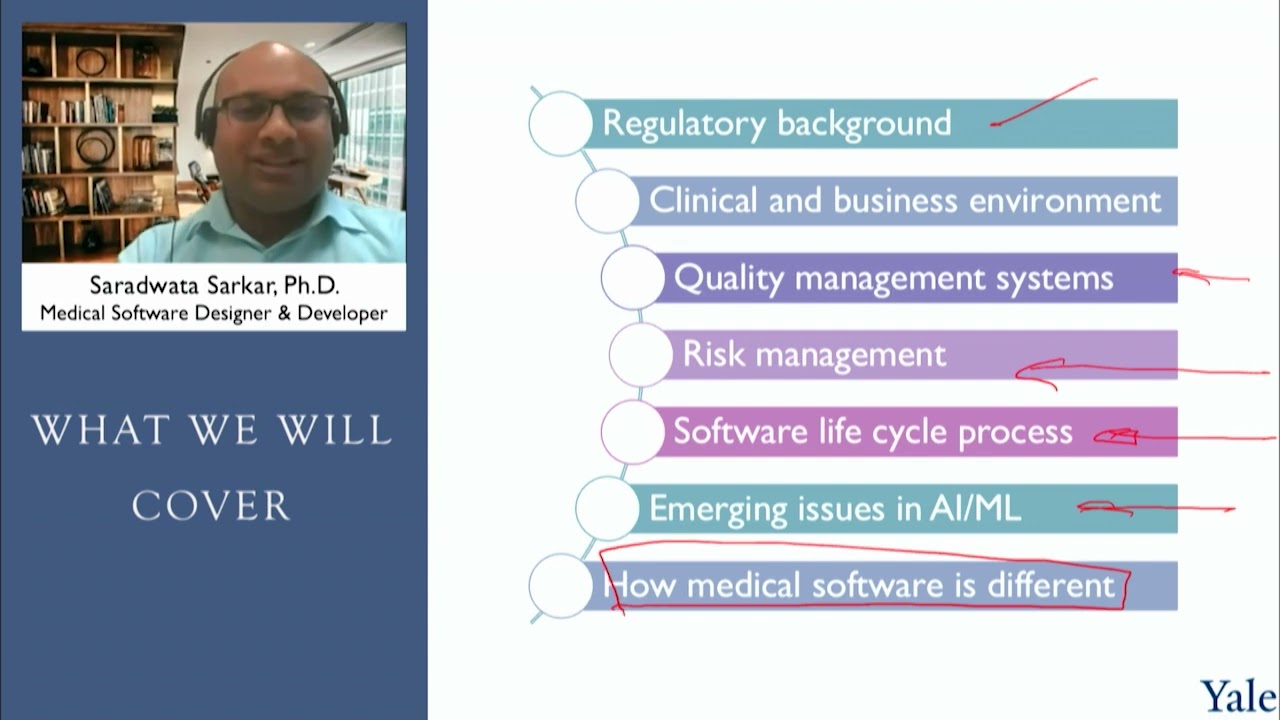
- Course objectives: regulatory process, environment, organizational constraints, technical background, life cycle
- Target audience: CS/engineering students, aspiring engineers, entrepreneurs, managers
- Guest expert anecdote about first day in medical device industry
- Introduction to the V-model and software life cycle
- Primary sources: FDA, IMDRF, EU regulations, and standards (ISO, IEC)
Cited Sources
- Medical Software Course textbook — The course is based on a textbook, but no specific title or author is given.
- FDA (U.S. Food and Drug Administration) — Mentioned as a primary regulatory source for medical software.
- IMDRF (International Medical Device Regulators Forum) — Mentioned as an international regulatory body.
- ISO (International Organization for Standardization) — Mentioned as a source of industry standards, e.g., ISO 9001.
- IEC (International Electrotechnical Commission) — Mentioned as a standards organization.
Concurring Sources
- FDA's Software as a Medical Device (SaMD) guidance — Aligns with the video's discussion of software as a medical device.
- ISO 13485:2016 Medical devices - Quality management systems — Supports the emphasis on quality management systems.
- IEC 62304:2006 Medical device software - Software life cycle processes — Provides a standard for the software life cycle mentioned in the video.
Contribution & Novelties
This video provides a clear and structured introduction to the field of medical software, emphasizing the regulatory and quality management aspects that are often overlooked in traditional software engineering education. It highlights the importance of understanding the entire ecosystem, from regulatory bodies to clinical environments, and introduces the V-model as a framework for development. The inclusion of a guest expert’s perspective adds practical insight.
Pour aller plus loin :
- FDA’s Software as a Medical Device (SaMD) guidance — Official regulatory framework for software as a medical device.
- ISO 13485:2016 Medical devices - Quality management systems — Key standard for quality management in medical device development.
- IEC 62304:2006 Medical device software - Software life cycle processes — International standard for medical software life cycle.
- V-Model (software development) — Overview of the V-model methodology.
- Digital Health Center of Excellence (FDA) — FDA’s initiative for digital health technologies.
145 words
Radar Profile
The radar profile shows high scores in quality of information and reliability, reflecting the academic credibility and structured presentation. The quantity of information is moderate, appropriate for an introductory lecture. The technical level is moderate, accessible to a broad audience. Overall, the video is a solid educational resource.