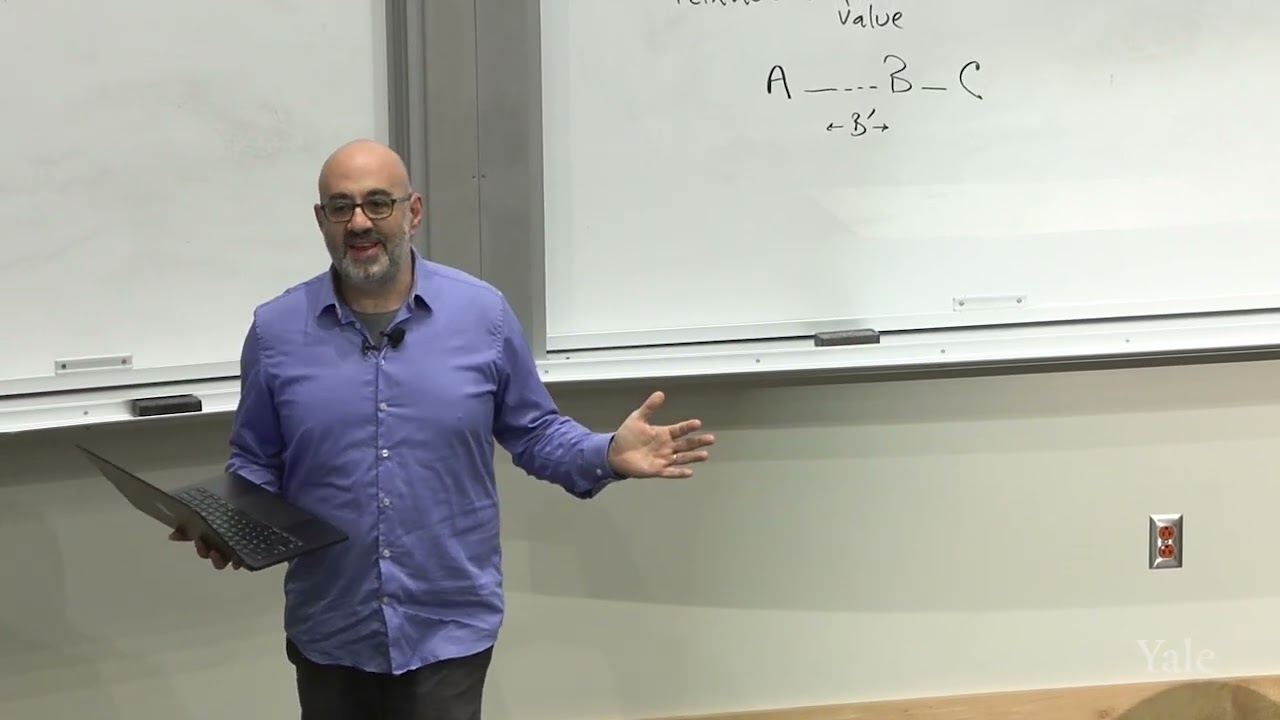
Class 10: Capital Chapters 10-13: Relative Surplus-Value, Division of Labor, Machinery, part 2
Keywords
Summary
178 words
Critical Evaluation
The lecture offers a rigorous and insightful analysis of Marx’s Capital, particularly focusing on the concepts of relative surplus value, division of labor, and machinery. Paul North, as a professor and co-editor of a new critical edition, demonstrates deep expertise and provides a clear conceptual framework for understanding the capitalist system. The strength of the lecture lies in its ability to synthesize complex ideas and present them in an accessible yet scholarly manner. North effectively distinguishes between absolute and relative surplus value, explaining how the latter is achieved through technological innovation and increased productivity, which reduces the cost of labor power. He also emphasizes the systemic nature of capitalism, where individuals are reduced to functions within an interconnected process. The lecture’s analytical approach, as opposed to a purely historical one, is well-justified and helps clarify Marx’s method. However, the lecture is primarily a conceptual overview and does not delve into empirical evidence or contemporary applications, which might limit its appeal for those seeking concrete examples. Additionally, while North addresses the trade-offs capitalists face, such as the tendency of the rate of profit to fall, he does not explore potential counterarguments or criticisms of Marx’s theory. The lecture’s structure is logical, moving from the three tales (things, society, system) to the specific mechanisms of surplus value production. The discussion of machinery as a technique for producing relative surplus value is particularly insightful, highlighting how technological history is subordinated to the history of capital. The lecture also touches on the perversion of human interdependence into class relations, a key theme in Marx’s work. Overall, the lecture is a valuable resource for students and scholars of political economy, offering a clear and nuanced interpretation of Marx’s ideas. The only minor weakness is the lack of engagement with alternative perspectives or critiques, but this does not detract significantly from the overall quality.
308 words
Title / Content Match
The title accurately reflects the content, which focuses on chapters 10-13 of Capital, specifically relative surplus-value, division of labor, and machinery.
Quality & Reliability
8/10
Lecture by a Yale professor, co-editor of a new critical edition of Capital, providing a rigorous analytical overview of Marx's concepts. The content is scholarly and well-structured, though it is an interpretation rather than a presentation of empirical data.
Key Moments
Markers derived by PSI from the transcript: the creator did not define chapters.
- Introduction and overview of the three tales: things, society, system.
- Discussion of Marx's method: analytical vs. historical account.
- Explanation of absolute and relative surplus value as systemic needs.
- The role of machinery in producing relative surplus value.
- Division of labor and its impact on productivity.
- The perversion of interdependence into class relations.
- The systemic nature of capital and the reduction of individuals to functions.
- Trade-offs for capitalists: constant vs. variable capital and the tendency of the rate of profit to fall.
Cited Sources
- Capital, Volume 1 (Princeton University Press) — The new English translation and critical edition of Marx's Capital, co-edited by Paul North.
- Course Playlist — Link to the full course playlist on YouTube.
Concurring Sources
- Capital, Volume 1 (Princeton University Press) — The new critical edition of Marx's Capital, which aligns with the lecture's interpretations.
Contribution & Novelties
This lecture provides a clear and structured overview of Marx’s concepts of relative surplus value, division of labor, and machinery, emphasizing the systemic nature of capitalism. It offers a valuable pedagogical resource for understanding these complex ideas.
Pour aller plus loin :
- Marx’s Capital (Wikipedia) — Overview of the book and its main themes.
- Relative surplus value (Wikipedia) — Explanation of the concept.
- Division of labour (Wikipedia) — Historical and economic perspectives.
72 words
Radar Profile
The radar profile shows high scores in quantity and quality of information, reflecting the lecture's depth and clarity. The technical level is moderate, suitable for an academic audience. Overall, the lecture is highly reliable and informative.
💬 No comments were provided for analysis.