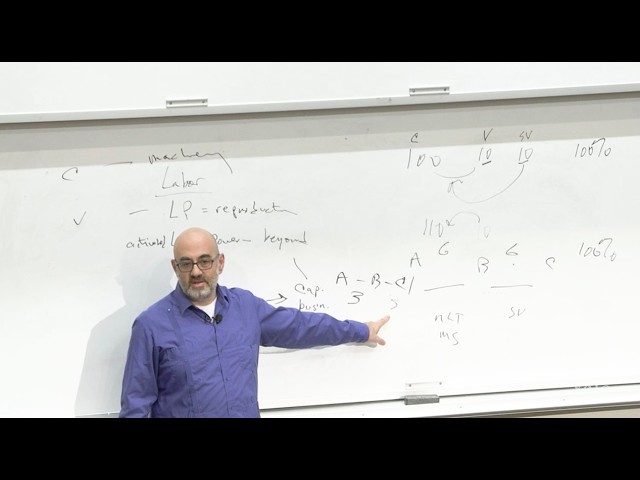
Class 7: Capital Chapters 5-9: Absolute Surplus-Value, Valorization, the Working Day, part 2
Keywords
Summary
220 words
Critical Evaluation
The lecture provides a rigorous and insightful analysis of Marx’s Capital, demonstrating a deep understanding of the text and its philosophical and economic implications. North’s expertise as a co-editor of a recent critical edition of Capital lends authority to his interpretation. He effectively clarifies complex concepts such as constant and variable capital, surplus value, and exploitation, making them accessible without oversimplifying. The discussion of standpoint is particularly valuable, as it highlights the inherent conflicts within the capitalist system. North’s emphasis on the distinction between the rate and amount of surplus value is a crucial point that is often overlooked, and he explains it with clear examples. The lecture is well-structured, building on previous sessions and preparing for future ones. However, it is a lecture, not a peer-reviewed publication, and thus represents an interpretive reading rather than an original contribution. The reliance on a single theoretical framework (Marxist) may limit its applicability to alternative economic perspectives. Additionally, the lecture assumes prior knowledge of the text, which might be challenging for newcomers. The title accurately reflects the content, and the lecture stays focused on the specified chapters. Overall, the lecture is of high quality, offering valuable insights for students and scholars of political economy.
202 words
Title / Content Match
The title accurately reflects the content, which covers chapters 5-9 of Capital, focusing on absolute surplus-value, valorization, and the working day.
Quality & Reliability
8/10
The lecture is delivered by a Yale professor and co-editor of a recent critical edition of Capital, providing high scholarly authority. The content is based on close reading of Marx's text, with clear explanations and references to specific chapters. However, it is a lecture, not peer-reviewed, and relies on the instructor's interpretation.
Key Moments
Markers derived by PSI from the transcript: the creator did not define chapters.
- Introduction: shifting from commodity vocabulary to capital vocabulary, standpoint of capital.
- Discussion of constant and variable capital, and the control levers of capital.
- Exploration of the term 'surplus value' and its translation from German 'Mehrwert'.
- Explanation of exploitation from different standpoints: capitalist vs. worker.
- Discussion on the measurement of labor power's value, including physical and social subsistence.
- Surplus value as non-negotiable, capitalists as functions of capital.
- Distinction between rate and amount of surplus value, with examples.
- The working day as the primary lever of capitalist control, historical struggles.
- Conclusion and transition to next topic: the fight over the length of the working day.
Cited Sources
- Capital: Critique of Political Economy, Volume 1 (Princeton University Press) — The critical edition co-edited by Paul North, referenced as the basis for the course.
- Course Playlist on YouTube — Link to other videos in the course series.
Concurring Sources
- Capital: Critique of Political Economy, Volume 1 — The primary source being studied, providing the theoretical basis for the lecture.
Contribution & Novelties
This lecture offers a detailed and accessible explanation of Marx’s concepts of surplus value and exploitation, emphasizing the importance of standpoint and the distinction between rate and amount of surplus value. It provides a valuable educational resource for understanding Capital.
Pour aller plus loin :
- Marx’s Capital Volume 1 — Wikipedia overview of the book.
- Surplus value — Wikipedia article on the concept.
- Labor theory of value — Wikipedia article on the underlying theory.
74 words
Radar Profile
The radar profile shows high scores in quality of information, technical level, and reliability, with a slightly lower score in quantity of information due to the focused scope of the lecture. This indicates a well-rounded, authoritative presentation.