2.7 | Deeper Dive: Kepler’s Law & Orbits | Rocket Science for Everyone with Yale’s Marla Geha
Keywords
Summary
166 words
Critical Evaluation
The video provides a clear and rigorous demonstration of how to apply Kepler’s Third Law to calculate orbital parameters. The instructor, Marla Geha, is a professor at Yale, lending credibility to the content. The calculations are presented step-by-step, with explicit attention to unit conversions, which is crucial for accuracy in physics. The use of scientific notation is well-explained and justified. The video covers a range of examples, from historical Sputnik to modern GPS and geosynchronous satellites, illustrating the practical relevance of the concepts. The argumentation is solid: each step is logically derived from the previous, and the instructor checks units at each stage. The sources are not explicitly cited within the video, but the content is based on well-established physics (Kepler’s laws, Newtonian gravitation). The video is part of a structured course, and the instructor’s expertise is evident. The title accurately reflects the content, and the video fulfills its promise of a deeper dive. The informal style, with occasional ‘um’s, may be less polished but does not detract from the scientific value. The video is suitable for learners with some background in algebra and physics; it is not for complete beginners. Overall, the video is a high-quality educational resource, with accurate content and clear explanations. The main limitation is the lack of external references, but this is compensated by the instructor’s authority and the logical presentation. The video could be improved by providing a summary of the formulas and perhaps a worked example with different units, but as it stands, it is an excellent tutorial.
255 words
Title / Content Match
The title accurately reflects the content: a deeper dive into Kepler's law and orbital calculations, consistent with the course context.
Quality & Reliability
9/10
The content is presented by a Yale professor, based on established physics (Kepler's laws, Newtonian gravity). The calculations are transparent and reproducible, with clear unit handling. The video is part of a structured course, and the instructor demonstrates expertise. Minor limitations: no external sources cited within the video, and the informal style may reduce precision, but the scientific content is accurate.
Key Moments
Markers derived by PSI from the transcript: the creator did not define chapters.
- Introduction to the deeper dive and scientific notation.
- Explanation of scientific notation with examples of Earth and Moon masses.
- Introduction to Kepler's Third Law and its components.
- Calculation for Sputnik: determining orbital height using Kepler's law.
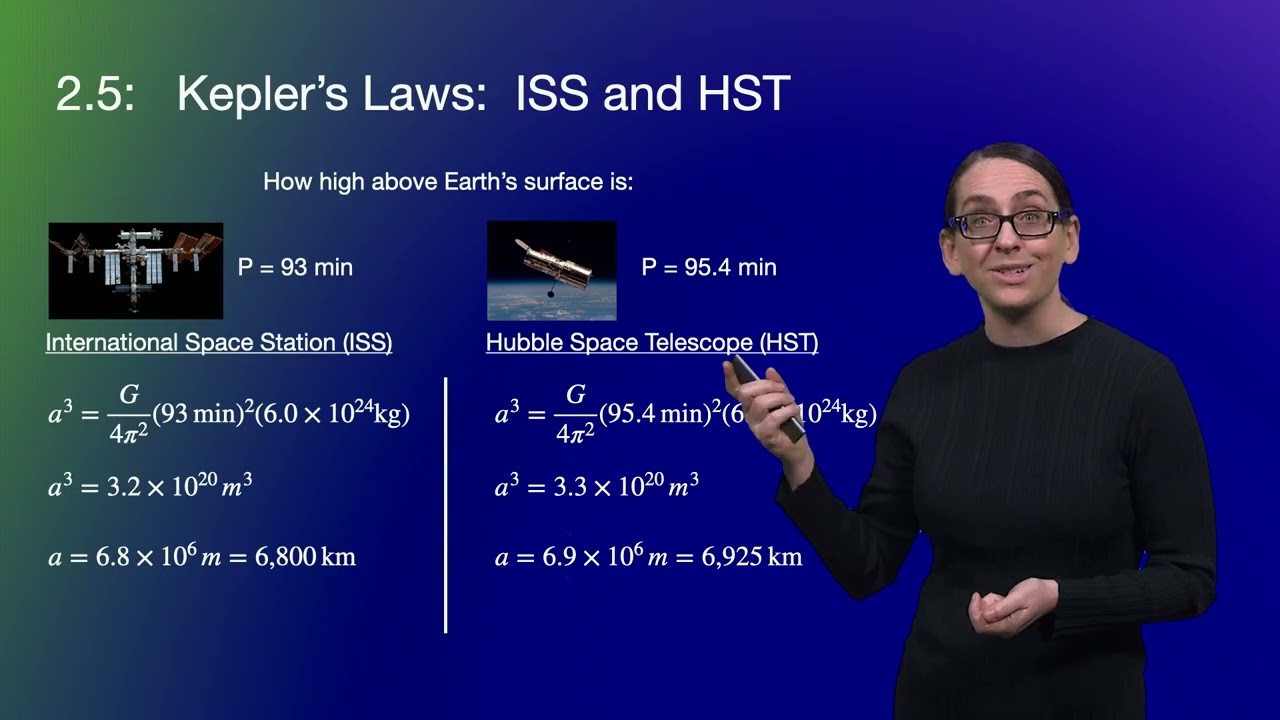
- Comparison of ISS and Hubble orbital heights.
- Calculation of Hubble's orbital velocity.
- Calculation of GPS satellite orbital period.
- Calculation of geosynchronous orbital height.
- Conclusion and wrap-up.
Cited Sources
- Rocket Science for Everyone - Yale Online — Course page for the full course, providing context and additional resources.
- Rocket Science for Everyone - Coursera — Coursera version of the course, with assessments and certificate.
- Rocket Science for Everyone - YouTube Playlist — Full playlist of the course videos.
Concurring Sources
- Kepler's laws of planetary motion - Wikipedia — Confirms the formulation and application of Kepler's Third Law.
- Gravitational constant - Wikipedia — Provides the value and units of G used in the calculations.
Contribution & Novelties
This video provides a practical, step-by-step application of Kepler’s Third Law to real-world satellite orbits, making abstract physics concepts tangible. It emphasizes unit consistency and scientific notation, which are often overlooked in introductory materials. The video is part of a broader course, but this deeper dive adds value by walking through calculations in detail.
Pour aller plus loin :
- Kepler’s laws of planetary motion — Essential background on Kepler’s laws.
- Gravitational constant — Details on the constant G used in the calculations.
- Geosynchronous orbit — Explanation of geosynchronous orbits and their applications.
92 words
Radar Profile
The radar profile shows high scores in quality and reliability, with slightly lower but still strong scores in quantity and technical level. This indicates a focused, accurate tutorial that may not cover a broad range of topics but excels in depth and correctness.