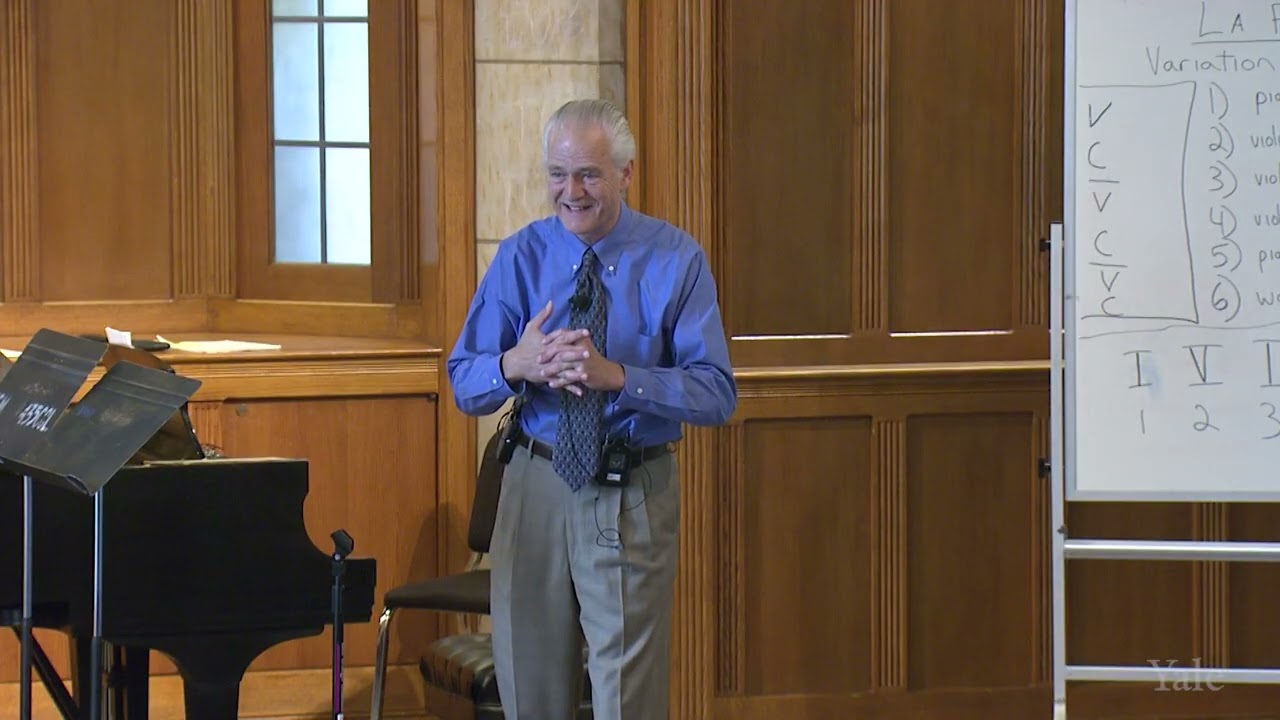
Lecture 10 Sonata-Allegro and Theme and Variations
Keywords
Summary
141 words
Critical Evaluation
The lecture is a masterclass in music appreciation, delivered by an expert with clear pedagogical skill. Professor Wright’s approach to breaking down sonata-allegro form into four functional types is highly effective, providing students with a practical framework for listening. The use of live musical examples, played on the piano and via recordings, reinforces the concepts and makes them tangible. The interactive nature of the lecture, with students identifying the functional types, actively engages the audience and solidifies their understanding. The transition to theme and variations is seamless, and the inclusion of a live performance of Corelli’s ‘La Folia’ is a brilliant way to illustrate the form in practice. The lecture is well-structured, with clear chapter markers, and the professor’s enthusiasm for the subject is infectious. However, the lecture is primarily a one-way transmission of knowledge, with limited critical discussion of alternative interpretations or historical context. The sources cited are not explicitly mentioned, though the lecture is part of a Yale course with accompanying materials. The adéquation between title and content is perfect, as the lecture focuses precisely on sonata-allegro and theme and variations. Overall, this is an excellent educational resource for anyone seeking to deepen their understanding of classical music forms.
201 words
Title / Content Match
The title accurately reflects the lecture's focus on sonata-allegro form and theme and variations.
Quality & Reliability
8/10
Lecture by a Yale professor, part of an accredited course, with clear pedagogical structure and musical examples. The content is based on established music theory and historical knowledge. The lecture is well-organized and the instructor demonstrates expertise. However, it is a single perspective and lacks peer review or external sources.
Chapters
Contribution & Novelties
The lecture provides a clear and systematic method for identifying the four functional types within sonata-allegro form, which is a valuable pedagogical contribution. It also offers a practical demonstration of theme and variations through live performance.
Pour aller plus loin :
- Sonata form — Wikipedia article providing a comprehensive overview of sonata form, including its history and structure.
- Theme and variations — Wikipedia article on variations in music, explaining the concept and its historical development.
- La Folia — Wikipedia article on the musical theme ‘La Folia’, used in Corelli’s work performed in the lecture.
94 words
Radar Profile
The radar profile shows high scores in quantity and quality of information, reflecting the lecture's comprehensive and well-structured content. The technical level is moderately high, suitable for an introductory university course. The overall reliability is strong, given the instructor's expertise and the institutional backing.