02 Component selection techniques Resistor
Keywords
Summary
141 words
Critical Evaluation
Value of the Information & Strength of the Argument
The video offers practical, actionable information for engineers selecting resistors. It explains the rationale behind using standard E-series values and provides a clear method for calculating temperature coefficient effects. The argumentation is based on industry practice and common sense, though it lacks formal citations. The presenter’s experience is evident, and the advice is generally sound, such as preferring 1% tolerance resistors as a default and being cautious about using non-standard power ratings.
Scientific Rigor, Source Quality, Title Accuracy
The video does not cite specific sources, but it references standard industry practices and datasheets from manufacturers like Vishay and Yageo. The information is consistent with common engineering knowledge, though the lack of formal references reduces its scientific rigor. The title accurately reflects the content, and the video stays on topic throughout.
139 words
Title / Content Match
The title accurately reflects the content, which focuses on resistor selection techniques.
Quality & Reliability
7/10
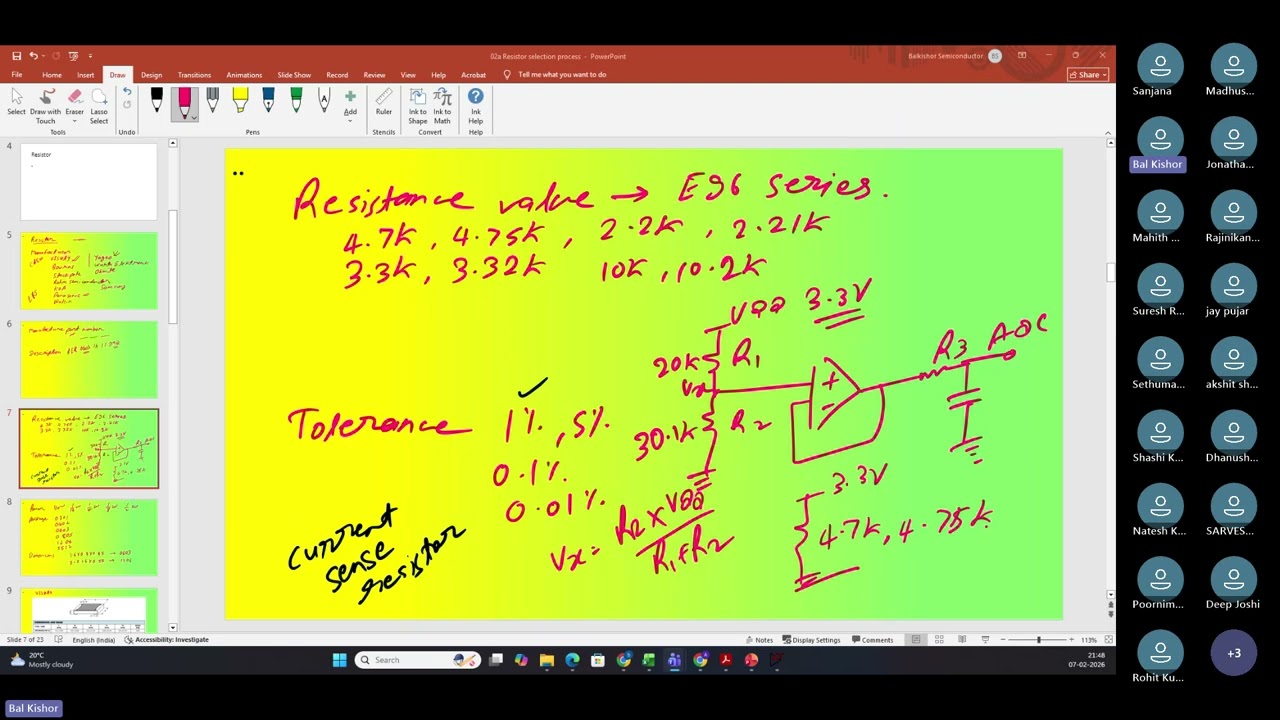
The video provides a practical tutorial on resistor selection, covering key parameters such as E-series values, tolerance, power rating, temperature coefficient, and derating. The information is generally accurate and aligns with standard engineering practices, though it lacks formal citations and some explanations are informal.
Key Moments
Markers derived by PSI from the transcript: the creator did not define chapters.
- Introduction to component selection techniques, focusing on resistors.
- Discussion on resistor manufacturers and series like Vishay, Yageo, Panasonic.
- Explanation of E-series values and why to use standard values like 4.75k instead of 4.7k.
- Detailed explanation of E96 series and how to interpret the values.
- Discussion on tolerance, power rating, and package sizes.
- Temperature coefficient calculation and its importance.
- Derating curve and its impact on power rating at higher temperatures.
- Automotive ratings (AEC-Q200) and differences from industrial resistors.
- Practical advice on selecting standard packages and power ratings.
- Conclusion and summary of key points.
Cited Sources
- Microcontroller design techniques playlist — Referenced as a related video for further learning on microcontroller design.
Concurring Sources
- E series of preferred numbers — Supports the explanation of E-series values and their standard nature.
- Resistor — General reference for resistor types and specifications.
Contribution & Novelties
The video provides a practical, experience-based guide to resistor selection, emphasizing the use of standard E-series values and the importance of temperature coefficient and derating. It offers clear examples and calculations, making it accessible for engineers. The advice to prefer standard values like 4.75k over 4.7k is a useful tip for improving accuracy.
Pour aller plus loin :
- E series (preferred numbers) — Explains the standard resistor value series.
- Resistor — General information on resistors, including types and specifications.
- Temperature coefficient — Definition and examples of temperature coefficient.
- Derating — Concept of derating in electronics.
95 words
Radar Profile
The radar profile shows high scores in quantity and quality of information, with moderate technical depth and reliability. The video is informative and practical, but lacks formal citations, which slightly lowers the reliability score.