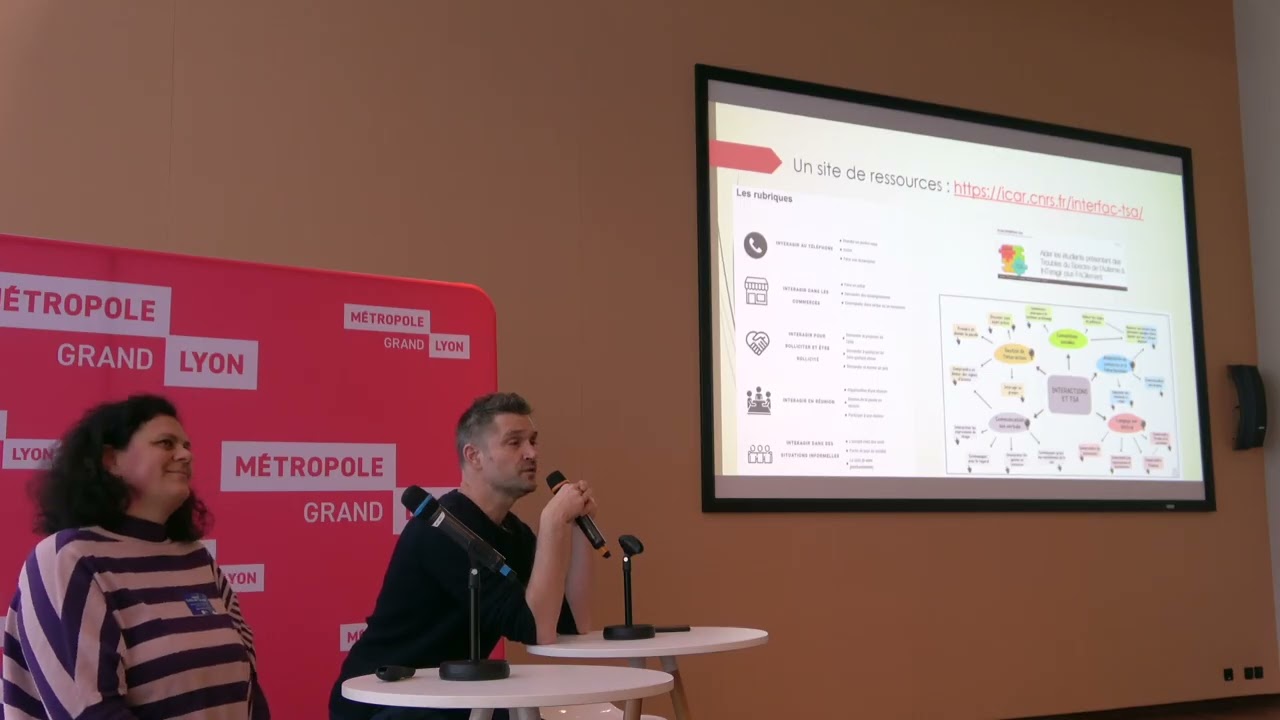
Le projet InterFact-TSA
Keywords
Summary
143 words
Critical Evaluation
Value of the Information & Strength of the Argument
The presentation provides valuable insights into a concrete project addressing the needs of autistic students. The argumentation is based on practical experience and collaboration, with a strong emphasis on ethical considerations. The speakers highlight the importance of co-construction with stakeholders and the need to avoid stigmatization. However, the talk is largely descriptive and lacks detailed data or evidence from the survey, which limits the strength of the argumentation.
Scientific Rigor, Source Quality, Title Accuracy
The scientific rigor is moderate: the project is based on established research in interaction analysis, but the results are not yet published. The sources cited are primarily the project’s own resources and the collaboration with disability services. The title accurately reflects the content, and the presentation is well-structured. The ethical reflection on masking adds depth, but the lack of concrete data and references to external literature weakens the overall rigor.
153 words
Title / Content Match
The title accurately reflects the content, which focuses on the InterFact-TSA project aimed at helping autistic students interact more easily.
Quality & Reliability
7/10
The presentation is based on a collaborative project involving researchers and disability support services, with an online survey (200+ responses) and resources built on authentic interaction corpora. However, the results are not yet published, and the talk is largely a testimony of experience rather than a peer-reviewed study.
Key Moments
Markers derived by PSI from the transcript: the creator did not define chapters.
- Introduction to the InterFact-TSA project and team presentation.
- Objectives: help autistic students interact, create training modules, and raise awareness.
- Online survey conducted with over 200 responses; results not yet published.
- Creation of educational resources based on authentic interaction corpora.
- Structure of the resources: key steps in conversations, routines, and multimodal aspects.
- Thibault Chambriard discusses his role in facilitating access to the field and raising ethical questions.
- Example of explicating implicit social codes without forcing conformity.
- Future plans for dissemination and training modules.
Cited Sources
- InterFact-TSA resources website — Mentioned as the site presenting the resources created by the project.
Concurring Sources
- ICAR laboratory — The laboratory conducting the research.
Contribution & Novelties
The project brings an original contribution by combining research on interaction with practical resources for autistic students, based on authentic corpora. The ethical reflection on masking is particularly valuable.
Pour aller plus loin :
- Autism spectrum disorder — Overview of ASD.
- Masking (personality) — Concept of masking in autism.
- Conversation analysis — Methodological basis for the project.
57 words
Radar Profile
The radar profile shows moderate scores across all dimensions, with a slight peak in reliability and information quality, reflecting the project's grounding in authentic data and ethical considerations, but lower scores in technical level and quantity of information due to the lack of published results and detailed data.