Le projet Langageons-nous !
Keywords
Summary
111 words
Critical Evaluation
Value of the Information & Strength of the Argument
The presentation provides valuable insights into a novel prevention program for early language development. The argumentation is based on the recognized importance of early language acquisition and the identified gaps in current practices. The speakers justify the need for the project by citing the lack of parental guidance on language, the late detection of language difficulties, and the scarcity of similar programs. They also emphasize the project’s evidence-based approach and its potential to be integrated into public health policies. However, the presentation is largely descriptive and lacks detailed evidence or preliminary results, which limits the strength of the argumentation.
Scientific Rigor, Source Quality, Title Accuracy
The scientific rigor is moderate. The speakers are credible experts, and the project is based on established knowledge about language development. They mention the ‘1000 days’ report and existing programs like ‘Parler Bambin’ and ‘Papoto’, but do not provide specific citations or data. The title accurately reflects the content. The presentation is more of a project overview than a rigorous scientific exposition, and the lack of references and empirical evidence reduces its scientific depth.
188 words
Title / Content Match
The title accurately reflects the project name and its focus on language development.
Quality & Reliability
7/10
The presentation is given by a research director and a speech therapist, both experts in language development. It describes an ongoing project with a clear methodology and mentions partnerships with academic and health institutions. However, it is a project presentation without published results, and the evidence base is not detailed.
Key Moments
Markers derived by PSI from the transcript: the creator did not define chapters.
- Introduction of the speakers and the project 'Langageons-nous !'.
- Presentation of the Occitadys association and its missions.
- Description of the DDL laboratory and its research themes.
- Origin of the project during the COVID-19 confinement.
- Goals of the project: sensitizing parents and physicians.
- Description of the mobile application and the tips for parents.
- The physician's language notebook and its use.
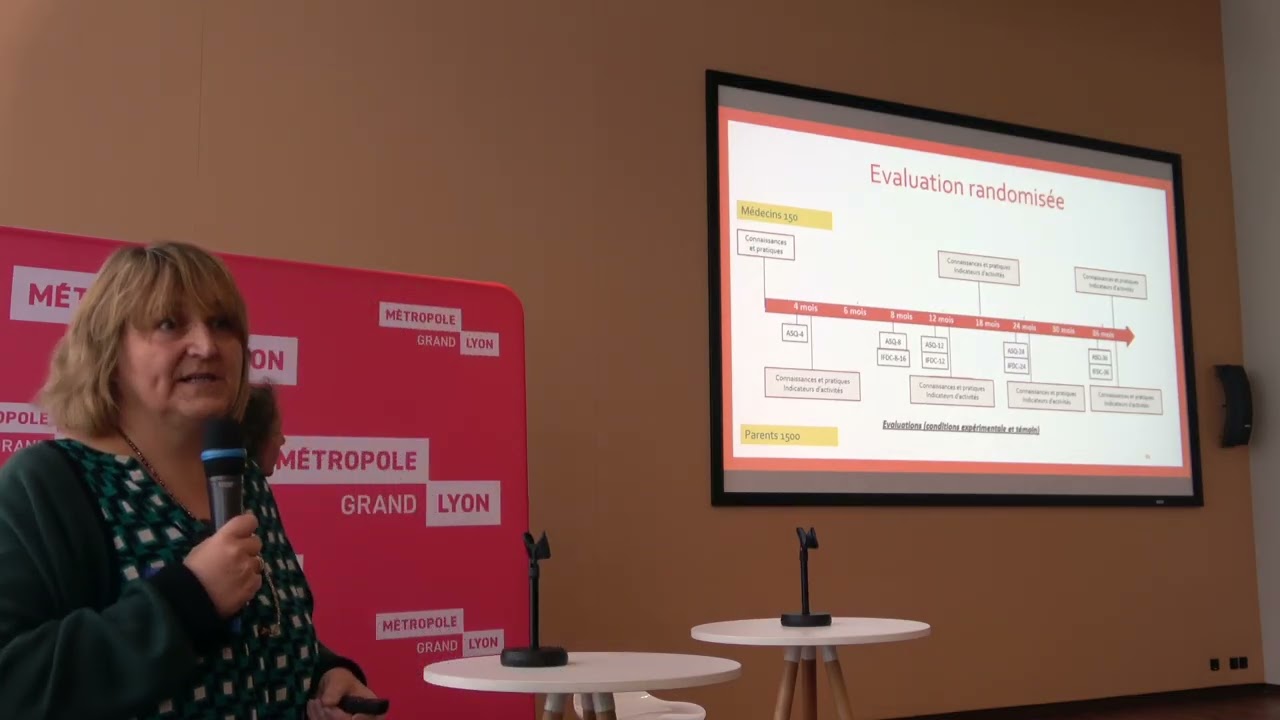
- Evaluation design: randomized controlled trial with 1500 children.
- Expected benefits and challenges of the project.
- Funding issues and call for support.
Cited Sources
- Laboratoire Dynamique du Langage (DDL) — Mentioned as the research laboratory involved in the project.
- Association Occitadys — Mentioned as the partner association for prevention and care.
- Rapport des 1000 jours — Mentioned as a reference for early childhood policies.
Concurring Sources
- Parler Bambin — Mentioned as an existing program targeting early language development, though focused on childcare professionals.
- Papoto — Mentioned as a program that discusses language development but lacks long-term parental follow-up.
Contribution & Novelties
The project ‘Langageons-nous !’ brings an original contribution by targeting both parents and physicians in a coordinated prevention program for language development in children under 3. It combines a mobile application with age-specific tips and a physician’s notebook for monitoring, and it is designed to be evaluated through a large-scale randomized controlled trial. This dual approach and the long-term follow-up are innovative compared to existing programs.
Pour aller plus loin :
- Language development in early childhood — Provides background on typical language acquisition.
- Parental involvement in early language intervention — Discusses the role of parents in language development.
- Randomized controlled trial in education — Explains the methodology used for evaluation.
110 words
Radar Profile
The radar profile shows balanced scores across information quantity, quality, technical level, and reliability, indicating a well-rounded but not exceptional presentation. The project is promising but still in development, which limits the strength of the evidence.
💬 No comments were provided for analysis.