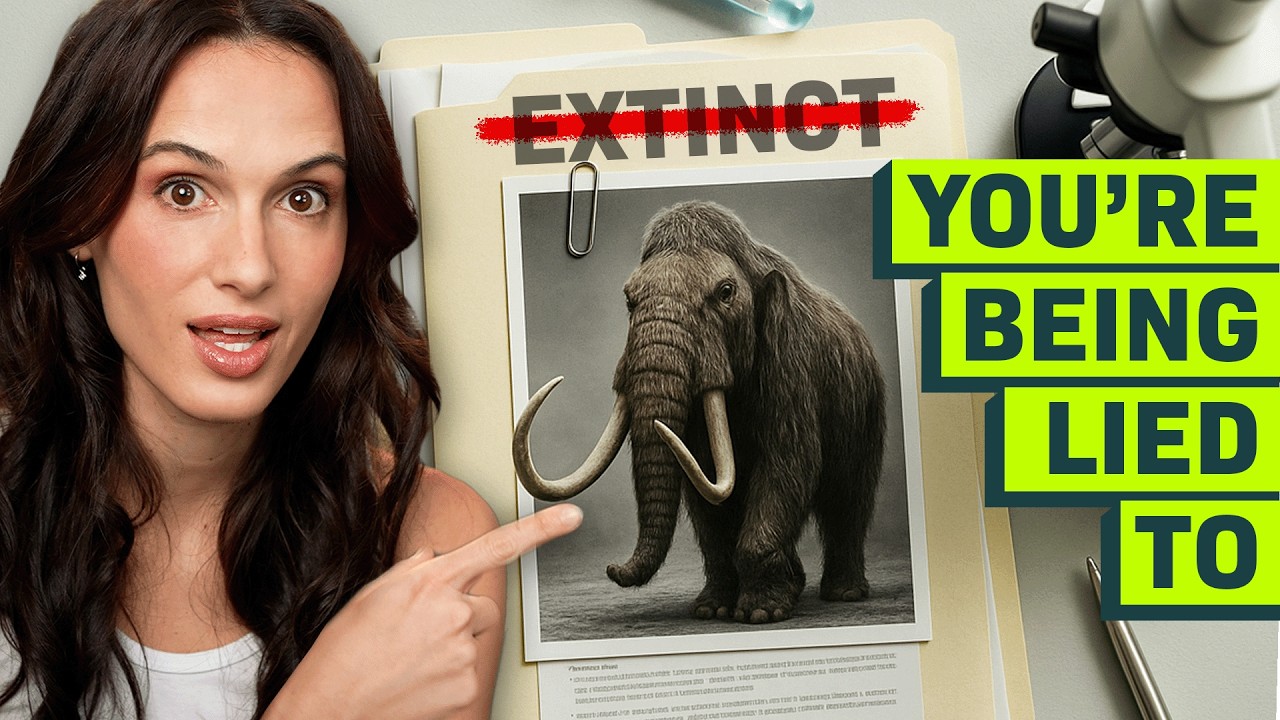
The Real Reason We Should Revive Extinct Animals
Keywords
Summary
141 words
Critical Evaluation
The video excels in making complex genetic concepts accessible without oversimplifying. Abram interviews experts, including scientists from Colossal Biosciences, providing credibility. She clearly distinguishes between the three methods and their limitations, avoiding sensationalism. The emphasis on genetic rescue is a valuable perspective often overlooked in mainstream discussions. The ethical questions are addressed thoughtfully, acknowledging both potential benefits and risks. The inclusion of specific examples, like the black-footed ferret and northern quoll, grounds the discussion in real-world applications. The video’s production quality is high, with engaging visuals and clear explanations. However, some might argue that the optimistic tone downplays the technical and ecological challenges. The ad segment, while clearly marked, interrupts the flow. Overall, the video is a rigorous and balanced introduction to de-extinction, suitable for a general audience interested in science and conservation.
133 words
Title / Content Match
The title accurately reflects the content, which focuses on the rationale for de-extinction and its broader implications for conservation.
Quality & Reliability
8/10
The video presents a well-researched overview of de-extinction, featuring interviews with scientists and clear explanations of genetic techniques. It distinguishes between cloning, back-breeding, and gene editing, and highlights the potential of genetic rescue for extant species. The information is accurate and up-to-date, though some simplifications are made for a general audience.
Key Moments
Markers derived by PSI from the transcript: the creator did not define chapters.
- Introduction to de-extinction and the Tasmanian tiger
- Explanation of back-breeding with the quagga example
- Discussion of cloning and the bucardo case
- Debate on whether dire wolves are truly de-extinct
- Definition of de-extinction and gene editing
- Introduction to genetic rescue with black-footed ferret
- Tasmanian tiger project and its ecological importance
- Ethical considerations of de-extinction
- Future prospects and conclusion
Cited Sources
- San Diego Zoo Wildlife Alliance - Biodiversity Banking — Referenced in the video as a resource for genetic banking and conservation efforts.
- Cleo Abram on IMDB — Credential for the video journalist.
- Cleo Abram's YouTube channel — Link to the creator's channel for more content.
- Related video: 'Can We Bring Back Extinct Animals?' — Suggested related content on de-extinction.
- Related video: 'The Woolly Mammoth Revival' — Suggested related content on mammoth de-extinction.
- Related video: 'Genetic Rescue' — Suggested related content on genetic rescue.
- Related video: 'The Thylacine Project' — Suggested related content on Tasmanian tiger de-extinction.
- Related video: 'De-extinction: Science or Fiction?' — Suggested related content on de-extinction.
- Related video: 'The Dodo's Return' — Suggested related content on dodo de-extinction.
- Related video: 'Passenger Pigeon Revival' — Suggested related content on passenger pigeon de-extinction.
- Related video: 'The Ethics of De-extinction' — Suggested related content on ethical aspects.
Concurring Sources
- San Diego Zoo Wildlife Alliance - Biodiversity Banking — Supports the idea of preserving genetic material for conservation.
Dissenting Sources
- Critique of de-extinction as 'playing God' — Some ethicists argue that de-extinction is ethically problematic and diverts resources from protecting existing species.
External References
Contribution & Novelties
The video provides a fresh perspective on de-extinction by shifting focus from resurrecting extinct species to using the same genetic tools for conservation of living species. It highlights the concept of genetic rescue, which is often overshadowed by the more sensational de-extinction projects. The explanation of the three methods (back-breeding, cloning, gene editing) is clear and accurate, and the discussion of the Tasmanian tiger’s ecological role adds depth.
Pour aller plus loin :
- Genetic rescue — Overview of the concept and its applications.
- CRISPR gene editing — The technology behind many gene editing approaches.
- Colossal Biosciences — Company leading de-extinction projects.
- Thylacine — Information on the Tasmanian tiger.
108 words
Radar Profile
The radar profile shows high scores in information quality and reliability, with slightly lower scores in technical depth and quantity, indicating a well-balanced but not overly technical presentation.
💬 Très positif. Sur les 30 commentaires analysés, la majorité exprime enthousiasme et admiration pour la clarté de l'explication et l'angle optimiste, avec quelques interrogations éthiques et une préoccupation pour la conservation des espèces existantes.