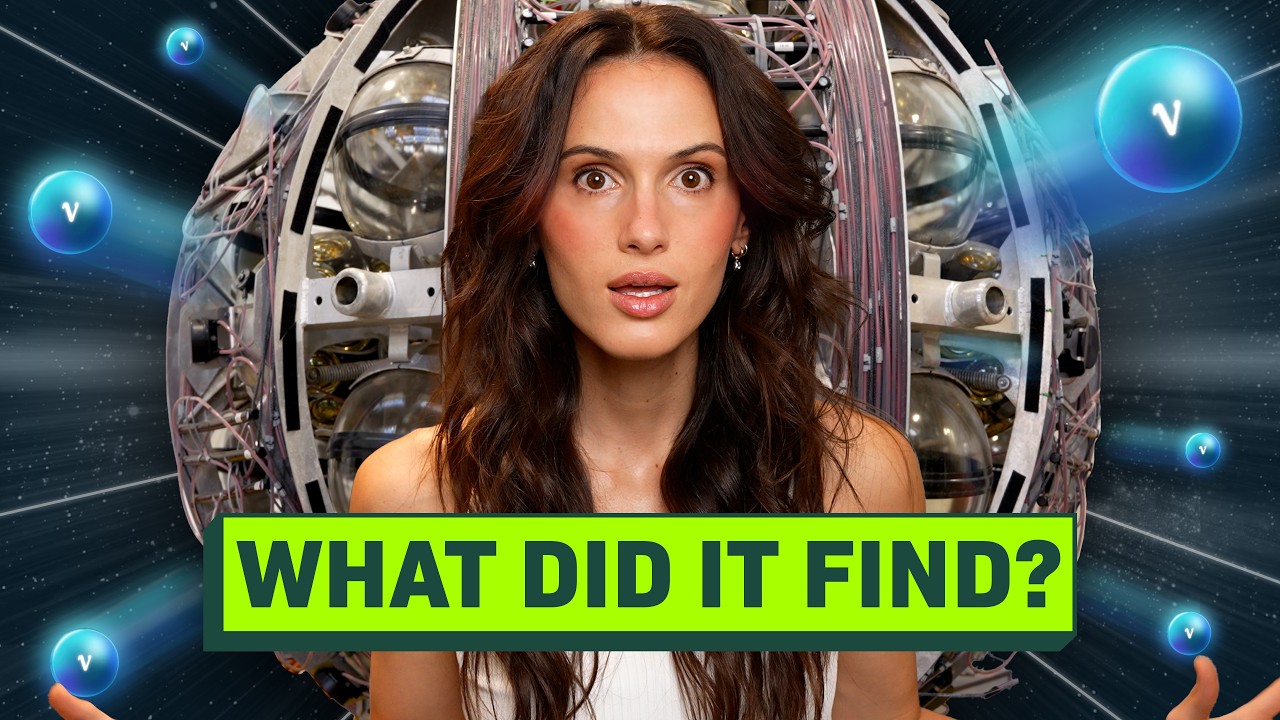
The Massive Machine at the Bottom of the Sea
Keywords
Summary
134 words
Critical Evaluation
The video excels in making complex physics accessible to a broad audience without sacrificing scientific accuracy. The explanations of neutrino properties, detection methods, and the Cherenkov effect are clear and well-illustrated. The inclusion of interviews with scientists adds credibility and depth. The video effectively conveys the significance of neutrino astronomy, citing specific discoveries and their implications. The production quality is high, with excellent visuals and animations that aid understanding. The sources cited in the description are reputable, including peer-reviewed articles in Nature and Science, as well as official project websites. The video’s argumentation is solid, building a logical case for the importance of neutrino detection. The title accurately reflects the content, and the video delivers on its promise. The only minor critique is that some simplifications, such as the analogy of a sonic boom, might oversimplify the physics, but they are used effectively for comprehension. Overall, this is an outstanding example of science communication, deserving of a top rating.
159 words
Title / Content Match
The title accurately reflects the content, focusing on the underwater neutrino telescope KM3NeT and its counterpart IceCube.
Quality & Reliability
8/10
The video is well-researched, featuring interviews with scientists and references to peer-reviewed publications. The information is accurate and up-to-date, with clear explanations of complex physics. Minor simplifications for a general audience are present but do not compromise accuracy.
Chapters
- What's the machine hidden under the sea?
- What is a neutrino?
- How do we know what's out in the universe?
- How do you catch a neutrino?
- Why can’t we see neutrinos?
- How do you know you’ve detected a neutrino?
- What’s hiding underneath Antarctica?
- What have we discovered with neutrinos?
- What don’t we know yet?
- Why is this HUGE* If True?
- )
Cited Sources
- Cosmogenic candidate lights up KM3NeT — Article about the 2023 KM3NeT detection
- IceCube-Gen2 — Future expansion of IceCube
- IceCube Neutrino Observatory — Official IceCube website
- KM3NeT — Official KM3NeT website
- Observation of a high-energy neutrino from a blazar — 2017 IceCube discovery paper
- Evidence for neutrino emission from the nearby active galaxy NGC 1068 — 2022 IceCube discovery paper
- Observation of an ultra-high-energy neutrino with KM3NeT — 2023 KM3NeT detection paper
Concurring Sources
- IceCube Neutrino Observatory — Confirms IceCube's role and discoveries
- KM3NeT — Confirms KM3NeT's design and status
External References
Contribution & Novelties
The video provides a compelling and accessible overview of neutrino astronomy, highlighting recent breakthroughs and the complementary nature of KM3NeT and IceCube. It offers a behind-the-scenes look at the construction of KM3NeT, which is rarely shown. The video effectively communicates the significance of neutrino detection for understanding cosmic phenomena.
Pour aller plus loin :
- Neutrino — Overview of neutrino physics.
- Cherenkov radiation — Explanation of the detection mechanism.
- IceCube Neutrino Observatory — Official site with further resources.
- KM3NeT — Official site with details on the project.
86 words
Radar Profile
The radar profile shows high scores in information quantity and quality, with a slightly lower score in technical level, indicating that the video is highly informative and accurate but accessible to a general audience. The overall reliability is strong, reflecting the use of credible sources.
💬 Très positif. Sur les 30 commentaires analysés, les téléspectateurs expriment une admiration unanime pour la qualité de la vulgarisation scientifique, la production visuelle et l'enthousiasme de la présentatrice, certains la comparant à Carl Sagan.