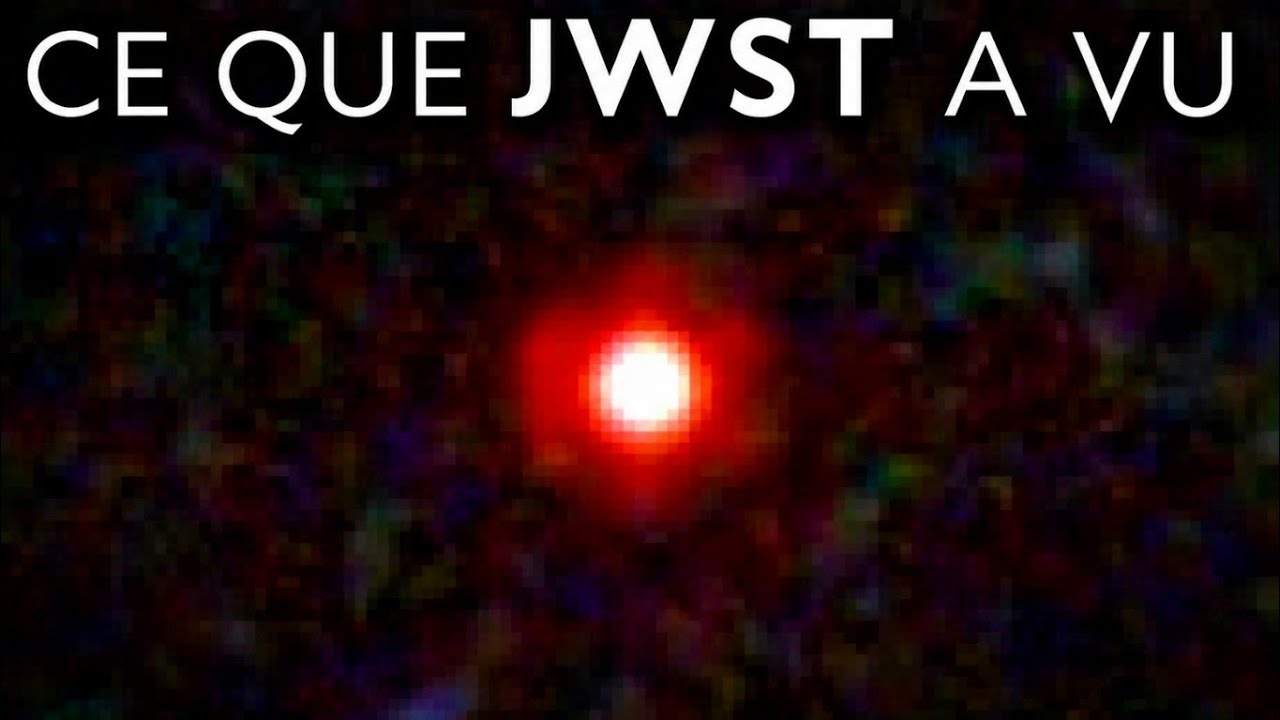
Le JWST a trouvé des points rouges aux confins de l'univers… et personne ne sait ce que c'est
Keywords
Summary
151 words
Critical Evaluation
The video provides a compelling and accessible overview of the Little Red Dots (LRDs) discovered by JWST, a topic of genuine scientific interest. It correctly identifies the key observational facts: the high redshift, the large masses of the central black holes, the Eddington limit problem, and the faintness of host galaxies. The narrative structure is engaging, using analogies (the library) and rhetorical questions to maintain viewer interest. The video references real scientific work, such as Labbé et al. (2023) in Nature, and mentions the NIRSpec instrument, which adds credibility. However, the video has several weaknesses. First, it does not provide a balanced view of the uncertainties. For example, it presents the Eddington limit as a hard barrier, but in reality, super-Eddington accretion is possible in short bursts, and some models allow for faster growth. The video also does not discuss alternative explanations that do not require new physics, such as the possibility that some LRDs are heavily obscured active galactic nuclei (AGN) with lower intrinsic masses. Second, the video lacks critical analysis of the sources it cites. It mentions Labbé et al. (2023) but does not explain that this paper was controversial and that subsequent studies have questioned whether all LRDs are truly at such high redshifts. The video also does not mention the role of dust extinction, which can redden objects and mimic high-redshift signatures. Third, the video’s tone is occasionally sensationalist, using phrases like ‘physically absurd’ and ‘violates everything we know,’ which may mislead viewers into thinking the standard model is on the verge of collapse. In reality, the LRD mystery is an active area of research with multiple plausible explanations. The video does not discuss the possibility that selection effects or instrumental artifacts could contribute. Finally, the video’s structure is somewhat repetitive, and it spends too much time on dramatic buildup rather than substantive explanation. The chapter markers are helpful, but the video could benefit from more quantitative details, such as the actual number of LRDs found and the statistical significance of the discrepancy with models. Overall, the video is a good introduction for a general audience but lacks the rigor expected of a scientific analysis. It earns a 4/5 for its engaging presentation and accurate core facts, but loses points for sensationalism and lack of critical depth.
381 words
Title / Content Match
The title accurately reflects the video's focus on the mysterious LRDs and their implications, though the subtitle 'personne ne sait ce que c'est' is slightly exaggerated as scientists have hypotheses.
Quality & Reliability
The video presents a clear, narrative-driven overview of the Little Red Dots (LRDs) discovered by JWST, referencing real scientific papers (Labbé et al. 2023) and missions (JWST, EUCLID). The content is accurate in describing the observational challenge and competing theories, but lacks depth in explaining the underlying physics and does not critically assess the cited sources. The tone is engaging but occasionally sensationalist.
Key Moments
- Introduction to the mystery of Little Red Dots.
- Overview of the standard Lambda-CDM model and galaxy formation.
- JWST launch and discovery of LRDs.
- Problem of supermassive black holes too early.
- Spectra showing broad emission lines and AGN signatures.
- Competing theories: heavy seeds, dense clusters.
- Link to Hubble tension and Universe Breakers.
- Conclusion and implications for cosmology.
Cited Sources
- Labbé et al. (2023), Nature – 'A population of red candidate massive galaxies ~600 Myr after the Big Bang' — Referenced as the key paper identifying LRDs.
- NASA JWST official ✓ verified — General reference for JWST mission.
- ESA EUCLID mission ✓ verified — Mentioned as a complementary mission.
- NIRSpec / NIRCam (STScI) — Instruments used for spectroscopy and imaging.
Concurring Sources
- Labbé et al. (2023), Nature — Original paper reporting LRDs.
- NASA JWST official — Mission overview.
Dissenting Sources
- Critiques of Labbé et al. (2023) questioning redshift estimates — Some studies suggest that dust reddening or lower-redshift interlopers may explain some LRDs.
Contribution & Novelties
The video synthesizes recent JWST findings on Little Red Dots into a narrative accessible to a general audience, highlighting the tension with standard cosmological models. It does not present original research but effectively communicates the state of the mystery.
Pour aller plus loin :
- Direct collapse black holes — A theoretical mechanism for forming massive black hole seeds.
- Super-Eddington accretion — Concept of accretion exceeding the Eddington limit, possibly allowing faster growth.
- JWST Advanced Deep Extragalactic Survey (JADES) — A major JWST survey that has detected many LRDs.
88 words
Radar Profile
The radar profile shows moderate scores across all dimensions, indicating a balanced but not exceptional video. The highest scores are in quantity of information and reliability, reflecting the use of real sources, while the lower technical level suggests the content is aimed at a general audience.