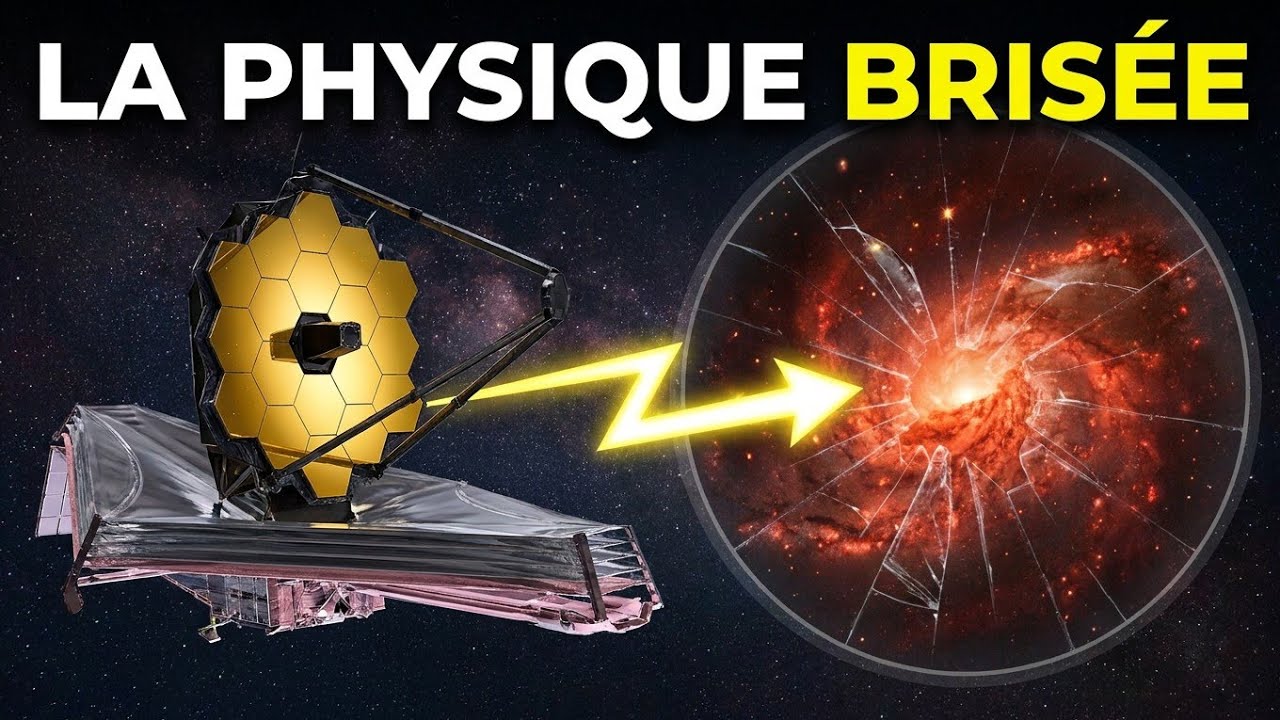
James Webb vient de trouver quelque chose qui brise 100 ans de physique
Keywords
Summary
153 words
Critical Evaluation
The video provides a comprehensive overview of recent JWST findings that challenge the standard cosmological model, referencing key peer-reviewed studies. The presentation is engaging and accessible, with clear explanations of complex concepts like redshift and the Hubble constant. However, the video adopts a somewhat sensationalist tone, framing the discoveries as a ‘crisis’ or ‘breaking 100 years of physics,’ which may overstate the current state of knowledge. While the findings are indeed significant, the scientific community views them as tensions to be resolved rather than a complete overthrow of established physics. The video does not adequately discuss the uncertainties in the measurements, such as potential systematic errors in stellar mass estimates or the possibility that some of the ‘massive’ galaxies could be explained by active galactic nuclei or dust. Additionally, the video lacks a balanced presentation of alternative explanations, such as the role of dark matter in galaxy formation or the possibility that the early galaxies are simply more efficient at forming stars. The sources cited are reputable and include Nature, Nature Astronomy, and The Astrophysical Journal Letters, which strengthens the credibility. The video also mentions the DESI 2024 results, which provide independent evidence for dynamical dark energy. However, the video does not critically evaluate the limitations of these studies or discuss contradictory evidence, such as the fact that some early galaxies appear consistent with Lambda-CDM predictions. The adéquation between the title and content is reasonable, though the title is more dramatic than the nuanced discussion in the video. Overall, the video is a useful summary of current tensions in cosmology but should be consumed with an awareness of its sensational framing and lack of critical depth.
276 words
Title / Content Match
The title is somewhat sensationalist but accurately reflects the video's focus on JWST findings that challenge the standard cosmological model.
Quality & Reliability
The video references several peer-reviewed studies (Labbé et al. 2023, Boylan-Kolchin 2023, Riess et al. 2023, DESI 2024) and provides URLs. However, it lacks critical discussion of uncertainties and alternative explanations, and the tone is somewhat sensationalist. The presenter does not have an obvious scientific affiliation, but the content is factually accurate based on cited sources.
Key Moments
- Introduction: JWST findings challenge 100 years of physics
- Explanation of the Big Bang and Lambda-CDM model
- Description of JWST's capabilities and launch
- First JWST images and discovery of massive early galaxies
- Labbé et al. 2023 study: six galaxies too massive for Lambda-CDM
- JADES-GS-z14-0: galaxy at redshift 14.32
- Hubble tension confirmed by JWST (Riess et al. 2023)
- Supermassive black holes and chemical enrichment in early universe
- Possible explanations: modified gravity, dark energy, early dark energy
- Conclusion: implications for our understanding of the cosmos
Cited Sources
- Labbé et al. (2023) - A population of red candidate massive galaxies ~600 Myr after the Big Bang ✓ verified — Cited as evidence for massive early galaxies
- JADES-GS-z14-0 (2024) - A galaxy at redshift 14.32 ✓ verified — Cited as the most distant spectroscopically confirmed galaxy
- Boylan-Kolchin (2023) - Stress testing ΛCDM with high-redshift galaxy candidates ✓ verified — Cited as tension between JWST observations and Lambda-CDM
- Riess et al. (2023) - JWST confirmation of the Hubble tension ✓ verified — Cited as confirmation of Hubble tension with JWST
- DESI 2024 - Dark Energy Spectroscopic Instrument results ✓ verified — Cited as evidence for dynamical dark energy
- Webb Telescope official site ✓ verified — General reference for JWST
- JADES Survey ✓ verified — Reference for JADES program
- Hubble tension overview (NASA) ✓ verified — Background on Hubble tension
- Planck mission (ESA) ✓ verified — Reference for CMB measurements
- WMAP mission (NASA) ✓ verified — Reference for dark matter
- CERN dark matter page ✓ verified — Reference for dark matter
- ESA dark energy page ✓ verified — Reference for dark energy
Concurring Sources
- Labbé et al. (2023) - Nature — Directly supports the claim of massive early galaxies.
- Riess et al. (2023) - ApJL — Confirms Hubble tension with JWST data.
- Boylan-Kolchin (2023) - Nature Astronomy — Shows tension between JWST galaxies and Lambda-CDM.
Dissenting Sources
- Some studies suggest early galaxies may be less massive than initially claimed — Alternative analyses using different stellar population models yield lower stellar masses, reducing tension with Lambda-CDM.
- Lambda-CDM simulations with efficient star formation can produce massive early galaxies — Some simulations show that with high star formation efficiency, Lambda-CDM can reproduce the observed galaxy masses.
Contribution & Novelties
The video synthesizes recent JWST discoveries that challenge the standard cosmological model, providing a clear narrative of the key findings and their implications. It goes beyond typical news coverage by explaining the underlying physics and connecting multiple lines of evidence (massive galaxies, Hubble tension, early black holes). The video also discusses possible theoretical resolutions, such as early dark energy and modified gravity, though it does not delve deeply into any single model.
Pour aller plus loin :
- Early Dark Energy models — A theoretical proposal to resolve the Hubble tension by adding a new energy component before recombination.
- Modified Gravity (MOND) — An alternative to dark matter that could explain some early galaxy formation issues.
- JWST Advanced Deep Extragalactic Survey (JADES) — The survey that discovered many of the early galaxies discussed in the video.
135 words
Radar Profile
The radar profile shows high scores in quantity of information and fiabilite_globale, reflecting the video's comprehensive coverage and use of peer-reviewed sources. The niveau_technique is moderate, indicating accessible explanations for a general audience. The qualite_information is slightly lower due to sensational framing and lack of critical depth.