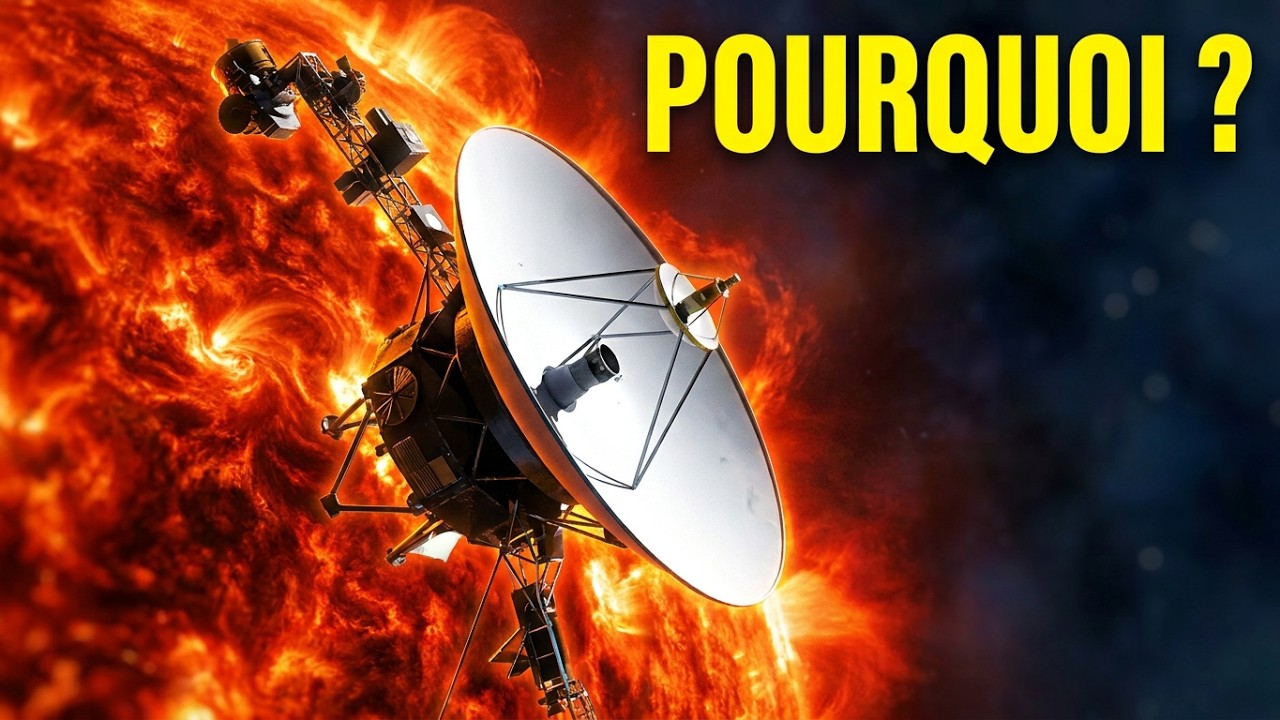
Cette sonde a traversé un mur à 50 000 degrés sans fondre, voici pourquoi
Keywords
Summary
199 words
Critical Evaluation
The video provides a compelling and largely accurate account of the Voyager missions and the physics of the heliopause crossing. The explanation of why the probe did not melt is scientifically sound: it correctly distinguishes between temperature (average kinetic energy of particles) and heat (total thermal energy transferred). In the interstellar medium, the plasma density is extremely low (around 0.1 particles per cubic centimeter), so despite the high temperature, the total energy transfer to the spacecraft is minimal. This is a classic example of the difference between temperature and heat, which is often misunderstood. The video uses analogies (e.g., a hot oven with few particles) to make the concept accessible. The sources cited are authoritative: NASA’s official Voyager page, the Golden Record overview, and two Nature Astronomy papers from 2019 that directly report the plasma measurements. The use of Wikipedia for general context is acceptable. The video does not contain any obvious factual errors or misleading claims. However, the presentation style is somewhat sensationalized, with dramatic language and music, which may give an exaggerated impression of the ‘wall of fire’ concept. The video also includes a lengthy historical narrative that, while engaging, is not strictly necessary for the central scientific question. The adéquation between title and content is good: the title promises an explanation of why the probe didn’t melt, and the video delivers that explanation clearly. The video does not present any controversial or unsubstantiated claims; it is a well-researched piece of science communication. The only minor issue is that the video could have more explicitly cited the specific studies during the narration, though the sources are provided in the description. Overall, the video is a reliable and informative resource for the general public, effectively communicating a subtle physics concept.
291 words
Title / Content Match
The title accurately reflects the core question addressed in the video, though it is somewhat sensationalized.
Quality & Reliability
The video is well-researched, citing official NASA sources and peer-reviewed studies. The explanation of temperature vs. heat is scientifically accurate. However, the dramatic presentation style may oversimplify some concepts.
Key Moments
- Introduction: Voyager probe crossed a 50,000°C plasma wall without melting.
- Question posed: why didn't the probe melt?
- 1965: Gary Flandro discovers rare planetary alignment for grand tour.
- Construction and launch of Voyager 1 and 2 in 1977.
- Golden Record described: contents and story of Anne Druyan's brainwaves.
- Jupiter flyby: discovery of volcanic activity on Io.
- Saturn flyby and decision to send Voyager 1 to Titan.
- Voyager 2 continues to Uranus and Neptune.
- Pale Blue Dot photo taken in 1990.
- Explanation of the heliosphere and solar wind.
- Termination shock and heliosheath described.
- Voyager 1 crosses heliopause in 2012; Voyager 2 in 2018.
- Key explanation: temperature vs. heat; low density prevents melting.
- Conclusion: real danger is cold from decaying power source.
Cited Sources
- NASA Voyager Mission Page ✓ verified — Official NASA page for Voyager mission details.
- Voyager Golden Record Overview ✓ verified — NASA page describing the Golden Record contents.
- Nature Astronomy 2019: Voyager 2 plasma measurements ✓ verified — Scientific paper reporting plasma temperature of 30,000–50,000 K at heliopause.
- Nature Astronomy 2019: Plasma densities beyond heliopause ✓ verified — Scientific paper on plasma densities measured by Voyager 1 and 2.
- NASA Eyes on the Solar System ✓ verified — Real-time position tracking of Voyager probes.
- Wikipedia: Voyager 1 ✓ verified — General information on Voyager 1.
- Wikipedia: Voyager 2 ✓ verified — General information on Voyager 2.
Concurring Sources
- NASA Voyager Mission Page — Official NASA information supporting mission details.
- Nature Astronomy 2019: Voyager 2 plasma measurements — Peer-reviewed study confirming plasma temperatures.
Contribution & Novelties
The video’s main contribution is a clear, accessible explanation of why the Voyager probes did not melt when crossing high-temperature plasma. It effectively uses the distinction between temperature and heat, a concept often misunderstood by the public. The historical narrative adds context but is not novel.
Pour aller plus loin :
- Kinetic theory of gases — Explains the relationship between temperature and particle motion.
- Debye length and plasma shielding — Relevant to understanding plasma behavior in low-density environments.
- Heliosphere and interstellar boundary explorer (IBEX) — A mission that maps the heliosphere boundary.
92 words
Radar Profile
The radar profile shows high scores in information quantity, quality, and reliability, reflecting the video's solid scientific foundation. The technical level is moderate, indicating good accessibility for a general audience. The overall note is high, consistent with the video's educational value.