What is a posterior predictive check and why is it useful?
Keywords
Summary
179 words
Critical Evaluation
Value of the Information & Strength of the Argument
The video provides a clear and practical introduction to posterior predictive checks, a crucial tool in Bayesian model validation. The value lies in its pedagogical approach: it explains the concept step-by-step, from the definition of the posterior predictive distribution to the computation of a Bayesian p-value. The argumentation is solid, as it uses a concrete example (car counts) and simulations to illustrate the process. The presenter correctly emphasizes that the choice of summary statistic for comparison depends on the model’s intended use, and he demonstrates how a poor fit can be detected. The explanation of why a Poisson model might fail (independence assumption) and the suggestion of a negative binomial alternative is theoretically sound. Overall, the video is informative and well-structured, making it a valuable resource for students and practitioners.
Scientific Rigor, Source Quality, Title Accuracy
The scientific rigor is high: the content is accurate and aligns with standard Bayesian methodology. The presenter is an academic, and the video is part of a lecture course based on his book. However, no external sources are cited in the video itself, and the description only provides links to the author’s website and a playlist. The title accurately reflects the content. The video is a tutorial, and the explanations are clear and precise. The use of simulation to illustrate the concept is appropriate and enhances understanding. The only minor weakness is the lack of explicit references to literature, but this is common in educational videos and does not detract from the overall quality.
259 words
Title / Content Match
The title accurately reflects the content, which explains posterior predictive checks and their utility.
Quality & Reliability
8/10
Clear explanation of a core Bayesian concept, with a concrete example and simulation. The presenter is an academic (Ben Lambert, lecturer in econometrics/statistics) and the content aligns with standard Bayesian methodology. No citations to external sources are given, but the material is well-established and accurately presented.
Key Moments
Markers derived by PSI from the transcript: the creator did not define chapters.
- Introduction to posterior predictive checks and their importance.
- Definition of the posterior predictive distribution and approximation method.
- Explanation of the two sources of uncertainty in sampling.
- Concept of comparing real data with simulated data.
- Introduction of the car counting example with Poisson and gamma distributions.
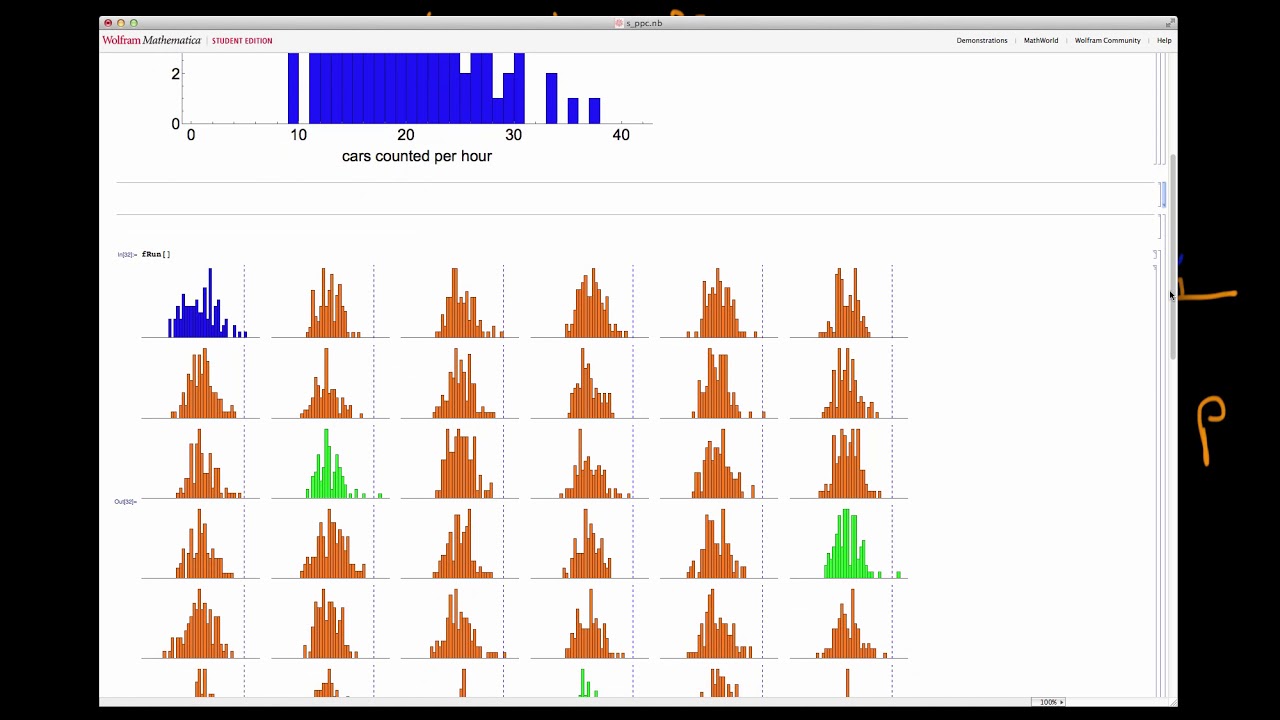
- Simulation in Mathematica: histograms and Bayesian p-value calculation.
- Interpretation of Bayesian p-value and model misfit.
- Discussion of potential causes of misfit and suggestion of negative binomial.
- Summary and emphasis on the importance of posterior predictive checks.
Cited Sources
- Ben Lambert's Bayesian resources — The video description links to this page for more information on Bayesian statistics.
- Lecture course playlist — The video is part of a lecture course, and this playlist contains the full series.
Concurring Sources
- Posterior predictive checks (Wikipedia) — This article describes posterior predictive checks and their use in model validation.
Contribution & Novelties
The video provides a clear and accessible explanation of posterior predictive checks, a fundamental tool in Bayesian model checking. It emphasizes the practical importance of PPCs and demonstrates their application with a simple example, making the concept tangible. The novelty lies in its pedagogical clarity and the use of simulation to illustrate the Bayesian p-value.
Pour aller plus loin :
- Posterior predictive distribution (Wikipedia) — This article provides a formal definition and context.
- Bayesian p-value (Wikipedia) — This section explains the Bayesian p-value in more detail.
- Negative binomial distribution (Wikipedia) — This distribution is suggested as an alternative to Poisson for overdispersed count data.
104 words
Radar Profile
The radar profile shows high scores in quality and reliability, with slightly lower scores in quantity and technical depth. This indicates a focused, well-explained tutorial that may not cover all advanced aspects but is solid for its purpose.