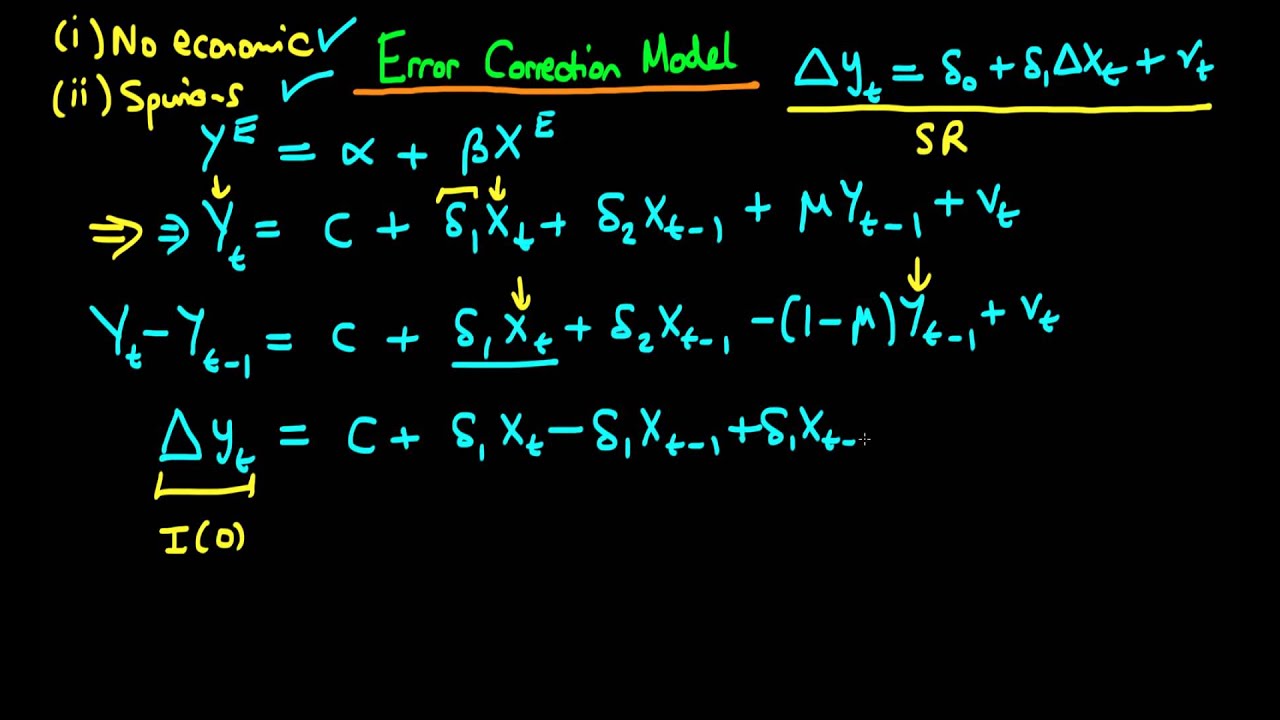
Error correction model - part 1
Keywords
Summary
133 words
Critical Evaluation
Value of the Information & Strength of the Argument
The video provides a clear and logical derivation of the error correction model, highlighting its advantages over simple first-difference regressions. The argumentation is solid, explaining both the theoretical (avoiding spurious regression) and economic (capturing long-run equilibrium) motivations. The step-by-step algebraic manipulation is well-presented, making the model accessible to viewers with a basic understanding of econometrics. However, the video lacks empirical examples or real-world applications, which could strengthen the practical value of the explanation.
Scientific Rigor, Source Quality, Title Accuracy
The video is scientifically rigorous, with a mathematically sound derivation and clear explanations of key concepts. The title accurately reflects the content, focusing on the introduction of the error correction model. The description provides links to course materials and related resources, but no specific academic sources are cited within the video itself. The lack of external references limits the ability to verify claims independently, but the theoretical foundation is standard in econometrics.
160 words
Title / Content Match
The title accurately reflects the content, which introduces the error correction model and its importance in econometrics.
Quality & Reliability
8/10
Clear, rigorous explanation of the error correction model, grounded in econometric theory. The derivation is mathematically sound and well-structured. However, no empirical examples or references to external sources are provided, limiting the verification of claims.
Key Moments
Markers derived by PSI from the transcript: the creator did not define chapters.
- Introduction to the error correction model and its importance in econometrics.
- Discussion of non-stationary variables and the limitation of regressing first differences.
- Introduction of the general dynamic model with lags and the problems of spurious regression.
- Derivation of the error correction model by subtracting lagged Y and manipulating terms.
- Explanation of the error correction term and its role in capturing long-run equilibrium.
- Economic interpretation of the error correction mechanism and the speed of adjustment.
- Summary of the benefits of ECM: combining short-run and long-run dynamics.
Cited Sources
- Oxbridge Tutor - Undergraduate Econometrics Course — Course materials and updates related to the video content.
- Ben Lambert - Bayesian Statistics — Information about upcoming Bayesian statistics videos and book.
- Ben Lambert - Econometrics Course Problem Sets and Data — Course materials, problem sets, and data for econometrics courses.
Concurring Sources
- Wikipedia - Error correction model — General overview of ECM and its applications.
- Wikipedia - Cointegration — Explains the concept of cointegration, which is central to ECM.
Contribution & Novelties
The video provides a clear and accessible introduction to the error correction model, emphasizing its role in combining short-run and long-run dynamics in time series analysis. It bridges the gap between theoretical econometrics and practical application, making it a valuable resource for students and practitioners.
Pour aller plus loin :
- Cointegration — Foundational concept for understanding ECM.
- Error correction model — Detailed overview and extensions.
- Engle-Granger two-step method — Estimation technique for cointegrated systems.
74 words
Radar Profile
The radar profile shows high scores in quality of information, technical level, and reliability, indicating a well-structured and rigorous tutorial. The quantity of information is moderate, as the video focuses on a single concept without extensive examples. Overall, the profile reflects a solid educational resource for econometrics.