An introduction to the Random Walk Metropolis algorithm
Keywords
Summary
132 words
Critical Evaluation
Value of the Information & Strength of the Argument
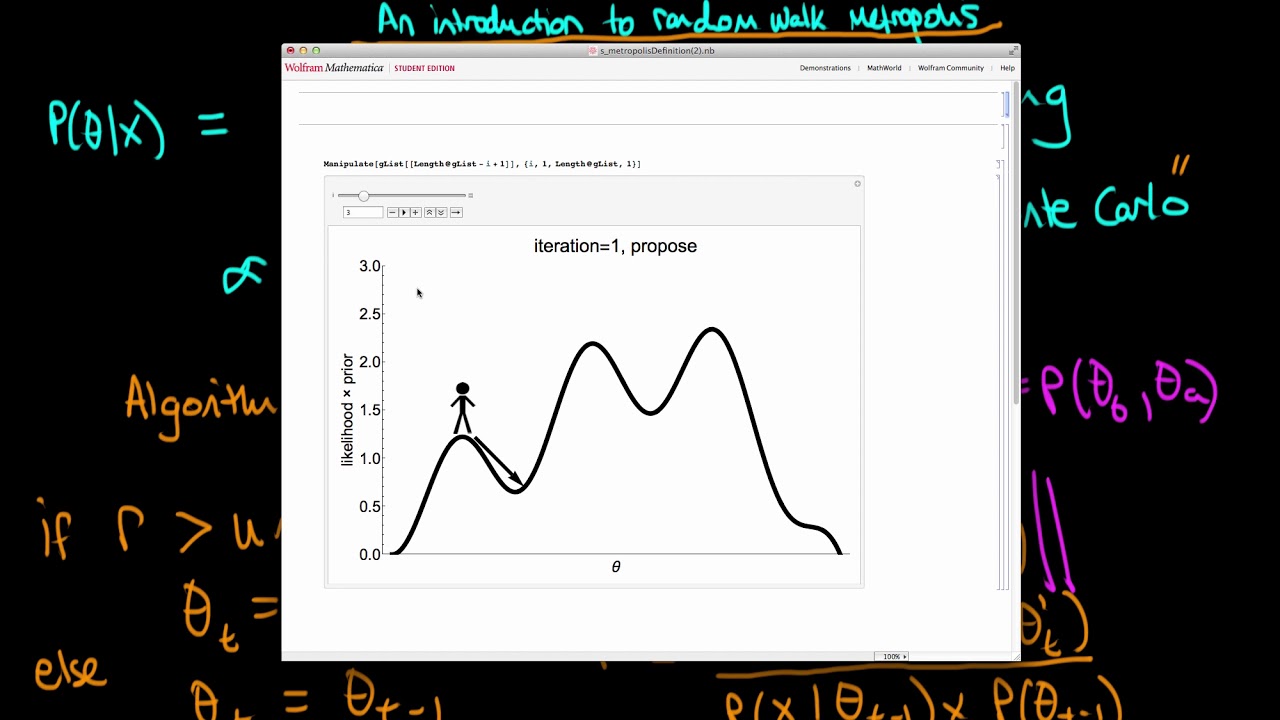
The video provides a solid introduction to the Random Walk Metropolis algorithm, explaining its purpose and mechanics clearly. The argumentation is logical and well-structured, moving from the basic concept to the algorithm’s steps and then to visual demonstrations. The use of animations effectively illustrates the process of sampling and convergence. The presenter emphasizes the algorithm’s simplicity and general applicability, which is a key strength. However, the video does not delve into advanced topics such as tuning parameters or convergence diagnostics, but for an introductory tutorial, it covers the essential ideas well.
Scientific Rigor, Source Quality, Title Accuracy
The scientific rigor is appropriate for an introductory tutorial. The algorithm is accurately described, and the visual demonstrations are consistent with the theory. The presenter references his book and website for further study, which adds credibility. The title accurately reflects the content. The video does not cite external sources, but it is based on established statistical methods. Overall, the content is reliable and well-presented.
170 words
Title / Content Match
The title accurately reflects the content, which is a clear introduction to the Random Walk Metropolis algorithm.
Quality & Reliability
8/10
Clear and accurate explanation of the algorithm, with visual demonstrations. The content is standard and well-established in Bayesian statistics. The author is an academic and provides supplementary resources. Minor limitations: no formal proofs, but appropriate for an introductory tutorial.
Key Moments
Markers derived by PSI from the transcript: the creator did not define chapters.
- Introduction to the Random Walk Metropolis algorithm and its purpose in Bayesian statistics.
- Explanation of the algorithm's steps: initial sample, proposal distribution, and acceptance ratio.
- Detailed description of the proposal distribution and the symmetry condition.
- Illustration of the algorithm using an animation in Mathematica, showing acceptance and rejection.
- Demonstration of sampling from a two-dimensional density and the path traced by the algorithm.
- Convergence of the sampling distribution to the target density after many iterations.
- Discussion of the influence of step size on efficiency and the algorithm's simplicity and applicability.
Cited Sources
- Ben Lambert's Bayesian statistics resources — Mentioned as a resource for further information on Bayesian statistics.
- Lecture course playlist — The video is part of a lecture course; playlist provided for further viewing.
Concurring Sources
- A Student's Guide to Bayesian Statistics — The video is based on material from this book by the author.
Contribution & Novelties
The video provides a clear and accessible introduction to the Random Walk Metropolis algorithm, using visual animations to illustrate the sampling process. It emphasizes the algorithm’s simplicity and broad applicability, making it a valuable starting point for students and practitioners new to MCMC methods.
Pour aller plus loin :
- Markov chain Monte Carlo — Overview of MCMC methods, including Metropolis-Hastings.
- Metropolis–Hastings algorithm — Generalization of the algorithm, with more details on proposal distributions.
- Bayesian inference — Background on Bayesian statistics and posterior distributions.
83 words
Radar Profile
The radar profile shows high scores in quality and reliability, with moderate scores in quantity and technical depth. This indicates a well-explained tutorial that is reliable but not extremely detailed or advanced.