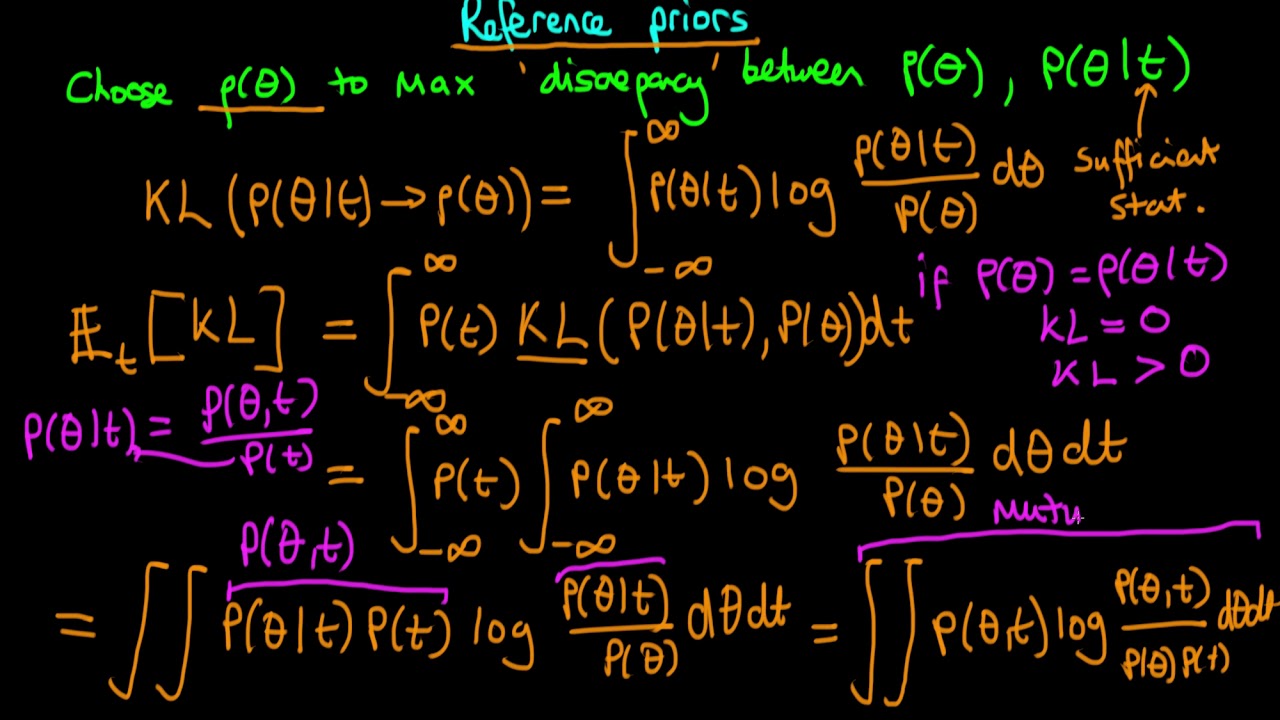
An introduction to reference priors
Keywords
Summary
126 words
Critical Evaluation
Value of the Information & Strength of the Argument
The video provides a valuable introduction to a nuanced topic in Bayesian statistics. It clearly explains the motivation behind reference priors and the mathematical derivation, making it accessible to viewers with a basic understanding of Bayesian concepts. The argumentation is solid, logically progressing from the definition of Kullback-Leibler divergence to its equivalence with mutual information. The presenter also offers a balanced perspective, acknowledging both the theoretical appeal and practical limitations of reference priors.
Scientific Rigor, Source Quality, Title Accuracy
The video is scientifically rigorous, with a correct mathematical derivation and accurate references to Bernardo’s work. However, it does not cite specific sources beyond the original concept, and the description provides only general links to the presenter’s website and course playlist. The title accurately reflects the content, which is an introductory explanation of reference priors.
143 words
Title / Content Match
The title accurately reflects the content, which is an introductory explanation of reference priors.
Quality & Reliability
8/10
The video provides a clear and mathematically sound explanation of reference priors, based on the foundational work of Bernardo (1979). The derivation is accurate and the presentation is rigorous, though it lacks explicit citations to primary literature beyond the original concept.
Key Moments
Markers derived by PSI from the transcript: the creator did not define chapters.
- Introduction to reference priors and their origin with Bernardo (1979).
- Definition of the discrepancy measure using Kullback-Leibler divergence.
- Explanation of why maximizing the divergence is desirable.
- Introduction of the expected Kullback-Leibler divergence and its derivation.
- Simplification to mutual information and its interpretation.
- Diagrammatic illustration of the effect of prior-data alignment.
- Discussion of practical limitations and philosophical objections.
Cited Sources
- Ben Lambert's Bayesian resources — The presenter's website with additional Bayesian statistics materials.
- Lecture course playlist — The playlist for the lecture course this video is part of.
Concurring Sources
- Bernardo, J. M. (1979). Reference Posterior Distributions for Bayesian Inference — The original paper introducing reference priors.
Contribution & Novelties
The video offers a clear and concise introduction to reference priors, a concept that is often presented in a highly technical manner. It bridges the gap between the abstract definition and practical understanding by deriving the equivalence between maximizing Kullback-Leibler divergence and mutual information. This provides a valuable pedagogical contribution for students of Bayesian statistics.
Pour aller plus loin :
- Reference prior - Wikipedia — Overview of reference priors and their history.
- Mutual information - Wikipedia — Definition and properties of mutual information.
- Kullback-Leibler divergence - Wikipedia — Mathematical foundation of the divergence measure.
94 words
Radar Profile
The radar profile shows high scores in quality and reliability, with moderate scores in quantity and technical level, indicating a focused and well-executed educational video that balances depth with accessibility.