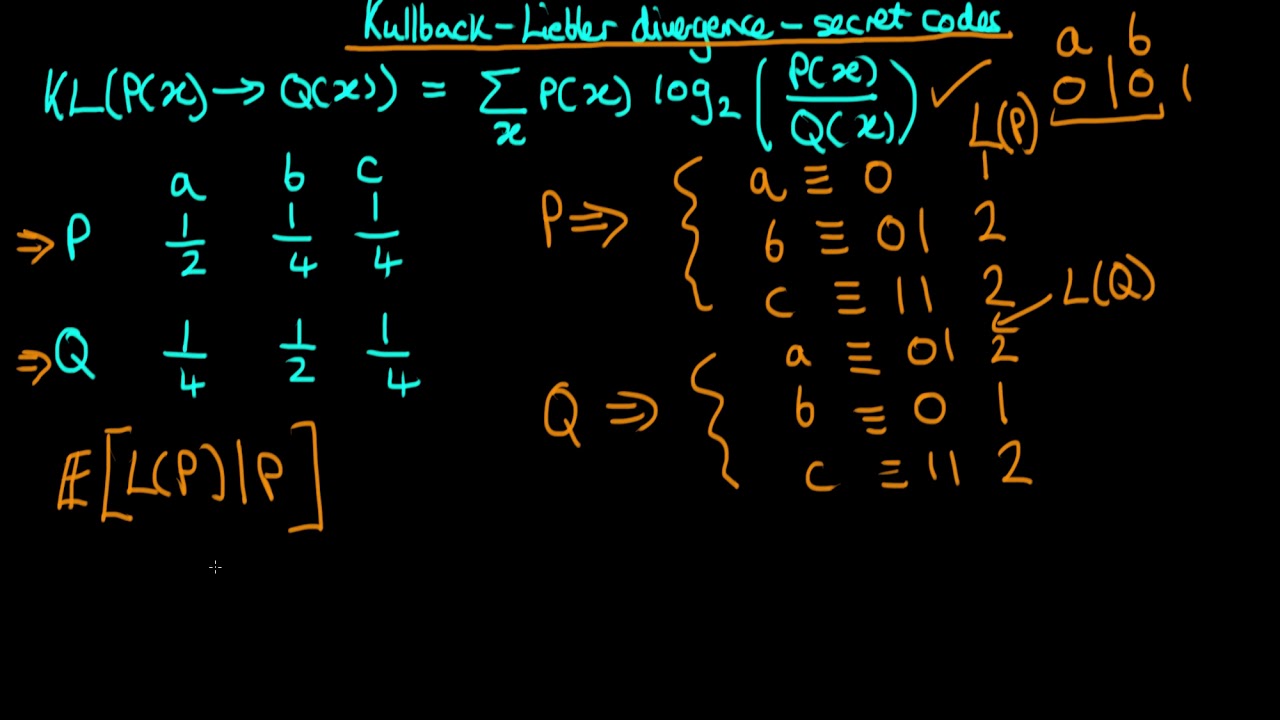
Explaining the Kullback-Liebler divergence through secret codes
Keywords
Summary
138 words
Critical Evaluation
Value of the Information & Strength of the Argument
The video provides a valuable intuitive explanation of KL divergence, which is often presented abstractly. The use of a concrete example with binary codes makes the concept tangible and helps build intuition. The argumentation is clear and logical: the presenter carefully constructs the optimal codes, computes expected lengths, and shows the equivalence to the KL divergence formula. The step-by-step derivation is easy to follow, and the conclusion that KL divergence represents the extra bits needed when using a suboptimal code is well-supported. The video also correctly notes the limitation that in general, KL divergence is a lower bound on the actual cost due to integer code lengths, which adds nuance to the explanation.
Scientific Rigor, Source Quality, Title Accuracy
The video is scientifically rigorous in its mathematical derivations and explanations. The author, Ben Lambert, is a known academic in Bayesian statistics, and the content aligns with standard textbook treatments. However, the video does not cite external sources directly, relying instead on the author’s expertise. The title accurately reflects the content, and the video fulfills its promise of explaining KL divergence through secret codes. The description provides links to the author’s website and a related playlist, which serve as additional resources but are not direct citations. Overall, the video is reliable for educational purposes, though it lacks explicit source citations.
228 words
Title / Content Match
The title accurately reflects the content: the video explains KL divergence through the lens of secret codes, making the concept accessible.
Quality & Reliability
8/10
The video provides a clear, intuitive explanation of KL divergence using a concrete example, with correct mathematical derivations. The author is an academic with expertise in Bayesian statistics, and the content aligns with standard textbook treatments. However, the video is a tutorial and does not cite external sources directly, limiting its depth for advanced viewers.
Key Moments
Markers derived by PSI from the transcript: the creator did not define chapters.
- Introduction to KL divergence and the secret code example.
- Definition of two languages P and Q with letter frequencies.
- Design of optimal binary codes for language P.
- Design of optimal binary codes for language Q.
- Calculation of expected code length for language P using its own code.
- Calculation of expected code length for language P using Q's code.
- Difference in expected lengths equals KL divergence.
- Derivation of KL divergence formula for the example.
- Interpretation of KL divergence as informational cost.
- Generalization and note on lower bound property.
Cited Sources
- Ben Lambert's Bayesian resources — Mentioned in the video description as a resource for Bayesian statistics.
- Lecture course playlist — Mentioned in the video description as part of a lecture course.
Concurring Sources
- Wikipedia: Kullback-Leibler divergence — Standard reference confirming the definition and properties of KL divergence.
Contribution & Novelties
The video offers a novel pedagogical approach to explaining KL divergence by framing it in terms of secret codes and optimal binary encoding. This intuitive perspective helps learners grasp the concept’s meaning beyond the mathematical formula. The example is carefully constructed to illustrate the exact equivalence between the expected code length difference and KL divergence, making the abstract concept tangible. The video also highlights the lower bound property, which is often overlooked in introductory treatments.
Pour aller plus loin :
- Kullback-Leibler divergence — Comprehensive overview of KL divergence, its properties, and applications.
- Information theory — Foundational concepts including entropy and coding theory.
- Bayesian statistics — Context for the use of KL divergence in Bayesian inference.
115 words
Radar Profile
The radar profile shows high scores in quality of information and reliability, with moderate scores in quantity and technical level. This indicates a well-explained tutorial that is accurate and trustworthy, but with limited depth and breadth compared to more comprehensive resources.