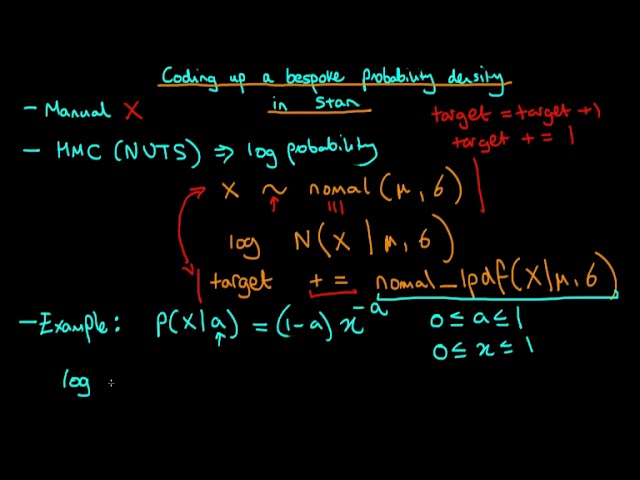
How to code up a bespoke probability density in Stan
Keywords
Summary
162 words
Critical Evaluation
Value of the Information & Strength of the Argument
The video provides valuable practical knowledge for Stan users, demonstrating a technique that extends the software’s capabilities. The argumentation is solid: it starts with the conceptual equivalence between sampling statements and log probability increments, then applies it to a concrete example. The step-by-step coding is clear, and the validation via posterior inference reinforces the correctness. The explanation of alternative coding methods (e.g., using _lpdf) adds depth. The only minor weakness is that the video does not discuss potential pitfalls or limitations of the approach, but overall the value is high for its target audience.
Scientific Rigor, Source Quality, Title Accuracy
The scientific rigor is good: the method is standard in Bayesian computation, and the example is correctly implemented. The video does not cite external sources, but it references the instructor’s book and website in the description. The title accurately reflects the content. No comments were provided, so no analysis of public reception is possible.
163 words
Title / Content Match
The title accurately reflects the content, which focuses on coding a custom probability density in Stan.
Quality & Reliability
8/10
The video is a clear, well-structured tutorial by an academic (Ben Lambert) with a solid background in Bayesian statistics. It explains the concept of incrementing the log probability in Stan and demonstrates a custom distribution example. The methods are standard and correctly presented, with practical coding steps. Minor limitations: no formal citations, but the content aligns with established Stan documentation and Bayesian methodology.
Key Moments
Markers derived by PSI from the transcript: the creator did not define chapters.
- Introduction: goal of sampling from custom distributions in Stan.
- Explanation of sampling statements as incrementing log probability.
- Example custom distribution: p(x|a) = (1-a) * x^{-a}.
- Generating data using inverse transform sampling.
- Coding the model in Stan: data, parameters, and model blocks.
- Using functions block to define custom log density.
- Compiling and running the model, checking posterior.
- Alternative coding with _lpdf suffix and omitting constants.
Cited Sources
- Ben Lambert's Bayesian resources — Mentioned in the description as a resource for Bayesian statistics.
- Lecture course playlist — The video is part of a lecture course; playlist linked in description.
Concurring Sources
- Stan User's Guide — Official documentation on custom functions and target increments.
Contribution & Novelties
The video offers a clear, practical tutorial on extending Stan to custom distributions, which is a common need but often not well documented. It bridges the gap between theory and implementation, showing exactly how to write the log density and use it in a model. The example is simple yet illustrative, and the alternative coding approaches provide flexibility. This is particularly useful for researchers and practitioners who need to implement non-standard models.
Pour aller plus loin :
- Stan User’s Guide — Official documentation on custom functions and target increments.
- Hamiltonian Monte Carlo — Background on the algorithm underlying Stan.
- Bayesian Data Analysis by Gelman et al. — Comprehensive reference on Bayesian methods and computation.
114 words
Radar Profile
The radar profile shows high scores in quality and reliability, with moderate scores in quantity and technical level. This indicates a focused, well-executed tutorial that provides solid information but is not exhaustive. The technical level is appropriate for intermediate users, and the reliability is high due to the standard methods used.