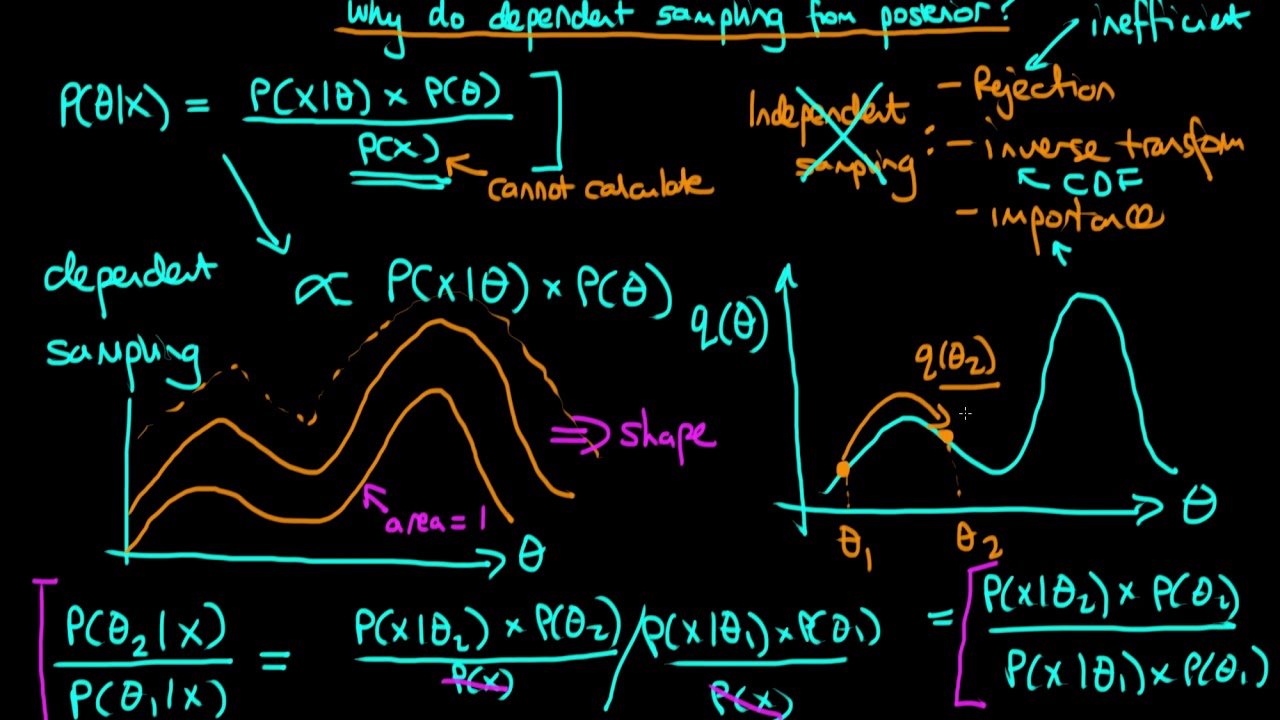
Why we typically use dependent sampling to sample from the posterior
Keywords
Summary
116 words
Critical Evaluation
Value of the Information & Strength of the Argument
The video provides a clear and intuitive explanation of why independent sampling fails in Bayesian inference, highlighting the computational challenges. The argumentation is logical and well-structured, building from the problem of the intractable normalizing constant to the solution of using ratios of the unnormalized posterior. The discrete example with analytical transition probabilities effectively demonstrates the convergence of the sampling distribution to the target, making the concept concrete. The presentation is rigorous and suitable for learners with a basic understanding of probability and Bayesian statistics.
Scientific Rigor, Source Quality, Title Accuracy
The scientific rigor is high: the explanation is mathematically sound and the example is correctly analyzed. However, the video does not cite specific sources or references beyond the instructor’s own materials (book and website). The title accurately reflects the content. The description mentions a book and a website, but these are not used as sources within the video itself. The video is part of a lecture series, and the content aligns with standard textbook treatments of MCMC methods.
177 words
Title / Content Match
The title accurately reflects the content, which explains the rationale for dependent sampling in Bayesian posterior inference.
Quality & Reliability
8/10
Clear explanation of fundamental concepts in Bayesian computation, with a worked discrete example and analytical demonstration. The content is accurate and well-structured, though it lacks references to primary literature.
Key Moments
Markers derived by PSI from the transcript: the creator did not define chapters.
- Introduction: why independent sampling fails for Bayesian inference.
- Explanation of rejection sampling and its inefficiency in high dimensions.
- Discussion of inverse transform sampling and importance sampling limitations.
- Introduction to dependent sampling and the ratio of unnormalized posterior.
- Illustration of the stepping algorithm using the ratio of unnormalized posterior.
- Discrete example with three states and calculation of transition probabilities.
- Markov state diagram and simulation showing convergence to the true distribution.
- Analytical demonstration of convergence using Mathematica.
- Conclusion: dependent sampling allows sampling from unnormalized distributions.
Cited Sources
- Ben Lambert's Bayesian resources — Instructor's website with additional Bayesian statistics materials.
- Lecture course playlist — Playlist containing this video and related lectures.
Concurring Sources
- A Student's Guide to Bayesian Statistics — Textbook by Ben Lambert that this lecture course follows.
Contribution & Novelties
The video provides a clear pedagogical explanation of why dependent sampling is necessary in Bayesian inference, using a simple discrete example to illustrate the concept. It bridges the gap between theoretical motivation and practical implementation, making the idea accessible to students.
Pour aller plus loin :
- Markov chain Monte Carlo — Overview of MCMC methods, including Metropolis-Hastings.
- Metropolis–Hastings algorithm — Detailed description of the algorithm discussed in the video.
- Bayesian inference — Background on Bayesian statistics and the role of the posterior distribution.
83 words
Radar Profile
The radar profile shows high scores in quality of information and technical level, with moderate scores in quantity and reliability. This indicates a focused, well-explained tutorial that may lack breadth and formal citations.