Panel data econometrics - an introduction
Keywords
Summary
126 words
Critical Evaluation
Value of the Information & Strength of the Argument
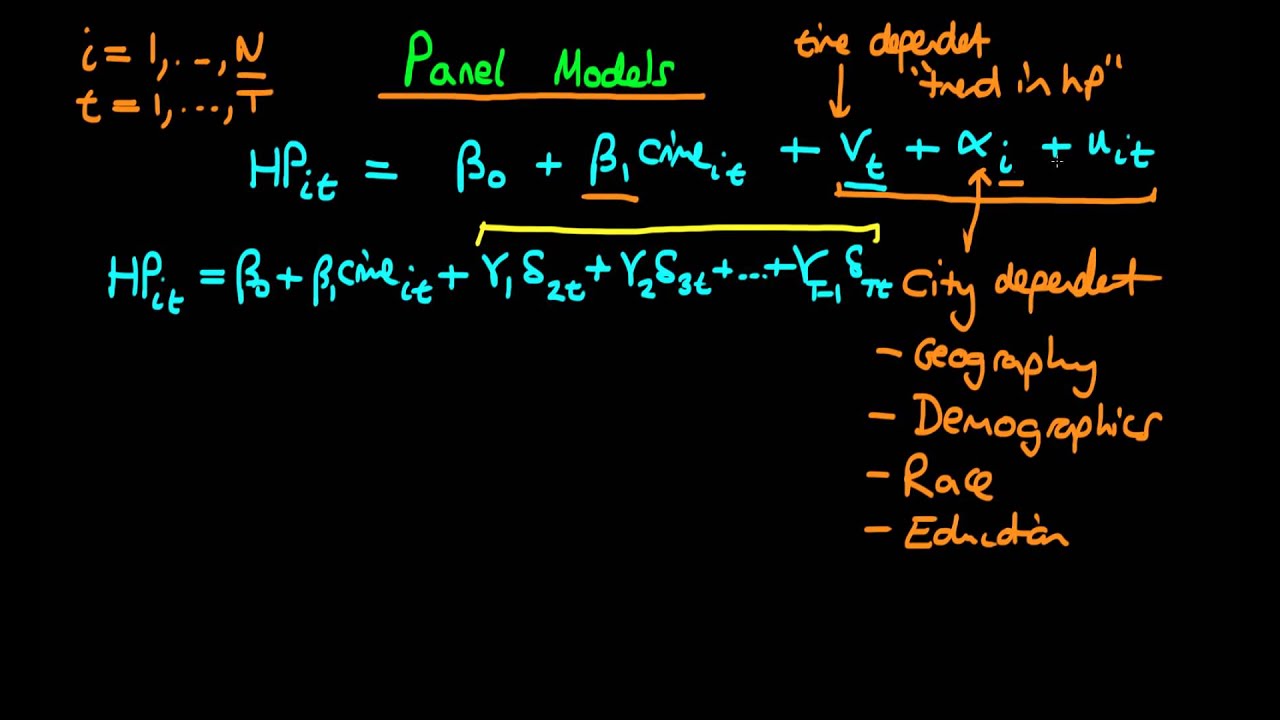
The video offers a clear and accessible introduction to a complex topic, using a concrete example to illustrate the concepts. The argumentation is logical and builds step by step, from the model specification to the identification of the problem with OLS. The explanation of why unobserved heterogeneity causes bias is particularly well done, with intuitive examples of how city-specific factors correlate with crime rates. The value lies in its pedagogical clarity, making it a useful starting point for students. However, it lacks depth in discussing potential solutions or alternative estimators, which is acknowledged as a teaser for future content.
Scientific Rigor, Source Quality, Title Accuracy
The video is scientifically rigorous in its presentation, correctly explaining the econometric concepts. However, it does not cite specific academic sources or provide references to the literature, which limits its scholarly depth. The title accurately reflects the content, as it is indeed an introduction to panel data econometrics. The description provides links to course materials and related resources, which are useful for further study. Overall, the video is reliable for educational purposes, but viewers seeking formal proofs or citations would need to consult additional sources.
199 words
Title / Content Match
The title accurately reflects the content, which is an introductory overview of panel data econometrics.
Quality & Reliability
8/10
Clear and rigorous explanation of panel data concepts, with a focus on unobserved heterogeneity. The video is well-structured and pedagogically sound, though it lacks formal proofs and references to specific literature.
Key Moments
Markers derived by PSI from the transcript: the creator did not define chapters.
- Introduction to panel data and the example of house prices and crime rates.
- Decomposition of the error term into time-specific, city-specific, and idiosyncratic components.
- Explanation of time-specific factors (BT) and city-specific factors (alpha).
- Discussion of why including dummy variables for time periods is feasible but for cities is not.
- Introduction of the combined error term and the requirement for OLS consistency.
- Explanation of why unobserved heterogeneity causes bias and inconsistency in OLS.
- Conclusion and teaser for next video on alternative estimators.
Cited Sources
- Oxbridge Tutor - Undergraduate Econometrics Course — Course materials and updates for the econometrics course.
- Ben Lambert - Bayesian Statistics — Information about upcoming Bayesian statistics videos and book.
- Ben Lambert - Econometrics Course Problem Sets and Data — Course materials, problem sets, and data for the econometrics course.
Concurring Sources
- Wooldridge, Introductory Econometrics — Standard textbook covering panel data methods.
Contribution & Novelties
The video provides a clear and intuitive introduction to panel data econometrics, specifically highlighting the issue of unobserved heterogeneity and its implications for OLS estimation. It is particularly useful for students new to the topic, as it breaks down complex concepts into understandable parts. The video does not present new research but serves as an educational resource.
Pour aller plus loin :
- Panel data - Wikipedia — Overview of panel data and its applications.
- Fixed effects model - Wikipedia — Discusses a common solution to unobserved heterogeneity.
- Random effects model - Wikipedia — Alternative approach to panel data analysis.
99 words
Radar Profile
The radar profile shows high scores in quality and reliability, with moderate scores in quantity and technical level. This indicates a well-explained but introductory video, suitable for learners, though not exhaustive in coverage.
💬 No comments were provided for analysis.