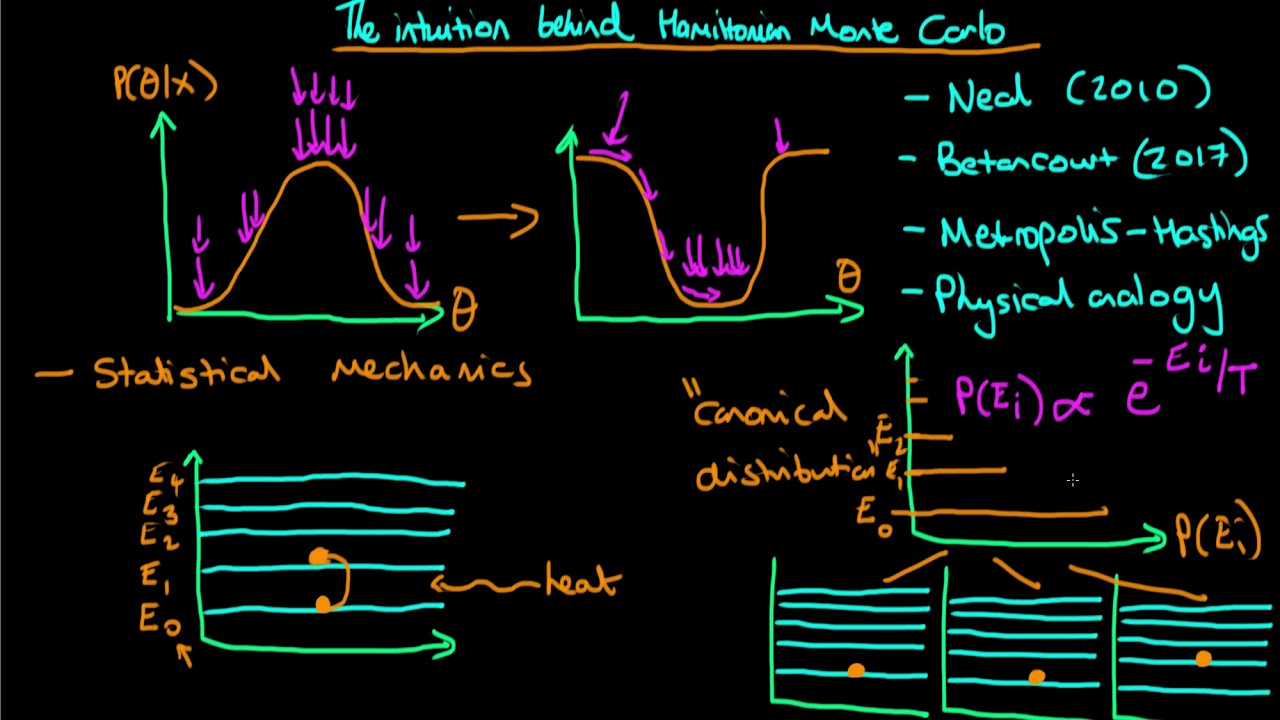
The intuition behind the Hamiltonian Monte Carlo algorithm
Keywords
Summary
160 words
Critical Evaluation
Value of the Information & Strength of the Argument
The video provides a clear and valuable explanation of HMC, making it accessible to those with a basic understanding of Bayesian statistics and MCMC. The argumentation is solid: it builds from a physical analogy to the mathematical formulation, and then to the algorithmic details. The presenter carefully derives the joint distribution and shows why the marginal distribution of parameters is the posterior. He also addresses the issue of proposal asymmetry and explains the momentum flip. The use of a bimodal example effectively illustrates the algorithm’s behavior. The video is well-structured and the reasoning is coherent.
Scientific Rigor, Source Quality, Title Accuracy
The video demonstrates scientific rigor by referencing two key papers: Neal (2011) and Betancourt (2017), and provides links in the description. The explanation aligns with these sources. The title accurately reflects the content, which focuses on the intuition behind HMC. The video is part of a lecture course and is based on the book ‘A Student’s Guide to Bayesian Statistics’ by Ben Lambert, which adds to its credibility. No comments were provided for analysis.
184 words
Title / Content Match
The title accurately reflects the content, which focuses on the intuition behind HMC.
Quality & Reliability
8/10
The video is a well-structured tutorial by an academic (Ben Lambert) that explains the Hamiltonian Monte Carlo algorithm using a physical analogy and statistical mechanics. It references two key papers (Neal 2011, Betancourt 2017) and provides links. The explanation is mathematically sound and aligns with standard literature.
Key Moments
Markers derived by PSI from the transcript: the creator did not define chapters.
- Introduction to the video and the physical analogy behind HMC.
- Explanation of the sledge analogy and flipping the posterior.
- Introduction to statistical mechanics and the canonical distribution.
- Derivation of the joint distribution of theta and momentum.
- Explanation of how proposals are generated using Hamiltonian dynamics.
- Discussion of the leapfrog integrator and symplectic property.
- Metropolis-Hastings acceptance step and momentum flip.
- Example on a bimodal posterior and conclusion.
Cited Sources
- A Conceptual Introduction to Hamiltonian Monte Carlo — Mentioned as a key reference for the video.
- MCMC using Hamiltonian dynamics — Referenced as part of the lecture course playlist.
- Ben Lambert's Bayesian resources — Provided as additional resources for Bayesian statistics.
Concurring Sources
- A Conceptual Introduction to Hamiltonian Monte Carlo — This paper by Michael Betancourt provides a detailed conceptual introduction to HMC, aligning with the video's content.
- MCMC using Hamiltonian dynamics — This chapter by Radford Neal is a standard reference for HMC, and the video's explanation is consistent with it.
Contribution & Novelties
This video provides a clear and intuitive explanation of HMC, making it accessible to a wider audience. It bridges the gap between the physical analogy and the mathematical formulation, which is often a barrier for learners. The video also emphasizes that HMC is a variant of Metropolis-Hastings, which helps in understanding its properties.
Pour aller plus loin :
- Hamiltonian Monte Carlo — Wikipedia article providing an overview and references.
- Stan — Official website of the Stan probabilistic programming language, which uses HMC.
- No-U-Turn Sampler — Paper introducing the NUTS algorithm, an extension of HMC used in Stan.
97 words
Radar Profile
The radar profile shows high scores in information quantity, quality, and reliability, with a slightly lower but still solid technical level. This indicates a well-balanced educational video that is both informative and trustworthy, with a moderate technical depth suitable for an intermediate audience.