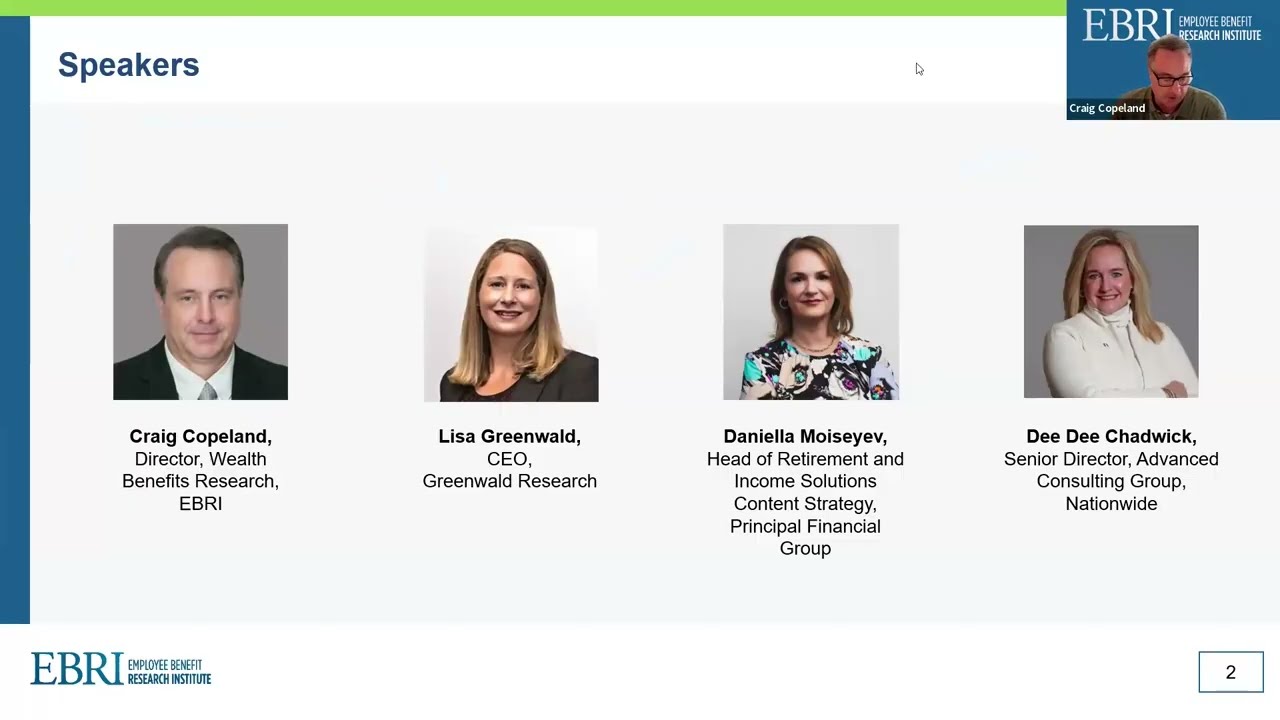
Retirement Confidence in 2026: Rising Costs, Debt, and Declining Confidence
Keywords
Summary
158 words
Critical Evaluation
Value of the Information & Strength of the Argument
The webinar provides valuable, up-to-date data on retirement confidence and related financial behaviors, based on a rigorous, long-running survey. The argumentation is solid, grounded in survey statistics and supplemented by industry research. The panelists effectively connect the data to practical implications for plan sponsors and advisors, offering actionable insights. However, the presentation is primarily descriptive, with limited critical evaluation of the survey’s limitations or potential biases.
Scientific Rigor, Source Quality, Title Accuracy
The webinar is scientifically rigorous, presenting findings from a well-established survey with transparent methodology. The sources are credible: EBRI and Greenwald Research are reputable organizations. The title accurately reflects the content, focusing on declining confidence due to rising costs and debt. The presentation is well-structured and the panelists are knowledgeable. No external sources are cited beyond the survey itself, but the internal consistency and expertise lend credibility.
148 words
Title / Content Match
The title accurately reflects the content, focusing on declining retirement confidence due to rising costs and debt.
Quality & Reliability
8/10
The webinar presents findings from the 2026 Retirement Confidence Survey, a long-running, nationally representative survey conducted by EBRI and Greenwald Research. The methodology is described (sample sizes, weighting), and the panelists are experts from reputable organizations. However, the presentation is largely descriptive without deep critical analysis or external verification of the data.
Key Moments
Markers derived by PSI from the transcript: the creator did not define chapters.
- Introduction and overview of the 2026 Retirement Confidence Survey methodology.
- Presentation of overall retirement confidence decline among workers.
- Discussion of factors impacting confidence: inflation, cost of living, debt, and health concerns.
- Analysis of workplace savings plan participation and the 'participant illusion'.
- Principal's research on non-participants and strategies to increase enrollment.
- Discussion of advice-seeking behavior and sources of financial information.
- Panel discussion on the role of human advice versus technology in retirement planning.
- Q&A session with audience questions.
Cited Sources
- 2026 Retirement Confidence Survey — The survey is the primary source of data discussed throughout the webinar.
- Principal Financial Group Research on Participant Illusion — Daniella Moiseyev presents findings from Principal's internal study on non-participants.
Concurring Sources
- EBRI Retirement Confidence Survey — The survey itself is the primary source, and its findings are consistent with previous years' trends.
Contribution & Novelties
The webinar provides fresh data from the 2026 Retirement Confidence Survey, highlighting a significant decline in confidence and the emergence of new concerns like AI’s impact on retirement. The concept of the ‘participant illusion’ is a novel insight, revealing a large group of workers who mistakenly believe they are saving. This has practical implications for plan design and communication.
Pour aller plus loin :
- Retirement Confidence Survey — Official page for the survey, providing historical data and reports.
- Behavioral finance — Relevant to understanding the psychological factors behind the participant illusion.
- Auto-enrollment — A key policy tool mentioned in the discussion, with evidence on its effectiveness.
- Financial literacy — Underlying issue affecting retirement planning and advice-seeking behavior.
117 words
Radar Profile
The radar profile shows high scores in quantity and quality of information, reflecting the comprehensive survey data and expert analysis. The technical level is moderate, suitable for a professional audience. The overall reliability is high due to the reputable sources and methodology.