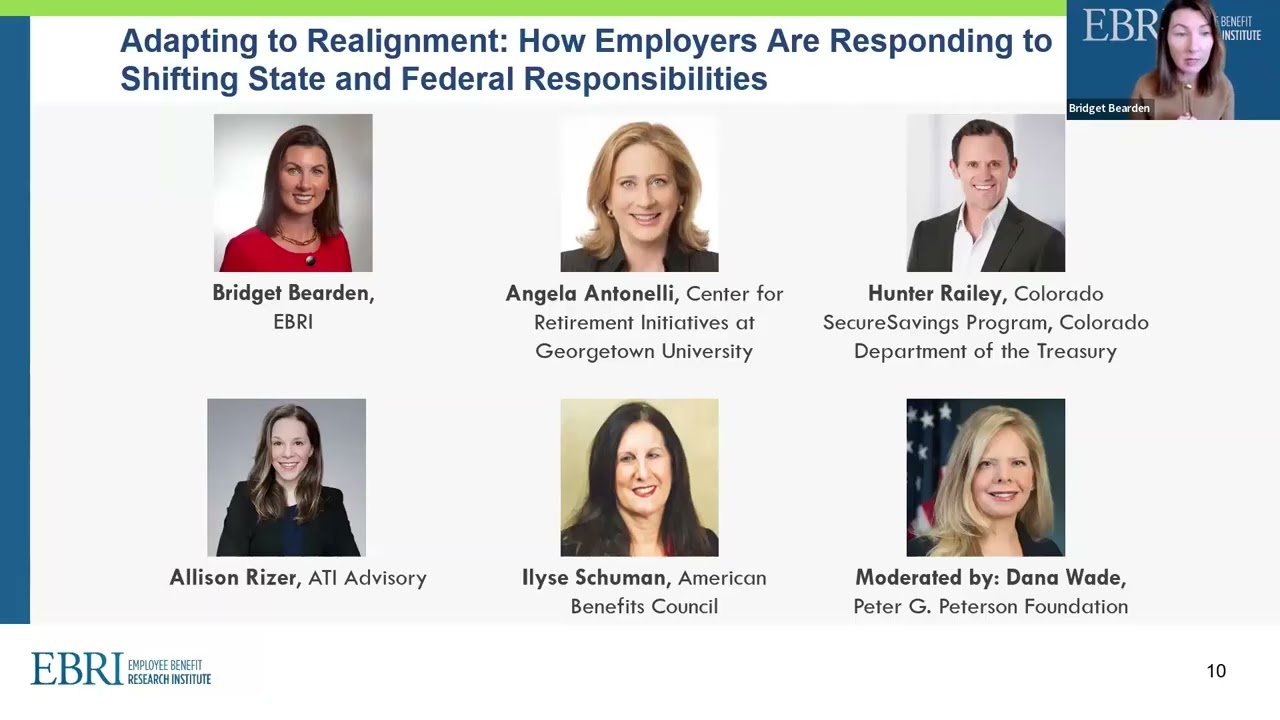
EBRI 2025 Fall Policy Forum: How Employers Respond to Shifting State & Federal Responsibilities
Keywords
Summary
219 words
Critical Evaluation
Value of the Information & Strength of the Argument
The video provides valuable insights into the current landscape of employer-sponsored benefits in the context of shifting state and federal responsibilities. The panelists bring diverse expertise, and the discussion is well-structured, with data from EBRI research and state program statistics. The argumentation is solid, relying on empirical evidence and expert opinion. However, the discussion is largely descriptive and does not deeply critique the effectiveness of the programs or explore potential drawbacks. The value lies in its comprehensive overview and the practical perspectives shared by the panelists.
Scientific Rigor, Source Quality, Title Accuracy
The video demonstrates scientific rigor by referencing specific research from EBRI, such as the Retirement Security Projection Model and surveys, and by citing statistics from the World Health Organization. The panelists are credible experts from reputable institutions. The title accurately reflects the content, which focuses on employer responses to shifting state and federal responsibilities. The sources cited are primarily from EBRI and the panelists’ organizations, and while they are not independently verified in the video, they are generally reliable. The discussion is well-moderated and stays on topic.
188 words
Title / Content Match
The title accurately reflects the content, which focuses on how employers respond to shifting state and federal responsibilities in the context of aging policy.
Quality & Reliability
7/10
The video features recognized experts from reputable organizations (Georgetown University, Colorado Secure Savings, ATI Advisory, American Benefits Council) and cites specific data from EBRI research. However, it is a policy forum discussion with a promotional component for EBRI's work, and the data presented is not independently verified within the video.
Key Moments
Markers derived by PSI from the transcript: the creator did not define chapters.
- Introduction and housekeeping by EBRI staff
- Overview of EBRI research on retirement security and aging
- Presentation of federal fiscal challenges by Dana Wade
- Audience poll on which program will have greatest impact
- Angela Antonelli discusses state auto-IRA programs and their impact
- Hunter Braley explains Colorado Secure Savings and multi-state portability
- Allison Riser discusses Medicaid cuts and long-term care financing
- Ely Schuman provides employer perspective on paid leave and health policy
- Panel discussion on challenges and opportunities for employers
- Q&A session with audience questions
Cited Sources
- EBRI Retirement Security Projection Model — Cited by Bridget as a key tool for projecting retirement savings shortfalls.
- EBRI Retirement Confidence Survey — Cited by Bridget as a long-running survey on retirement confidence.
- Georgetown University Center for Retirement Initiatives — Angela Antonelli's organization, which tracks state retirement programs.
- Colorado Secure Savings Program — Hunter Braley's program, highlighted for its multi-state portability.
- Peter G. Peterson Foundation — Dana Wade's organization, which focuses on fiscal sustainability.
Concurring Sources
- EBRI Retirement Security Projection Model — Supports the claim that one in three Americans will run short of money in retirement.
- Georgetown University Center for Retirement Initiatives — Provides data on state auto-IRA programs and their adoption.
- Colorado Secure Savings Program — Example of a state program with multi-state portability.
Dissenting Sources
- No discordant sources found — The video presents a consensus view among panelists; no conflicting sources were cited.
Contribution & Novelties
The video provides a comprehensive overview of the current state of employer-sponsored benefits in the context of shifting state and federal responsibilities, with a focus on retirement and aging policy. It highlights the growth of state auto-IRA programs and their potential to reduce retirement savings shortfalls, as well as the challenges employers face in navigating a complex regulatory landscape. The discussion offers valuable insights for policymakers, employers, and benefit professionals.
Pour aller plus loin :
- Auto-IRA — Overview of automatic enrollment individual retirement accounts.
- Employee Retirement Income Security Act (ERISA) — Federal law governing employer-sponsored retirement plans.
- Social Security insolvency projections — Official projections from the Social Security Administration.
- Medicaid long-term care — Information on Medicaid’s role in financing long-term care.
121 words
Radar Profile
The radar profile shows high scores in quantity of information and technical level, reflecting the depth of data and expert analysis. The quality of information and global reliability are also strong, though slightly lower due to the promotional nature of the forum. Overall, the video is a valuable resource for understanding the policy landscape.
💬 No comments were provided for analysis.