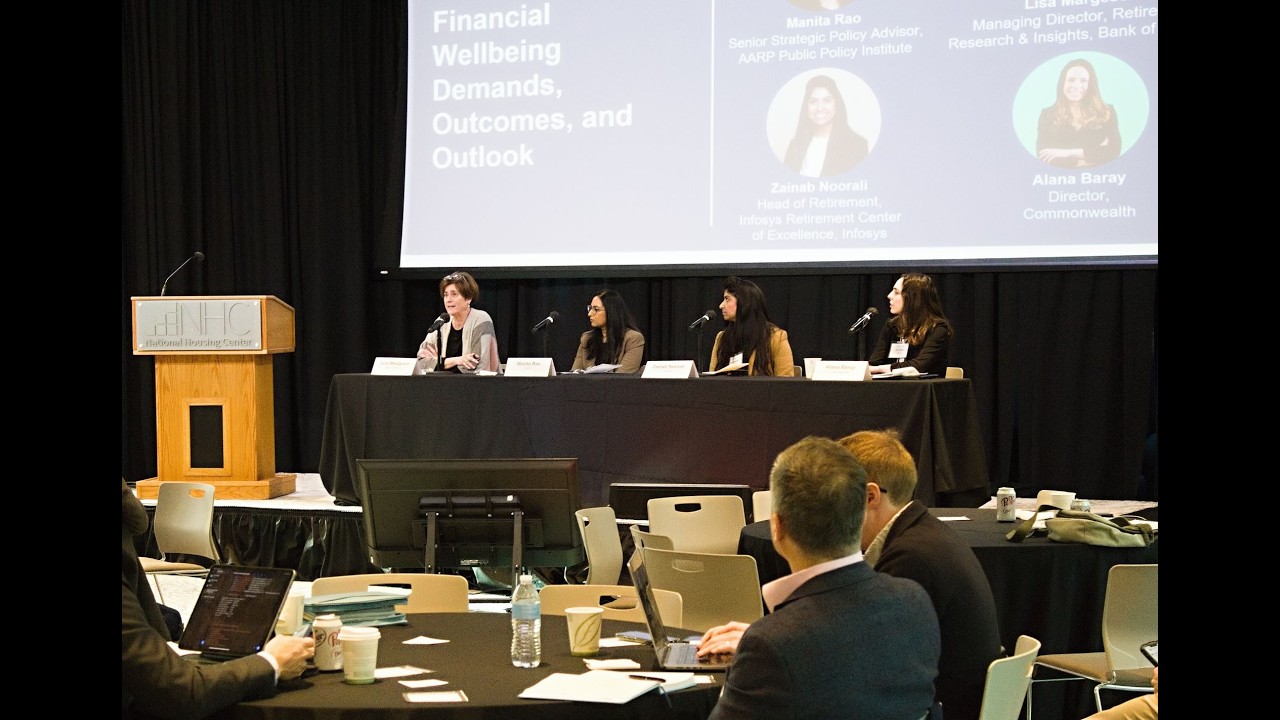
EBRI 2025 Financial Wellbeing Symposium — Financial Wellbeing Demands, Outcomes, and Outlook
Keywords
Summary
207 words
Critical Evaluation
Value of the Information & Strength of the Argument
The video provides valuable insights into employee financial wellbeing and benefits from multiple perspectives: employer survey data, academic research, and technology provider experience. The argumentation is solid, with each panelist supporting their points with data or professional experience. Lisa Margeson’s survey data offers concrete statistics on employee sentiment and benefit preferences. Manita Zhao’s research provides quantitative evidence on the impact of benefits on financial stress and turnover, though the methodology is not fully detailed. Zanib Nurali’s perspective highlights practical challenges in benefits adoption and the role of technology. The discussion is coherent and builds on previous panels, but it lacks critical evaluation of the data and potential limitations.
Scientific Rigor, Source Quality, Title Accuracy
The scientific rigor is moderate. The panelists cite their own research and reports, but the sources are not independently verified. The Bank of America report is proprietary, and the AARP-USC study is not published in a peer-reviewed journal. The title accurately reflects the content, which is a symposium session on financial wellbeing. The discussion is expert opinion rather than a systematic review, and the lack of detailed methodology limits the ability to assess the robustness of the findings. No comments were provided, so no analysis of public reception is possible.
213 words
Title / Content Match
The title accurately reflects the content: a symposium session on financial wellbeing demands, outcomes, and outlook, with a focus on employee benefits.
Quality & Reliability
7/10
The video features expert panelists from reputable organizations (Bank of America, AARP, Infosys) presenting survey data and academic research. However, the discussion is largely qualitative and based on proprietary or unpublished research, with limited methodological detail. The claims are plausible and align with broader industry knowledge, but the lack of full data access and peer review reduces the score.
Key Moments
Markers derived by PSI from the transcript: the creator did not define chapters.
- Introduction of panelists and topic: employee perspective on financial wellbeing and benefits.
- Lisa Margeson presents Bank of America's 15th annual Workplace Benefits Report: financial wellness trends, employee priorities (equity, guaranteed income, wellness reimbursements), and headwinds (caregiver burnout, debt, healthcare costs).
- Discussion on personal debt: 9 in 10 employees carry debt, credit card debt surpasses mortgage debt, and a third say debt impacts productivity.
- Manita Zhao presents AARP-USC research on benefits access and impacts: disparities by race and gender, and effects on financial stress and turnover.
- Zanib Nurali discusses the gap between plan-level adoption and employee-level adoption, emphasizing the need for digital tools and guided decision-making.
- Panelists discuss actionable strategies: smart plan design, education, and emerging benefits like emergency savings and debt assistance.
- Concluding remarks on the importance of listening to employees and leveraging technology to improve benefits utilization.
Cited Sources
- Bank of America Workplace Benefits Report — Lisa Margeson cites the 15th annual report from Bank of America on employee financial wellbeing and benefits.
- AARP-USC Research on Employer-Sponsored Benefits — Manita Zhao presents findings from a study conducted with the University of Southern California on benefits access and impacts.
Concurring Sources
- PwC Employee Financial Wellness Survey — PwC's survey reports similar trends in employee financial stress and the importance of benefits.
- SHRM Employee Benefits Survey — SHRM's survey provides data on benefits offerings and employee preferences, aligning with the video's discussion.
Dissenting Sources
- Critique of Employer-Sponsored Benefits as a Solution — Some researchers argue that employer-sponsored benefits may not be sufficient to address systemic financial insecurity, and that policy changes are needed. This perspective is not discussed in the video.
Contribution & Novelties
The video contributes to the discussion on financial wellbeing by combining employer survey data, academic research, and technology provider insights. It highlights the gap between benefit availability and employee adoption, and provides evidence that non-traditional benefits (e.g., paid leave, work-from-home) have significant positive impacts on financial stress and turnover. The panel also offers practical recommendations for employers to improve benefits utilization.
Pour aller plus loin :
- Employee Benefit Research Institute — The organizing institution, with research on employee benefits and financial wellbeing.
- Financial Stress and Employee Productivity — American Psychological Association resource on the impact of financial stress on productivity.
- Guaranteed Income Programs — Overview of guaranteed income concepts and experiments.
- Health Savings Accounts (HSAs) — IRS publication on HSAs, relevant to the discussion on education and benefits.
128 words
Radar Profile
The radar profile shows moderate to high scores across all dimensions, with slightly lower technical level and reliability due to the reliance on proprietary research and expert opinion. The video is informative and credible but not highly technical or rigorously peer-reviewed.