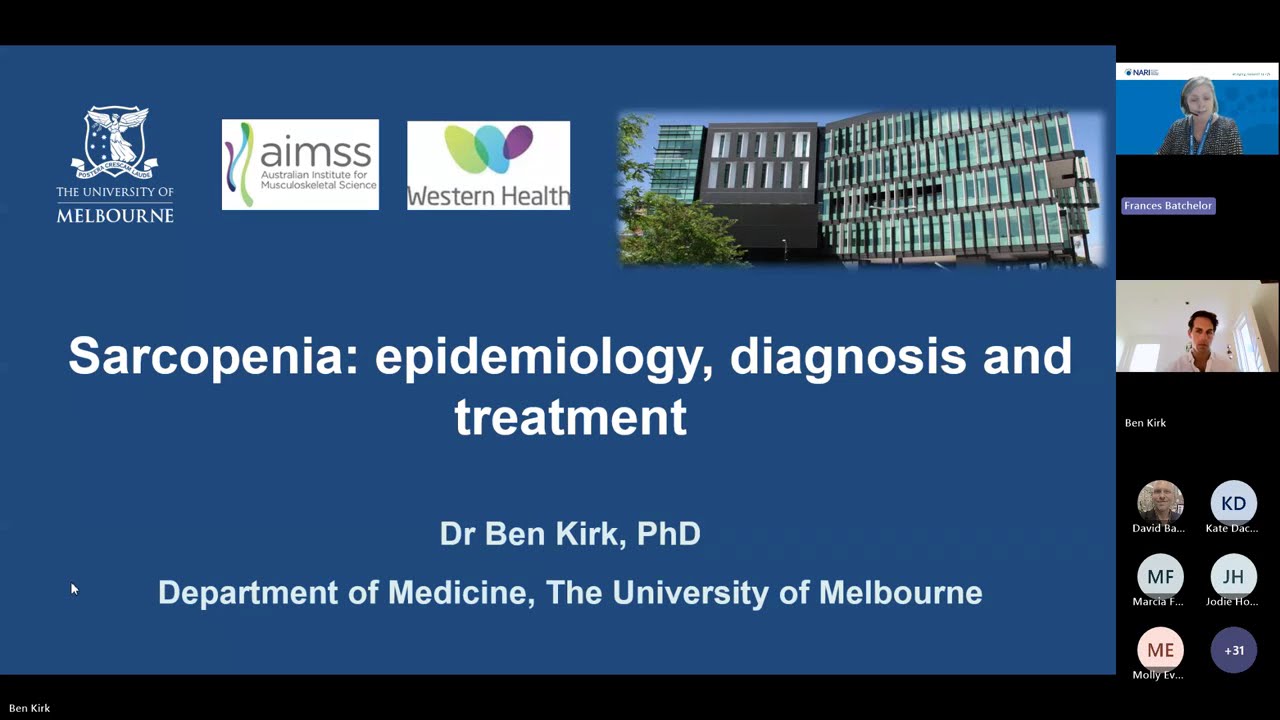
NARI Seminars in Ageing: Sarcopenia Epidemiology, Diagnosis & Treatment presented by Dr Ben Kirk.
Keywords
Summary
181 words
Critical Evaluation
Value of the Information & Strength of the Argument
The presentation provides valuable insights into the current state of sarcopenia research and clinical practice. Dr Kirk effectively argues for the need for a unified definition, supported by the historical context of competing criteria and the resulting confusion. He presents the GLIS initiative as a robust, systematic approach to achieving consensus, highlighting its global representation and Delphi methodology. The discussion of the biology of sarcopenia is clear and well-illustrated, explaining the cellular mechanisms underlying muscle degeneration. The argumentation is solid, grounded in epidemiological data and expert consensus, though some claims could benefit from more specific citations. Overall, the content is highly informative for clinicians and researchers, offering a comprehensive update on sarcopenia.
Scientific Rigor, Source Quality, Title Accuracy
The presentation demonstrates scientific rigor, drawing on peer-reviewed literature and the speaker’s own research. Dr Kirk references key studies and initiatives, such as the Australian Body Composition Study and UK Biobank, and discusses the GLIS consensus process. The title accurately reflects the content, which covers epidemiology, diagnosis, and treatment. The talk is well-structured and provides a balanced view of the evidence, acknowledging uncertainties and ongoing work. The lack of detailed citations in the slides is a minor limitation, but the overall quality is high.
211 words
Title / Content Match
The title accurately reflects the content, which covers epidemiology, diagnosis, and treatment of sarcopenia as presented by Dr Ben Kirk.
Quality & Reliability
8/10
Presentation by a recognized expert in sarcopenia, based on peer-reviewed research and international consensus processes. The content is well-structured, references key studies and initiatives, and avoids overstatement. Minor limitations include reliance on personal interpretation of basic science and lack of detailed citations for some claims.
Key Moments
Markers derived by PSI from the transcript: the creator did not define chapters.
- Introduction and acknowledgment of traditional owners
- History of sarcopenia: coined by Dr. Owen Rosenberg in late 1980s
- Evolution of sarcopenia definitions from 1994 to 2022
- Comparison of European, Asian, and American diagnostic criteria
- Problems with competing definitions: variability in prevalence and lack of ICD-10 code
- Development of GLIS consensus definition using Delphi method
- Key components of GLIS definition: muscle mass and strength, physical performance as outcome
- Next steps: operationalizing the definition with working groups
- Biology of sarcopenia: cellular mechanisms of muscle repair and degeneration
- Risk factors: aging, malnutrition, low protein, vitamin D deficiency
Cited Sources
- GLIS definition publication — The consensus definition for sarcopenia developed by the Global Leadership Initiative in Sarcopenia.
- Australian Body Composition Study — Data on muscle mass across the lifespan used to illustrate age-related decline.
- UK Biobank — MRI data showing increase in muscle fat with age.
Concurring Sources
- Sarcopenia: revised European consensus on definition and diagnosis — European consensus definition, consistent with the need for unified criteria.
- Asian Working Group for Sarcopenia: 2019 consensus update on sarcopenia diagnosis and treatment — Asian criteria, showing regional differences in cutoffs.
Dissenting Sources
- Sarcopenia: revised consensus on definition and diagnosis — The European definition includes physical performance as a diagnostic criterion, whereas the GLIS definition treats it as an outcome.
Contribution & Novelties
This seminar provides a timely update on the global consensus definition of sarcopenia, highlighting the shift from multiple regional criteria to a unified framework. It offers a clear explanation of the biological mechanisms underlying muscle degeneration and emphasizes the importance of muscle strength over mass in diagnosis. The presentation also outlines the ongoing efforts to operationalize the definition and seek WHO endorsement, which could significantly impact clinical practice and research.
Pour aller plus loin :
- Sarcopenia: revised European consensus on definition and diagnosis — Key reference for the European definition.
- Global Leadership Initiative in Sarcopenia (GLIS) — Official website of the initiative.
- Sarcopenia: revised consensus on definition and diagnosis — Open-access article on the European consensus.
116 words
Radar Profile
The radar profile shows high scores in information quantity, quality, and reliability, with a slightly lower technical level, indicating a presentation that is comprehensive and trustworthy but accessible to a broad professional audience.
💬 No comments were provided for analysis.