Seminars in Ageing: Homecare packages and decision making
Keywords
Summary
218 words
Critical Evaluation
Value of the Information & Strength of the Argument
The presentation offers valuable insights into the application of behavioural economics to aged care policy. The argumentation is well-structured, moving from theoretical concepts to empirical analysis. The use of interactive examples effectively illustrates the influence of heuristics on decision-making. The speaker’s doctoral research provides a solid foundation, with a clear description of the data and methods used. The discussion of the Canadian dataset and its advantages over Australian data is particularly informative. The argument that nudging can be a tool for good if based on evidence is compelling, though the speaker acknowledges the ethical complexities. The presentation is strong in its conceptual framework and practical implications, though it could benefit from more detailed presentation of the statistical results.
Scientific Rigor, Source Quality, Title Accuracy
The presentation demonstrates scientific rigour through the use of a large, linked dataset and established statistical methods. The speaker references her own PhD thesis and mentions the interRAI assessment system, but does not provide specific citations for the behavioural economics concepts or the Canadian data. The title accurately reflects the content, which focuses on decision-making in home care packages. The presentation is based on original research, which adds to its credibility, but the lack of peer-reviewed publications or external references limits the ability to verify the findings independently. The speaker’s affiliation with the Aged Care Quality and Safety Commission lends some authority, but the presentation is primarily an expert opinion based on her research.
247 words
Title / Content Match
The title accurately reflects the content, focusing on decision-making in home care packages.
Quality & Reliability
7/10
Presentation of doctoral research with a clear methodology and large dataset, but limited peer-reviewed publication details and reliance on a single data source.
Key Moments
Markers derived by PSI from the transcript: the creator did not define chapters.
- Introduction and acknowledgement of traditional owners
- Overview of the ageing population and the importance of home care
- Interactive example illustrating decision-making biases
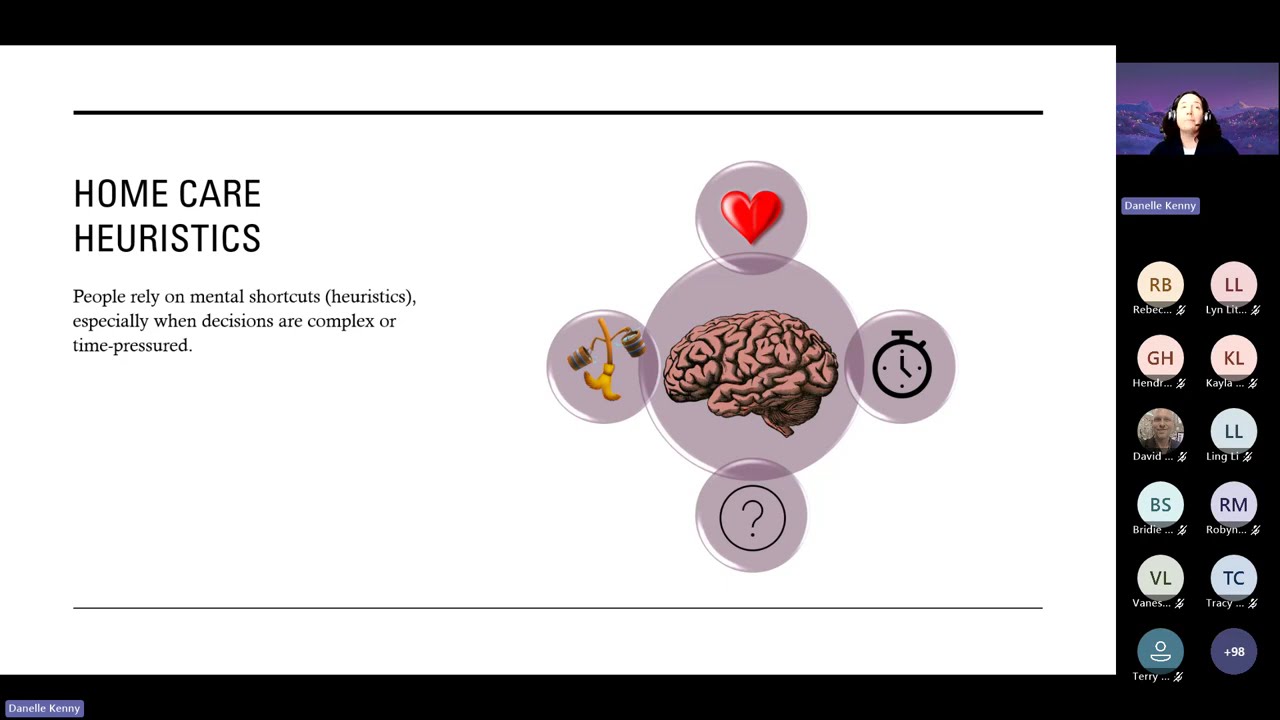
- Discussion of heuristics and their impact on home care choices
- Explanation of 'harsh' decision environments and decision fatigue
- Introduction to nudging and its ethical implications
- Critique of Australian data infrastructure for home care evaluation
- Description of the Canadian interRAI dataset and its advantages
- Methodology: outcomes, covariates, and statistical models
- Presentation of results: discharge destinations and length of stay
- Discussion of the skewed distribution of length of stay and implications
Cited Sources
- Full PhD thesis (link in description) — Referenced as a source for deeper exploration of the topics discussed.
Concurring Sources
- interRAI official website — The assessment system used in the Canadian dataset.
Contribution & Novelties
The presentation provides a novel application of behavioural economics to understand decision-making in home care packages, using a large-scale dataset to link service use to outcomes. It highlights the importance of considering cognitive biases in policy design and the potential of nudging to improve decision-making. The research addresses a significant gap in the literature by empirically testing theoretical concepts.
Pour aller plus loin :
- Heuristics in judgment and decision-making — Overview of heuristics and biases.
- Nudge theory — Concept of nudging in behavioural economics.
- interRAI — International assessment system used in the research.
93 words
Radar Profile
The radar profile shows high scores in information quantity and technical level, reflecting the detailed presentation of research methodology and findings. The quality of information and overall reliability are slightly lower, indicating that while the content is well-structured, it relies on a single study and lacks external validation.