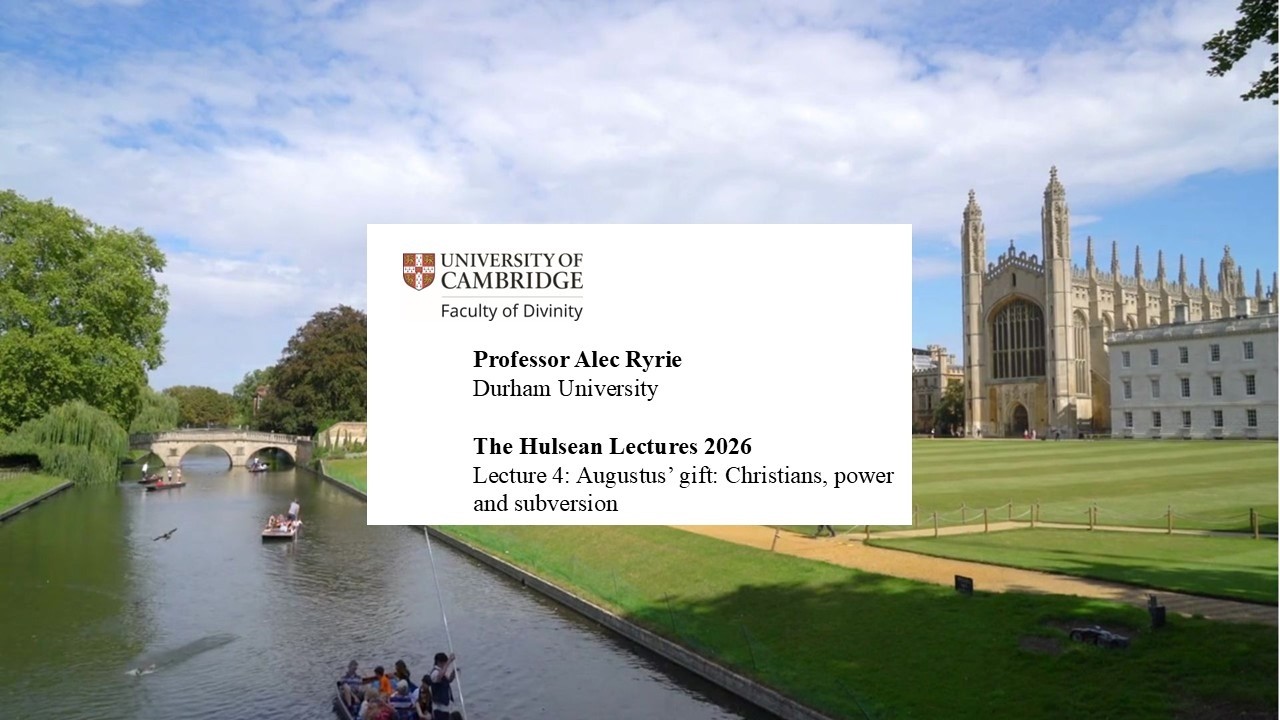
Hulsean Lectures 2026: Lecture 4
Keywords
Summary
184 words
Critical Evaluation
Value of the Information & Strength of the Argument
The lecture offers a compelling and original thesis: that Christianity’s characteristic response to power is subversion, not confrontation or alliance. Ryrie supports this with a wide range of historical examples, from the Gospels to the early church, the Reformation, and modern China. The argument is nuanced, acknowledging that Christians have often aligned with power, but arguing that this is a distortion of the faith’s core pattern. He engages with primary sources (e.g., Polycarp, Pliny) and secondary scholarship, though he does not cite specific works. The argumentation is logical and persuasive, though some points are speculative (e.g., the influence of Augustus on Christian thought). Overall, the lecture provides valuable insights into the political theology of Christianity.
Scientific Rigor, Source Quality, Title Accuracy
The lecture demonstrates strong scholarly rigor: Ryrie is a professor of divinity and the content is well-researched. He references primary sources (Gospels, Paul, Polycarp, Pliny) and historical events accurately. However, he does not provide explicit citations for secondary sources, which limits verifiability. The title accurately reflects the content, focusing on Augustus’ political strategy and its resonance in Christian history. The lecture is well-structured and the argument is coherent. No comments were provided for analysis.
204 words
Title / Content Match
The title accurately reflects the content: the lecture focuses on Augustus' political strategy and its influence on Christian approaches to power.
Quality & Reliability
8/10
The lecture is delivered by a recognized academic (Professor Alec Ryrie, Durham University) and presents a coherent historical argument grounded in primary sources (Gospels, Paul, Polycarp, Pliny) and scholarly interpretations. The argument is nuanced, acknowledges complexity, and avoids overstatement. However, it is a lecture, not peer-reviewed, and some interpretations are contestable.
Key Moments
Markers derived by PSI from the transcript: the creator did not define chapters.
- Introduction and overview of the lecture series
- Augustus' political strategy: preserving the republic's form while subverting its power
- Christianity's distinct approach: neither alliance nor challenge, but subversion
- Jesus' 'Render unto Caesar' as the seed of subversive obedience
- Early Christian martyrs: Polycarp and the Scillitan Martyrs
- The church as a corporate entity and its subversive nature
- The legacy of subversive obedience in Christian history
- The desire to recreate persecution and discomfort with power
- Eastern Orthodox 'symphony' vs. Western subversion
- Conclusion: subversion as a lens for understanding Christian political theology
Cited Sources
- The Gospel of Matthew — Cited for Jesus' response on paying taxes (Matthew 22:21)
- The Gospel of John — Cited for Jesus' statement 'My kingdom is not of this world' (John 18:36)
- Paul's Epistle to the Romans — Cited for Paul's teaching on obedience to governing authorities (Romans 13)
- The Martyrdom of Polycarp — Cited for Polycarp's subversive response to the proconsul
- Pliny the Younger's Letter to Trajan — Cited for Roman suspicion of Christian clandestine practices
Concurring Sources
- The Gospel of Matthew — Supports the interpretation of Jesus' subversive obedience.
- The Martyrdom of Polycarp — Illustrates the pattern of subversive obedience in early Christianity.
Dissenting Sources
- Some New Testament scholars — Some scholars argue Jesus was an apocalyptic revolutionary, which would contradict the subversive obedience interpretation.
Contribution & Novelties
The lecture offers a fresh framework for understanding Christian political theology: subversion as a distinctively Christian strategy. It synthesizes historical examples to argue that this approach has been more characteristic than either alliance or opposition. This perspective challenges common assumptions and provides a lens for interpreting contemporary Christian engagement with power.
Pour aller plus loin :
- Augustus — Background on Augustus’ political strategy.
- Render unto Caesar — Discussion of Jesus’ saying and its interpretations.
- Political theology — Overview of the field.
- Martyrdom of Polycarp — Primary source on early Christian martyrdom.
- Pliny the Younger on Christians — Context on Roman persecution.
101 words
Radar Profile
The radar profile shows high scores in quantity and quality of information, reflecting the lecture's depth and scholarly grounding. The technical level is moderate, indicating accessibility to a general audience. Overall, the lecture is highly reliable and informative.