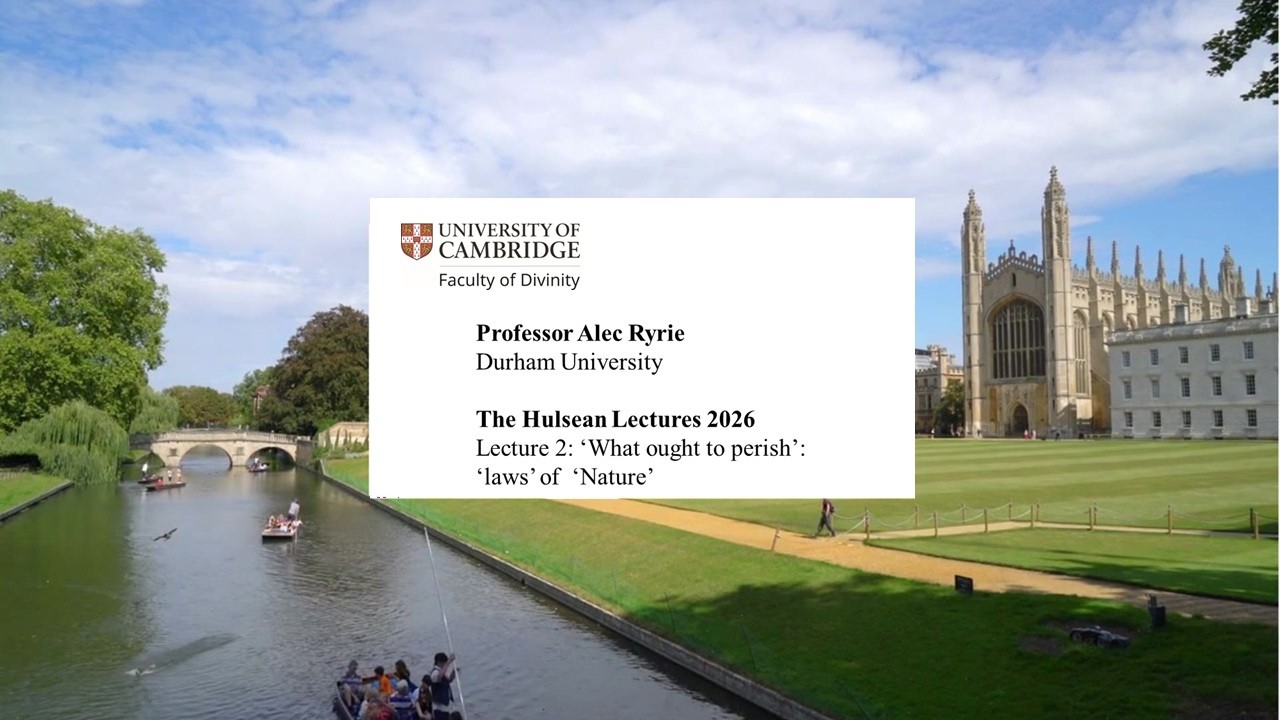
Hulsean Lectures 2026: Lecture 2
Keywords
Summary
156 words
Critical Evaluation
Value of the Information & Strength of the Argument
The lecture provides valuable historical insights into the reception of Darwinism and its ethical implications. Ryrie’s argumentation is solid, drawing on primary sources and historical figures to illustrate his points. He effectively demonstrates how Darwin’s theory was not only a scientific breakthrough but also a catalyst for philosophical and theological debates. The discussion of Huxley’s internal conflict and Nietzsche’s radical reinterpretation adds depth to the analysis. However, the lecture is primarily descriptive rather than prescriptive, and Ryrie does not offer a clear resolution to the ethical dilemmas he presents. The value lies in its comprehensive overview and the connections drawn between disparate thinkers.
Scientific Rigor, Source Quality, Title Accuracy
Ryrie demonstrates scholarly rigor by referencing original works and historical documents, such as Darwin’s ‘Origin of Species’, Malthus’s ‘Essay on Population’, and Huxley’s lectures. He accurately attributes quotes and ideas to their sources, showing careful research. The title is appropriate for a lecture series, though it does not specify the content. The lecture is well-structured and maintains a clear focus on the ethical implications of Darwinism. No comments were provided for analysis.
190 words
Title / Content Match
The title 'Hulsean Lectures 2026: Lecture 2' is generic, but the content aligns with the series' theme, focusing on the historical and philosophical implications of Darwinism.
Quality & Reliability
8/10
The lecture is delivered by a recognized academic (Professor Alec Ryrie, Durham University) and is part of a prestigious lecture series. It is well-structured, references historical sources accurately, and demonstrates scholarly rigor. However, as a lecture, it is not peer-reviewed and may contain interpretive elements.
Key Moments
Markers derived by PSI from the transcript: the creator did not define chapters.
- Introduction by the chair, summarizing the first lecture and setting the stage for the second.
- Ryrie introduces the concept of 'Darwin's problem' and the struggle for existence.
- Discussion of liberal Protestant theologians who embraced evolution but rejected its harsh implications.
- Examination of Herbert Spencer and the idea of progressive evolution.
- Analysis of Tennyson's poetry and the geological forerunners of Darwinism.
- Discussion of Malthus and political economists as intellectual precursors.
- Exploration of Nietzsche's critique of Darwin and his own Darwinian ethics.
- Huxley's dilemma regarding eugenics and the impossibility of a stable ethical society.
- Conclusion on the legacy of Darwinism and its moral challenges.
Cited Sources
- On the Origin of Species — Darwin's foundational work on evolution by natural selection.
- An Essay on the Principle of Population — Malthus's work that influenced Darwin's concept of the struggle for existence.
- Evolution and Ethics — Huxley's lectures on the conflict between cosmic and ethical processes.
- Beyond Good and Evil — Nietzsche's critique of morality and his Darwinian influences.
- The Descent of Man — Darwin's work on human evolution and sexual selection.
Concurring Sources
- Darwin's Dangerous Idea — Daniel Dennett's philosophical exploration of Darwinian evolution and its implications.
- The Descent of Man — Darwin's own work on human evolution, which touches on ethical implications.
Dissenting Sources
Contribution & Novelties
This lecture offers a nuanced historical analysis of the ethical implications of Darwinism, highlighting the tension between scientific naturalism and moral philosophy. It provides a comprehensive overview of how various thinkers, from liberal theologians to Nietzsche, responded to the challenges posed by Darwin’s theory. The lecture’s originality lies in its synthesis of these responses and its emphasis on the enduring relevance of these debates.
Pour aller plus loin :
- Social Darwinism — Overview of the application of Darwinian concepts to society.
- Eugenics — Historical movement that sought to improve human genetics, often justified by Darwinian principles.
- T.H. Huxley — Biographical information on the prominent advocate of Darwinism and his ethical struggles.
111 words
Radar Profile
The radar profile shows high scores in information quantity, quality, and reliability, with a slightly lower technical level, indicating a lecture that is rich in content and well-researched but accessible to a general academic audience. The balance suggests a strong scholarly contribution with clear communication.