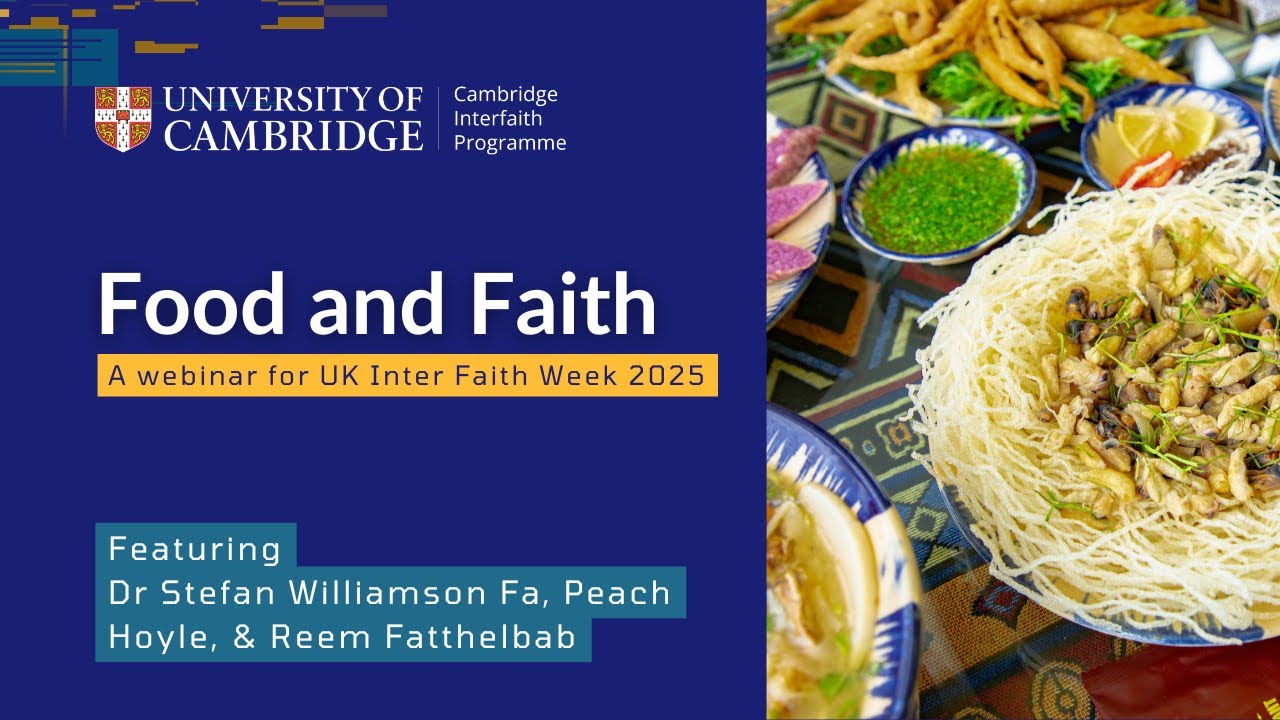
Webinar: Food, Faith & Community
Keywords
Summary
120 words
Critical Evaluation
Value of the Information & Strength of the Argument
The webinar provides valuable insights into the role of food in religious and community life, drawing on original ethnographic research. The speakers present compelling arguments that challenge common assumptions, such as the idea that food sharing is trivial or merely symbolic. They demonstrate how food practices are deeply embedded in ethical and spiritual frameworks, and how they can build bridges across differences. The argumentation is solid, with each speaker grounding their claims in specific examples and theoretical concepts. However, the format is introductory, and the depth of analysis is limited by the time constraints.
Scientific Rigor, Source Quality, Title Accuracy
The speakers are credible researchers from the University of Cambridge, and their presentations are based on fieldwork and engagement with relevant literature. They reference specific concepts and traditions, such as the Quran and Hadith, and anthropological theories. The title accurately reflects the content. The webinar is well-structured, with clear sections and a coherent discussion. The sources cited are primarily the researchers’ own work and general references, but they are appropriate for the format.
182 words
Title / Content Match
The title accurately reflects the content, which explores the intersection of food, faith, and community through three case studies.
Quality & Reliability
8/10
The webinar features three researchers from the University of Cambridge presenting their ethnographic fieldwork. The content is well-structured, with clear references to academic concepts and traditions. The speakers are credible, and the discussion is grounded in empirical research. However, the format is a webinar aimed at teachers, so it is more introductory than deeply analytical.
Chapters
Cited Sources
- Charities Aid Foundation — Mentioned in relation to statistics on Muslim charitable giving during Ramadan.
- Trussell Trust — Referenced as the largest food bank network in the UK, Christian-based.
Concurring Sources
- Cambridge Interfaith Programme — The host organization, providing context for the webinar's purpose.
Contribution & Novelties
The webinar offers a nuanced perspective on the intersection of food, faith, and community, highlighting often-overlooked practices such as Muslim food aid and women’s interfaith gatherings. It challenges the dichotomy between ‘high-level’ and ‘grassroots’ interfaith work, suggesting that everyday acts of sharing food have significant social and political implications. The research presented is original and contributes to the fields of religious studies and anthropology.
Pour aller plus loin :
- Ethnography — Provides background on the methodological approach used by the speakers.
- Interfaith dialogue — Contextualizes the broader field of interfaith engagement.
- Food sovereignty — Relevant to discussions of food aid and community resilience.
103 words
Radar Profile
The radar profile shows high scores in quality and reliability, reflecting the academic rigor and credible sources. The quantity of information is moderate, and the technical level is relatively low, indicating an introductory presentation. This suggests a balanced profile suitable for a general audience interested in the topic.