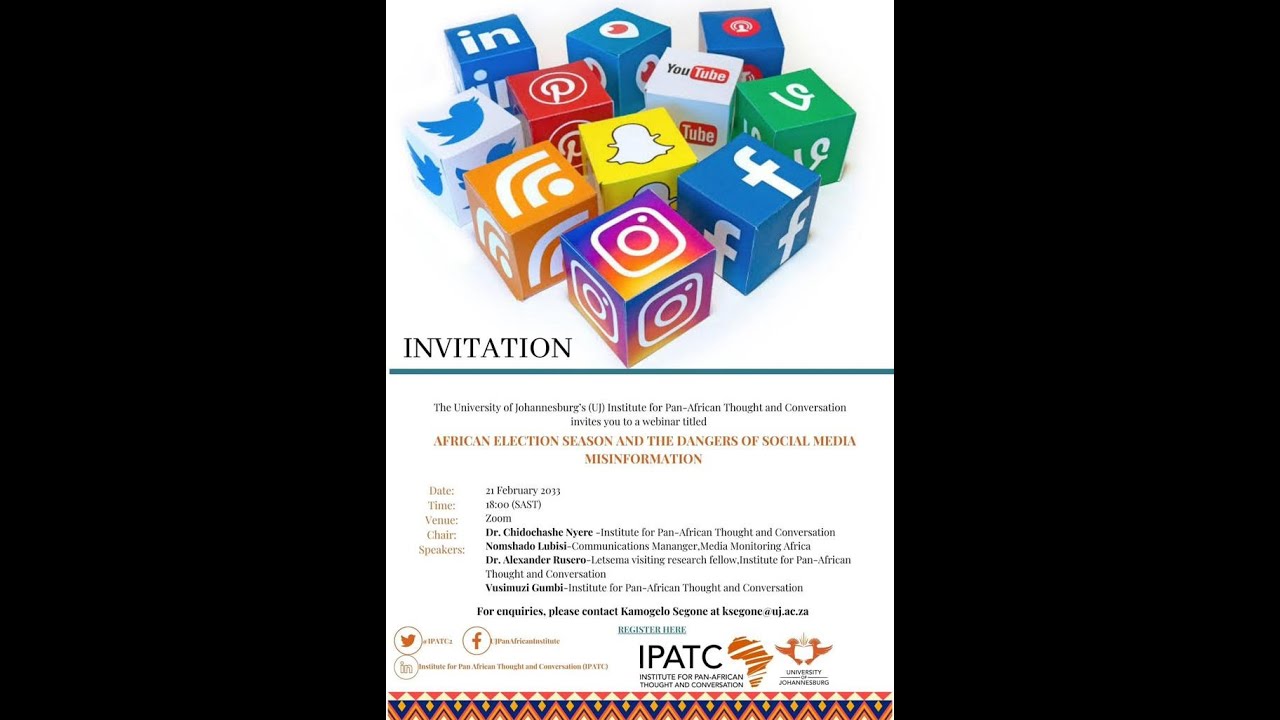
WEBINAR| African Election Season and the Dangers of Social Media Misinformation
Keywords
Summary
140 words
Critical Evaluation
Value of the Information & Strength of the Argument
The webinar provides a valuable overview of the challenges posed by misinformation in African elections, with specific examples from Zimbabwe and Nigeria. The speakers offer a critical perspective on the role of social media, highlighting issues such as the lack of regulation, the influence of political elites, and the potential for misinformation to undermine democratic processes. The argumentation is largely qualitative and anecdotal, relying on the speakers’ expertise and observations rather than empirical data. While the discussion is insightful, it lacks concrete solutions or evidence-based recommendations, which limits its practical value.
Scientific Rigor, Source Quality, Title Accuracy
The webinar demonstrates a moderate level of scientific rigor. The speakers are academics with relevant expertise, and the discussion is grounded in theoretical frameworks such as the colonial matrix of power. However, the presentation lacks citations to specific studies or reports, and the arguments are not systematically supported by evidence. The title accurately reflects the content, and the discussion stays on topic. The webinar does not provide a comprehensive review of the literature, but it offers a thoughtful analysis of the issues at hand.
190 words
Title / Content Match
The title accurately reflects the content, which focuses on the dangers of social media misinformation during African elections.
Quality & Reliability
6/10
The webinar features expert speakers with academic credentials, but the discussion is largely opinion-based and lacks empirical data or verifiable sources. The technical quality is uneven, with some connectivity issues.
Key Moments
Markers derived by PSI from the transcript: the creator did not define chapters.
- Introduction by Dr. Odila Aayodel, head of the digital Africa research unit, setting the context of the webinar.
- Dr. Chidochashe Nyere introduces the first speaker, Dr. Alexander Rusero, highlighting his academic background.
- Dr. Rusero begins his presentation on the five pillars of misinformation: hoaxes, propaganda, disinformation, populism, and colonial matrix of power.
- Discussion of the Zimbabwean election context, including the delimitation report controversy and the role of cyber warriors.
- Q&A session begins with questions about youth engagement, censorship, and regulation of social media.
- Dr. Rusero responds to questions, discussing the lack of safety nets on social media and the need for civil society education.
- Further Q&A on deepfakes, censorship, and the role of social media in democratic elections.
- Discussion on the responsibility of citizens and the potential for authoritarian resilience.
- Concluding remarks and call for action from the speakers.
Cited Sources
- UNESCO on information as a public good — Mentioned by Dr. Rusero in the context of information being a public good.
Concurring Sources
- UNESCO on information as a public good — Aligned with the webinar's emphasis on the importance of information for democracy.
Contribution & Novelties
The webinar offers a pan-African perspective on the dangers of social media misinformation during elections, with specific case studies from Zimbabwe and Nigeria. It introduces the concept of the ‘colonial matrix of power’ as a framework for understanding the control of digital platforms. The discussion highlights the role of ‘cyber warriors’ and the challenges of regulating social media in African contexts.
Pour aller plus loin :
- Misinformation on Wikipedia — Provides a general overview of misinformation and its types.
- Disinformation on Wikipedia — Explores the deliberate spread of false information.
- Social media and democracy — Discusses the impact of social media on democratic processes.
- Deepfake on Wikipedia — Relevant to the discussion on AI-generated misinformation.
- Coloniality of power — Theoretical framework referenced in the webinar.
125 words
Radar Profile
The radar profile shows moderate scores across all dimensions, with a slight emphasis on quantity of information and a lower score on technical level. This reflects a discussion that is informative but not highly technical or data-driven.
💬 Sur les 0 commentaires analysés, aucune tendance n'a pu être identifiée.