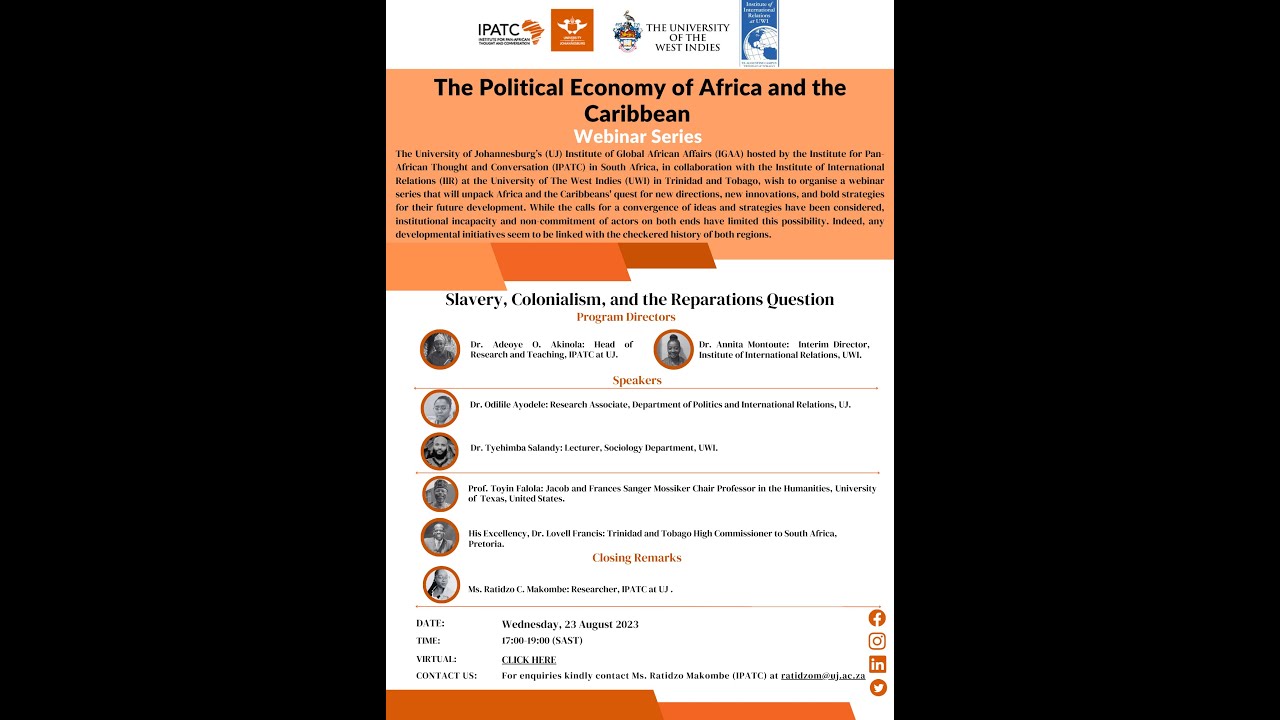
WEBINAR SERIES | PART 1: "Slavery, Colonialism, and the Reparations Question"
Keywords
Summary
128 words
Critical Evaluation
Value of the Information & Strength of the Argument
The value of the information lies in its comprehensive overview of the historical and contemporary dimensions of slavery and colonialism, presented by experts with deep knowledge. The arguments are well-structured and persuasive, particularly Falola’s emphasis on the continuity of exploitation and Ayodele’s focus on infrastructure. However, the discussion is largely qualitative and lacks specific data or citations, which weakens the empirical grounding. The argumentation is strong in its moral and historical framing but could benefit from more concrete evidence.
Scientific Rigor, Source Quality, Title Accuracy
The scientific rigor is moderate: the speakers are credible academics, but they do not systematically cite sources. The title accurately reflects the content, and the discussion is coherent. The lack of formal citations and the ideological tone reduce the overall rigor. No comments were provided, so no analysis of public reception is possible.
147 words
Title / Content Match
The title accurately reflects the content, which focuses on the historical impact of slavery and colonialism and the reparations debate.
Quality & Reliability
7/10
The webinar features academic experts with relevant credentials, but the discussion is largely opinion-based and lacks rigorous citation of sources. The arguments are coherent and grounded in historical context, but the lack of verifiable data and the ideological framing reduce the overall reliability.
Key Moments
Markers derived by PSI from the transcript: the creator did not define chapters.
- Introduction by Dr. Annita Montoute, outlining the webinar series and collaboration.
- Dr. Adeoye Akinola introduces the topic and panelists.
- Professor Toyin Falola begins his keynote on the impact of slavery and colonialism.
- Falola discusses the ongoing nature of exploitation and the need for reparations.
- Dr. Odilile Ayodele presents on colonial infrastructure and its effects.
- Ayodele argues for a rethinking of global economic systems.
- Discussion on African agency and the role of the diaspora.
- Q&A session begins with audience questions.
- Panelists respond to questions on reparations and practical steps.
- Closing remarks by Ms. Ratidzo C. Makombe.
Cited Sources
- Institute for Pan-African Thought and Conversation (IPATC) — The host institution, mentioned in the description.
- Institute of International Relations (IIR), University of the West Indies — Collaborating institution, mentioned in the description.
Concurring Sources
- Reparations for slavery — General context on reparations.
Dissenting Sources
- Critiques of reparations — Some argue that reparations are impractical or that current generations are not responsible.
Contribution & Novelties
The webinar provides a platform for experts to discuss the reparations question from both African and Caribbean perspectives, highlighting the need for a unified approach. It offers a nuanced analysis of how colonialism’s legacy continues to affect development, particularly through infrastructure and economic systems.
Pour aller plus loin :
- Reparations for slavery — Overview of the reparations debate.
- Colonialism and development — Discussion of colonialism’s impact on development.
- African Union and reparations — AU’s stance on reparations.
77 words
Radar Profile
The radar profile shows moderate scores across all dimensions, with slightly higher scores in quantity of information and technical level, reflecting the depth of discussion but limited empirical grounding.