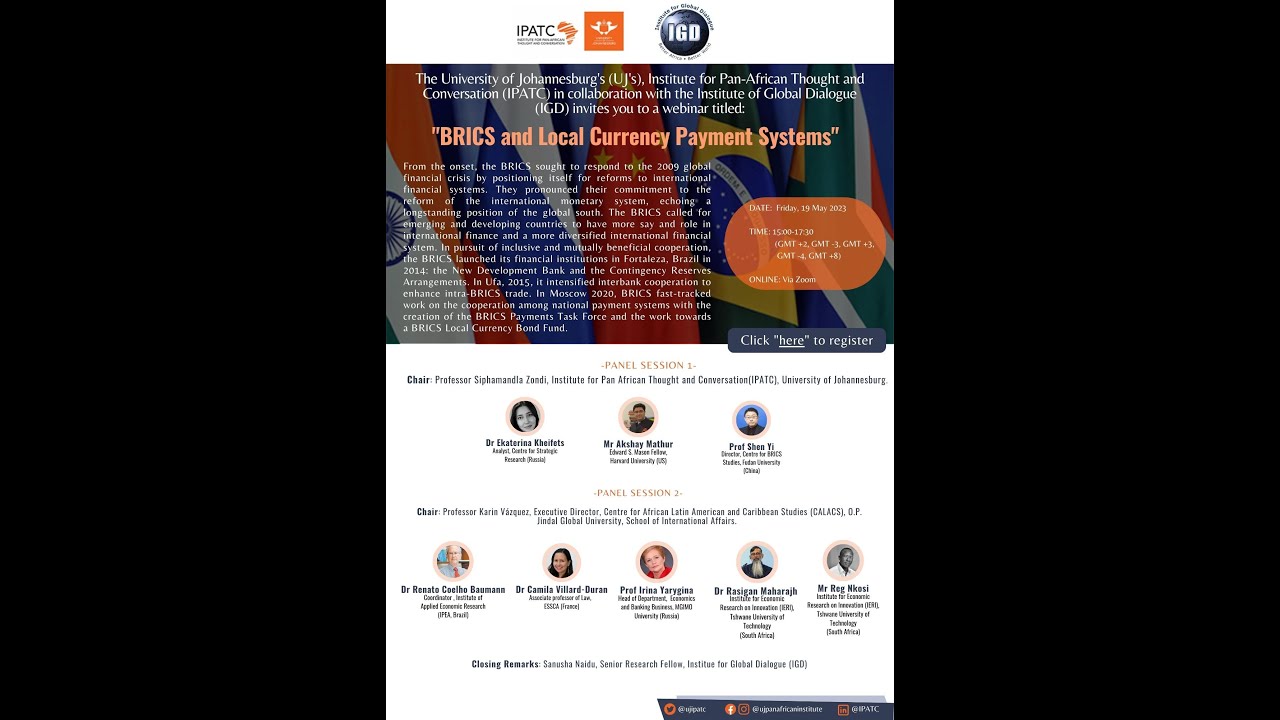
WEBINAR| BRICS and the Local Currency Payment Systems
Keywords
Summary
124 words
Critical Evaluation
Value of the Information & Strength of the Argument
The webinar provides valuable insights into the motivations and challenges of creating BRICS local currency payment systems. Panelists offer diverse perspectives from Brazil, Russia, India, and South Africa, enriching the discussion. The argumentation is generally solid, with speakers grounding their views in economic and geopolitical analysis. However, some statements reflect national interests, and the lack of a Chinese panelist limits the comprehensiveness. The discussion is more descriptive than prescriptive, but it effectively highlights the trade-offs and practical hurdles.
Scientific Rigor, Source Quality, Title Accuracy
The webinar demonstrates scientific rigor through the expertise of the panelists and the structured format. While specific sources are not cited in the video, the discussion references key initiatives like the New Development Bank and BRICS Payments Task Force. The title accurately reflects the content, focusing on local currency payment systems. The webinar is a valuable contribution to the discourse on financial multipolarity, though it would benefit from more concrete data and case studies.
167 words
Title / Content Match
The title accurately reflects the content, which focuses on BRICS and local currency payment systems.
Quality & Reliability
7/10
The webinar features academic experts and policy analysts from BRICS countries, providing a balanced and informed discussion. However, it is a recorded webinar with limited peer review, and some statements reflect national perspectives rather than objective analysis.
Key Moments
Markers derived by PSI from the transcript: the creator did not define chapters.
- Introduction by Prof. Siphamandla Zondi, setting the context for the webinar.
- Dr. Ekaterina Kheifets discusses the rationale for a BRICS payment system and the challenges.
- Akshay Mathur provides a geoeconomic perspective on the evolution of BRICS financial initiatives.
- Q&A session addressing questions on foreign reserves, debt, and currency usage.
- Discussion on central bank digital currencies and their potential role in BRICS.
- Panelists debate the feasibility of de-dollarization and the importance of aligning financial and trade architectures.
- Second panel begins, focusing on advancing the BRICS payment system.
- Dr. Renato Coelho Baumann discusses Brazil's perspective on local currency payments.
- Prof. Irina Yarygina elaborates on Russia's approach to financial integration.
- Dr. Rasigan Maharajh and Mr. Reg Nkosi present on innovation and financial systems.
Cited Sources
- New Development Bank — Mentioned as a BRICS financial institution launched in 2014.
- BRICS Contingent Reserve Arrangement — Referenced as part of BRICS financial cooperation.
Concurring Sources
- IMF Working Paper on De-dollarization — Supports the discussion on de-dollarization challenges.
Dissenting Sources
- The Dollar's Dominance is Not Easily Challenged — Contrasts with the webinar's optimistic view on de-dollarization, emphasizing the dollar's entrenched role.
Contribution & Novelties
The webinar provides a multi-stakeholder perspective on the development of BRICS local currency payment systems, highlighting both geopolitical and geoeconomic drivers. It offers a nuanced discussion on the challenges of de-dollarization, including infrastructure gaps and the need for alignment with real trade flows. The inclusion of experts from multiple BRICS countries enriches the analysis, though it lacks a Chinese perspective.
Pour aller plus loin :
- BRICS and De-dollarization: A Review — IMF working paper on de-dollarization trends.
- Central Bank Digital Currencies and the Future of Money — BIS report on CBDCs.
- The Geopolitics of Financial Infrastructure — CFR analysis on financial infrastructure.
102 words
Radar Profile
The radar profile shows high scores in information quantity and quality, reflecting the webinar's comprehensive coverage. The technical level is moderate, suitable for an informed audience. Overall reliability is good, though the lack of specific citations and the panel's national perspectives slightly reduce the score.
💬 Sur les 0 commentaires analysés, aucune tendance n'a pu être dégagée.