PAINT: Parallel-in-time Neural Twins for Dynamical System Reconstruction
Keywords
Summary
184 words
Critical Evaluation
Value of the Information & Strength of the Argument
The presentation provides valuable insights into the limitations of autoregressive models for dynamical system reconstruction and proposes a novel parallel-in-time approach. The argumentation is solid, supported by theoretical analysis (error propagation, Jacobian) and empirical results on a challenging turbulent flow problem. The authors clearly explain the motivation, the method, and the results, and they address potential questions. The value lies in the conceptual shift from autoregressive to parallel-in-time prediction, which could improve the stability and accuracy of neural surrogates. The argumentation is coherent and well-structured, with a clear logical flow from problem definition to solution and evaluation.
Scientific Rigor, Source Quality, Title Accuracy
The presentation is scientifically rigorous, with a clear theoretical framework and empirical validation. The authors reference prior work on error accumulation and mitigation strategies, though specific citations are not provided in the talk. The title accurately reflects the content, and the presentation is well-organized. The main limitation is the lack of detailed source citations in the talk itself, but the methodology appears sound. The adéquation between title and content is excellent.
183 words
Title / Content Match
The title accurately reflects the content: the presentation introduces PAINT, a method for parallel-in-time neural twins, and demonstrates its application to dynamical system reconstruction.
Quality & Reliability
8/10
The talk presents original research with theoretical analysis and empirical validation on a turbulent flow problem. The methodology is clearly explained, and the claims are supported by experimental results. However, the presentation is a seminar talk, and the full details are in the paper, which is not provided. The absence of external verification and the limited scope of the experiments (2D) slightly reduce the score.
Key Moments
Markers derived by PSI from the transcript: the creator did not define chapters.
- Introduction and motivation: reconstructing velocity fields for wind farms and industrial applications.
- Definition of neural twin and the learning problem: given measurement history, predict the last true state.
- Discussion on autoregressive models and the on-trajectory property.
- Explanation of over-reliance on autoregressive state and error propagation analysis.
- Introduction of PAINT method: parallel-in-time prediction without autoregressive state.
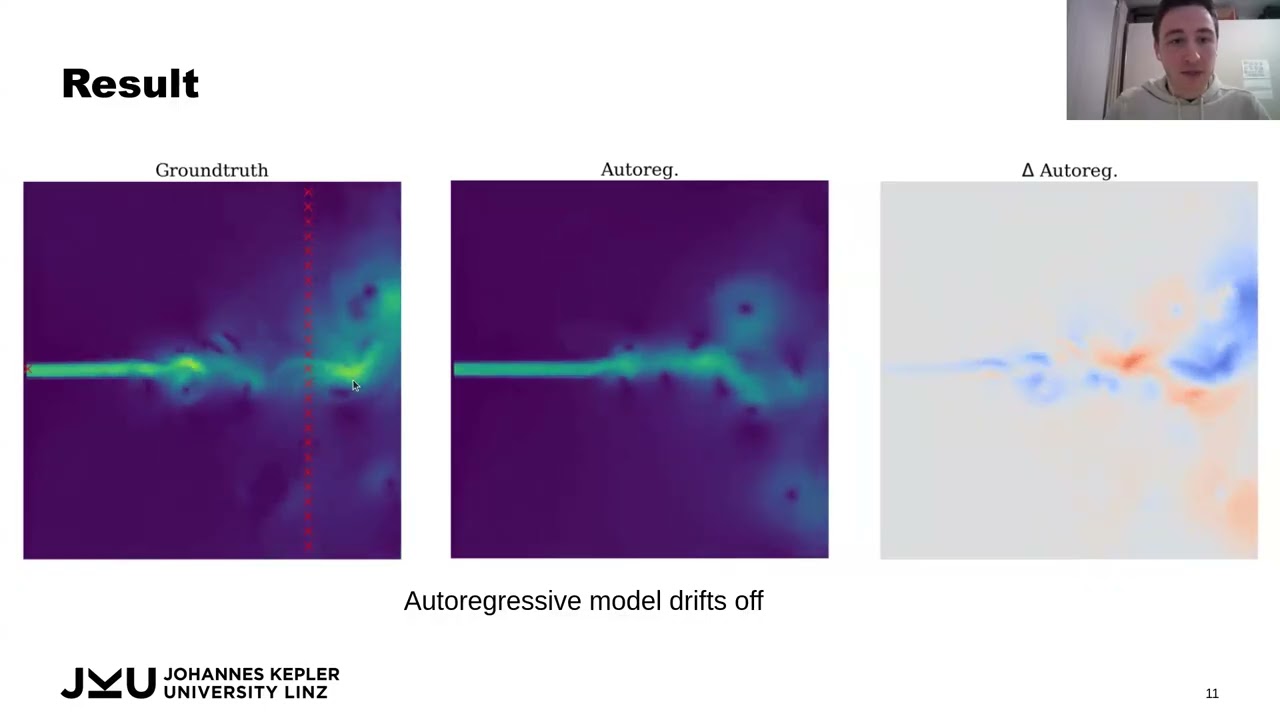
- Results on 2D turbulent flow: PAINT stays on-trajectory, autoregressive drifts.
- Discussion on insights, advantages, and disadvantages of PAINT.
- Conclusion and future work: extension to 3D flows.
Cited Sources
- PAINT: Parallel-in-time Neural Twins for Dynamical System Reconstruction — The paper presenting the method, mentioned as the basis of the talk.
Concurring Sources
- Deep learning for dynamical systems — General literature on neural surrogates for dynamical systems.
Dissenting Sources
- Autoregressive models for time series — Autoregressive models are widely used and can be effective in some settings, but PAINT argues they suffer from drift.
Contribution & Novelties
The main novelty is the parallel-in-time approach to neural twins, which avoids the error accumulation of autoregressive models by predicting a window of states simultaneously. This is supported by theoretical analysis showing that PAINT is on-trajectory, whereas autoregressive models are not. The method also provides instantaneous uncertainty estimates via the generative model. The talk highlights the over-reliance on autoregressive state as a key issue and proposes a simple yet effective solution.
Pour aller plus loin :
- Flow Matching — Flow matching is a generative modeling technique used in PAINT to model the distribution of states.
- Neural Ordinary Differential Equations — A related approach for modeling dynamical systems with neural networks.
- Teacher Forcing — The training technique that contributes to over-reliance on autoregressive state.
123 words
Radar Profile
The radar profile shows high scores across all dimensions, indicating a well-balanced presentation with strong technical depth, reliable information, and good quantity of content. The lowest score is in 'niveau_technique' (8), which is still high, suggesting the talk is accessible to a technical audience but not overly specialized.
💬 Sur les 0 commentaires analysés, aucune tendance n'est disponible.