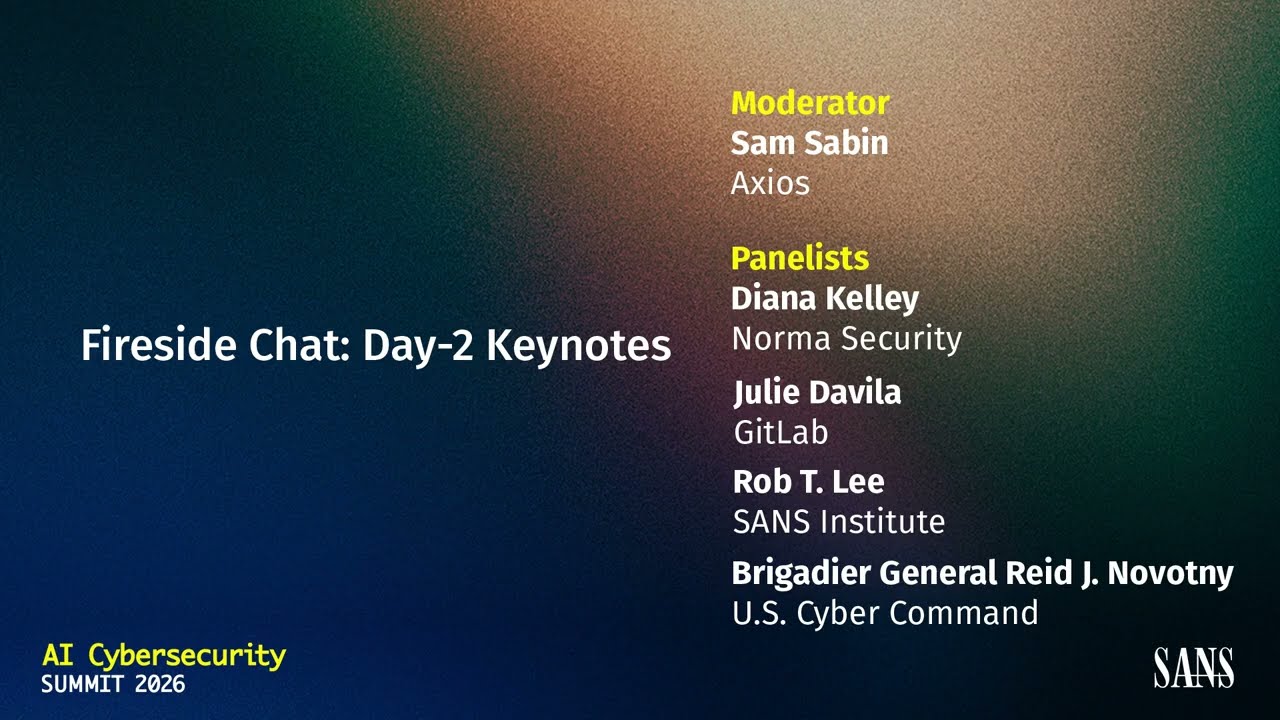
Fireside Chat with Day 2 Keynote Speakers
Keywords
Summary
154 words
Critical Evaluation
Value of the Information & Strength of the Argument
The value of the information lies in the diverse perspectives of the panelists, who bring experience from industry, military, and consulting. They provide practical insights into AI risk management, such as the use of SLMs and the importance of understanding model provenance. The argumentation is generally solid, with panelists building on each other’s points and offering real-world examples. However, some claims are anecdotal and lack empirical evidence, and the discussion occasionally veers into speculative territory, such as the potential for AI to democratize cyber attacks. Overall, the arguments are coherent and well-reasoned, though not rigorously scientific.
Scientific Rigor, Source Quality, Title Accuracy
The panelists are credible experts in cybersecurity, and their opinions carry weight. However, the discussion does not cite specific studies or data, relying instead on personal experience and general knowledge. The title accurately reflects the content, as it is a fireside chat with keynote speakers. The lack of formal citations and the subjective nature of the discussion limit its scientific rigor, but it provides valuable qualitative insights into the current state of AI security.
185 words
Title / Content Match
The title accurately reflects the content: a fireside chat with keynote speakers from the SANS AI Cybersecurity Summit.
Quality & Reliability
7/10
The discussion features experienced cybersecurity professionals, including a CISO, a VP of Product Security, and a military officer, providing practical insights. However, it is a panel discussion with subjective opinions and lacks formal citations or data, limiting its scientific rigor.
Key Moments
Markers derived by PSI from the transcript: the creator did not define chapters.
- Introduction of panelists and the question of whether AI can be secured.
- Discussion on AI as a teenager and the analogy to parenting.
- Debate on the role of frontier model providers and the competitive pressure from China.
- Exploration of small language models (SLMs) as a more controllable alternative.
- Discussion on the moral implications of AI discovering exploits.
- Insights into the military's approach to AI security and risk management.
- Audience questions on AI ethics and the potential for AI to democratize cyber attacks.
- Panelists discuss the importance of understanding AI's limitations and the need for proactive risk management.
- Closing thoughts on how organizations can adopt AI responsibly.
Cited Sources
- SANS Summits — Mentioned as a resource for further learning from leading voices in cybersecurity.
Concurring Sources
- NIST AI Risk Management Framework — Aligns with the panel's emphasis on risk management for AI.
Dissenting Sources
- AI Security: A Survey — Provides a more technical and comprehensive overview of AI security challenges, contrasting with the panel's high-level discussion.
Contribution & Novelties
The video provides a unique panel discussion that synthesizes perspectives from industry, military, and consulting on AI security. It offers practical advice on risk management and the use of SLMs, and highlights the geopolitical and ethical dimensions of AI in cybersecurity.
Pour aller plus loin :
- AI Risk Management Framework — NIST’s framework for managing AI risks.
- Small Language Models — Overview of SLMs and their applications.
- Law of Armed Conflict — Legal principles governing military operations, relevant to the discussion on AI in warfare.
85 words
Radar Profile
The radar profile shows a balanced score across all dimensions, with slightly higher scores in information quality and reliability, reflecting the expertise of the panelists. The lower score in technical level indicates that the discussion is accessible to a broad audience, while still providing valuable insights.
💬 No comments were provided for analysis.