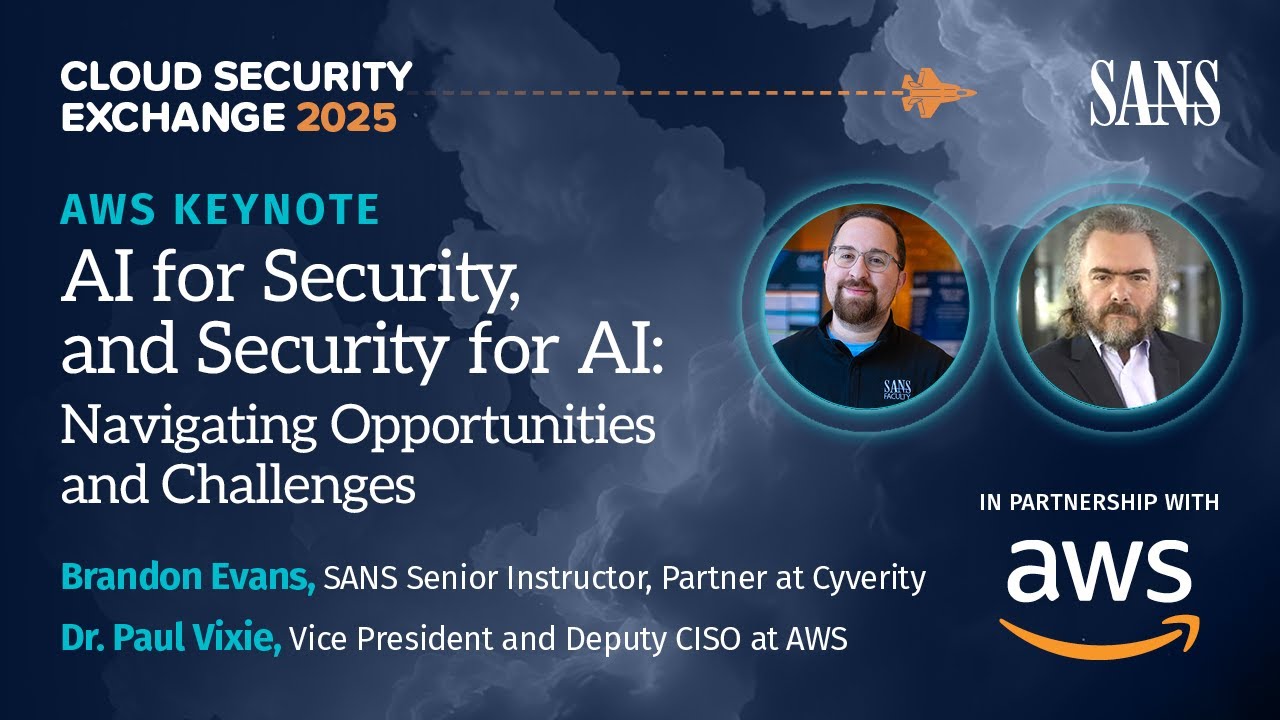
AWS Keynote: AI for Security, and Security for AI
Keywords
Summary
160 words
Critical Evaluation
Value of the Information & Strength of the Argument
The value of the information is high, as it provides practical insights from experienced security professionals on a timely topic. The argumentation is solid, relying on real-world examples and analogies (e.g., SQL injection, Deep Blue) to illustrate points. The speakers acknowledge uncertainties and advocate for a cautious, skeptical approach, which enhances credibility. However, some claims lack empirical backing, and the discussion is more conversational than rigorously structured.
Scientific Rigor, Source Quality, Title Accuracy
The scientific rigor is moderate; the talk is based on professional experience rather than peer-reviewed research. No specific sources are cited, but the speakers reference industry statistics and common knowledge. The title accurately reflects the content, and the discussion stays on topic. The lack of formal citations is a minor weakness, but the expertise of the speakers lends authority.
141 words
Title / Content Match
The title accurately reflects the content, which addresses both using AI for security and securing AI systems.
Quality & Reliability
8/10
The speakers are recognized experts (SANS Senior Instructor, AWS Deputy CISO) and the content is grounded in practical experience and industry knowledge. However, the discussion is largely opinion-based and lacks detailed citations or empirical data, which slightly reduces the score.
Key Moments
Markers derived by PSI from the transcript: the creator did not define chapters.
- Introduction and statistics on AI adoption and security preparedness.
- Discussion on the difference between AI safety and security.
- Examples of unsafe AI outputs (e.g., napalm instructions, gasoline spaghetti).
- Comparison of generative AI to traditional AI (Deep Blue example).
- Discussion on prompt injection and separating control/data planes.
- Risks of uploading proprietary data to AI models.
- Introduction to agentic AI and the need for least privilege.
- Challenges of identity management for machines.
- Advice on choosing the right level of AI adoption.
- Encouragement to experiment and learn, and to avoid over-credulity.
Contribution & Novelties
The talk provides a practical perspective on securing AI, emphasizing the need to combine safety and security considerations. It offers actionable guidance on prompt injection mitigation and least privilege for agentic AI.
Pour aller plus loin :
- OWASP Top 10 for Large Language Model Applications — Key resource for LLM security risks.
- NIST AI Risk Management Framework — Framework for managing AI risks.
- Prompt injection attacks — Overview of prompt injection vulnerabilities.
- Agentic AI — Concept of autonomous AI agents.
80 words
Radar Profile
The radar profile shows high scores in information quantity and quality, reflecting the depth of discussion. Technical level is moderately high, suitable for a professional audience. Overall reliability is strong due to the speakers' expertise, though the lack of formal citations slightly lowers the score.
💬 No comments were provided for analysis.