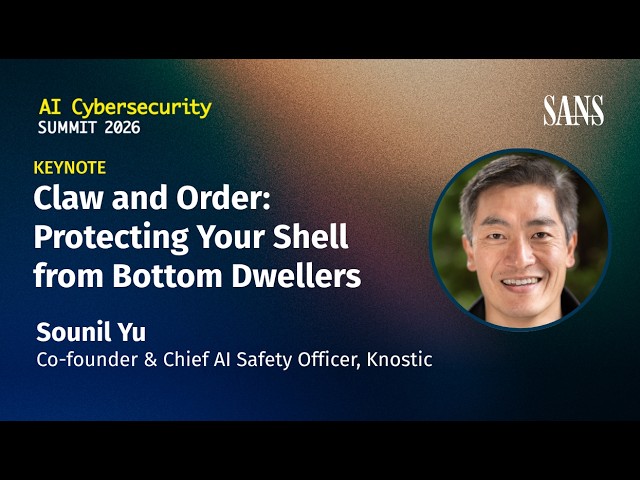
Keynote: Claw and Order: Protecting Your Shell
Keywords
Summary
155 words
Critical Evaluation
Value of the Information & Strength of the Argument
The talk provides valuable insights into the security challenges of AI agents, using the OpenClaw phenomenon as a case study. The argument is well-structured, drawing analogies to architecture and construction to explain complex concepts. The speaker supports his points with examples from recent events and industry tools, though some claims are anecdotal. The emphasis on the ‘agent rule of two’ and the need for architectural controls is practical and actionable.
Scientific Rigor, Source Quality, Title Accuracy
The speaker references several sources, including Anthropic’s Claude models, Meta’s agent rule of two, and tools from NVIDIA and Cisco. However, specific URLs are not provided in the talk, and the description only includes general links to SANS resources. The title is catchy and relevant, but the content goes beyond just OpenClaw to broader AI security architecture. The talk is opinion-based, but the speaker’s expertise lends credibility.
152 words
Title / Content Match
The title is catchy and relevant, using a pun on 'law and order' to discuss securing AI agents like OpenClaw.
Quality & Reliability
7/10
The speaker is a recognized expert in cybersecurity, co-founder of Knostic, and presents a coherent argument based on recent developments and industry practices. However, the talk is largely opinion and anecdotal, with limited empirical data or peer-reviewed sources.
Key Moments
Markers derived by PSI from the transcript: the creator did not define chapters.
- Introduction and the fable of the three little pigs, emphasizing architecture over materials.
- Discussion on how architecture compensates for weaker materials, using examples from vulnerability research.
- Comparison of AI models to building materials, and the evolution of 'building codes' in AI development.
- Introduction of OpenClaw and its rapid adoption, highlighting its security risks.
- Explanation of the 'agent rule of two' and how OpenClaw defaults to the danger zone.
- Overview of security tools from NVIDIA, Cisco, and Knostic to secure OpenClaw.
- Future predictions: agents becoming more autonomous, capability shifting to architecture, and the need for new operating models.
- Discussion on organizational change and the role of individual contributors as managers of AI agents.
Cited Sources
- SANS AI Cybersecurity Resources — General resource for AI security from SANS.
- SANS Summits — Upcoming SANS summits for continued learning.
Concurring Sources
- SANS AI Cybersecurity Resources — Supports the talk's theme of AI security.
Contribution & Novelties
The talk provides a fresh perspective on AI security by emphasizing the importance of architecture and scaffolding over the raw capabilities of AI models. It introduces the ‘agent rule of two’ as a practical framework for assessing risks in AI agents. The discussion on the evolution of ‘building codes’ in AI development is a novel analogy that helps understand the rapid pace of change.
Pour aller plus loin :
- Zero Trust Architecture — Relevant to the security principles mentioned.
- Dunbar’s number — Referenced in the talk regarding organizational limits.
- Agent rule of two — Not a verified URL, but the concept is from Meta; consider searching for it.
108 words
Radar Profile
The radar profile shows high scores in information quantity and quality, with moderate technical depth and reliability. This indicates a well-informed talk with practical insights, though it relies on expert opinion rather than empirical data.
💬 No comments were provided for analysis.