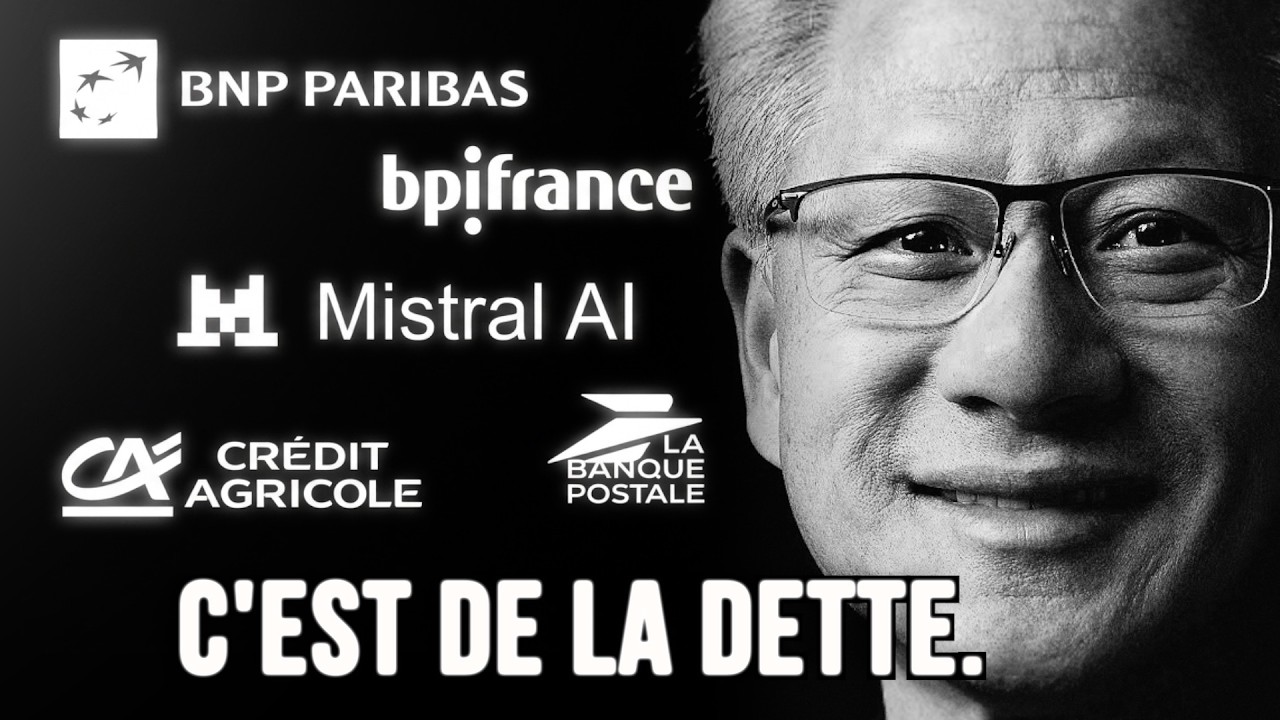
Ce qu'on ne vous dit pas sur les 830 millions de Mistral AI
Keywords
Summary
123 words
Critical Evaluation
The video offers a compelling and well-researched analysis of Mistral AI’s debt financing, shedding light on the often-overlooked financial mechanics behind AI infrastructure. The creator effectively uses data from reputable sources like Reuters, Bloomberg, and TrendForce to support the argument that GPUs are now considered bankable collateral. The comparison to energy infrastructure financing in the 1990s is insightful and provides a useful framework for understanding the shift. However, the video has some weaknesses. It relies heavily on speculative reasoning, particularly regarding the future value of GPUs and the impact of geopolitical events like the helium shortage. While the sources are credible, the video does not include direct interviews or primary data, and the creator’s promotional tone for their Patreon may undermine objectivity. The analysis of the HBM market and price increases is accurate, but the extrapolation to Mistral’s specific situation could be more nuanced. The video also tends to oversimplify complex financial and geopolitical issues, potentially misleading viewers who are not already familiar with the topic. Despite these limitations, the video provides valuable insights into the financialization of AI infrastructure and its broader implications, making it a worthwhile watch for those interested in the business side of AI.
198 words
Title / Content Match
The title accurately reflects the content, which focuses on the hidden aspects of Mistral AI's $830 million debt financing.
Quality & Reliability
7/10
The video provides a well-structured analysis of Mistral AI's debt financing, supported by multiple credible sources (Reuters, Bloomberg, TechCrunch, TrendForce, etc.). The reasoning is logical and data-driven, though it includes speculative elements and a promotional tone. The sources are recent and relevant, but the video lacks direct interviews or primary data beyond the cited reports.
Key Moments
Markers derived by PSI from the transcript: the creator did not define chapters.
- Introduction: The official narrative vs. the real story behind Mistral's $830M debt.
- Explanation of the debt financing: 7 banks, 13,800 Nvidia GB300 GPUs as collateral.
- Comparison between equity financing and debt financing in AI.
- Key data: HBM market allocated, DRAM prices up 90-95% quarterly.
- The logic of banks: GPUs as appreciating collateral vs. real estate.
- Impact on AI costs: inference prices rising due to hardware scarcity.
- Addressing the objection of GPU obsolescence: older GPUs still in use.
- Examples of other GPU-backed debt: CoreWeave, Lambda Labs.
- Historical parallel: energy deregulation in the 1990s.
- Geopolitical factor: helium shortage from Qatar affecting semiconductor production.
- Conclusion: The real story is about collateral and supply chains, not sovereignty.
Cited Sources
- Reuters: France's Mistral raises $830 million debt for AI data centre build-up — Primary source for the debt financing announcement.
- TechCrunch: Mistral AI raises $830M in debt to set up a data center near Paris — Confirms the debt amount and purpose.
- Bloomberg: AI Startup Mistral Raises $830 Million in Data Center Debt Rush — Provides additional details on the financing.
- Gide: Gide advises Mistral AI on its first financing amounting to approximately USD 830 million — Legal advisor's press release confirming the transaction.
- SK Hynix: 2026 Market Outlook - Focus on the HBM-led Memory Supercycle — Source for HBM market allocation and seller-driven market.
- TrendForce: Samsung, SK Hynix reportedly plan 20% HBM3e price hike for 2026 — Source for DRAM price increases.
- Fortune: Iran war helium shortage Qatar chip supply chains AI boom — Context for helium shortage impact on semiconductors.
- Futurum Group: Mistral Forge takes aim at RAG but who actually needs custom models? — Analysis of Mistral's product strategy.
- Introl: Hyperscaler capex $600B 2026 AI infrastructure debt January 2026 — Data on hyperscaler capital expenditures.
- Mistral AI: Forge — Mistral's official announcement of Forge.
- SemiAnalysis: Memory Mania - How a once in four decades... — Analysis of memory market dynamics.
- CNBC: Micron AI memory shortage HBM Nvidia Samsung — News on memory shortage.
- CNBC: The Iran war is threatening supply helium what it means for markets — Impact of helium shortage on markets.
- Data Center Dynamics: Mistral AI raises $830M in debt financing for data center in Paris, France — Industry news on the data center.
- Goldman Sachs: Why AI companies may invest more than $500 billion in 2026 — Projections on AI investment.
- MUFG: AI Chart Weekly 12/19 Financing the AI Supercycle — Data on AI financing.
- Reuters: Helium prices soar Qatar LNG halt exposes fragile supply chain — Helium price surge and supply chain fragility.
Concurring Sources
- Reuters: France's Mistral raises $830 million debt for AI data centre build-up — Confirms the debt financing amount and purpose.
- TechCrunch: Mistral AI raises $830M in debt to set up a data center near Paris — Corroborates the debt amount and data center plans.
- Bloomberg: AI Startup Mistral Raises $830 Million in Data Center Debt Rush — Provides additional details on the financing.
- Gide: Gide advises Mistral AI on its first financing amounting to approximately USD 830 million — Legal confirmation of the transaction.
Dissenting Sources
- Futurum Group: Mistral Forge takes aim at RAG but who actually needs custom models? — This source questions the demand for custom models, which could affect Mistral's revenue projections and the viability of the debt.
Contribution & Novelties
The video provides a novel perspective on AI infrastructure financing by highlighting the shift from equity to debt financing backed by GPU collateral. It connects this to broader market dynamics, including HBM shortages and geopolitical risks, offering a comprehensive view of the AI supply chain’s financialization.
Pour aller plus loin :
- GPU as collateral: The rise of GPU-backed lending — Overview of GPU technology and its market.
- HBM memory market — Explanation of HBM and its importance in AI.
- Semiconductor supply chain — Context on the global semiconductor supply chain.
- Helium shortage impact — General information on helium and its uses.
- CoreWeave — Example of a GPU cloud provider with significant debt.
112 words
Radar Profile
The radar profile shows high scores in information quantity and quality, indicating a data-rich and well-sourced analysis. The technical level is moderately high, suitable for an informed audience. The overall reliability is strong, though the promotional tone and speculative elements slightly reduce the score.
💬 Sur les 0 commentaires analysés, aucune tendance n'est disponible.