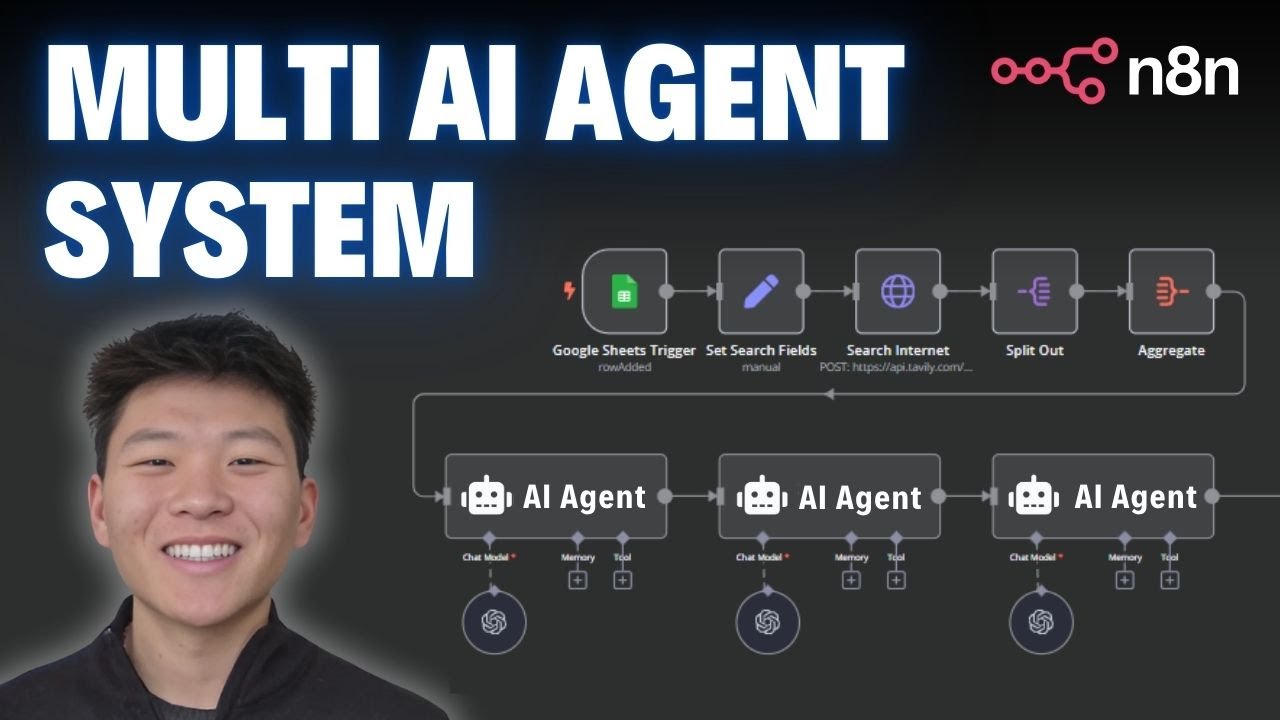
Build this Multi AI Agent System for Research and Content Creation in n8n
Keywords
Summary
146 words
Critical Evaluation
Value of the Information & Strength of the Argument
The video provides a practical, hands-on demonstration of building a multi-agent content creation system. The value lies in its step-by-step approach, showing how to integrate external APIs (Tavily) and orchestrate multiple agents for specific tasks. The argumentation is clear and logical, explaining the purpose of each component and how they work together. The creator also shares insights from his experience, such as switching from Grok to a different model to handle emojis better, which adds practical value. However, the tutorial lacks deep technical explanations and does not discuss potential limitations or alternative approaches in detail.
Scientific Rigor, Source Quality, Title Accuracy
The tutorial is based on the creator’s own experience and does not cite external scientific sources. The main external references are the Tavily API and n8n platform, but no official documentation is linked. The title accurately describes the content, and the video stays on topic. The creator promotes his community and services, which is common in tutorial videos but does not detract from the technical content. Overall, the rigor is moderate, typical for a tutorial format.
186 words
Title / Content Match
The title accurately reflects the content: a tutorial on building a multi-agent AI system for research and content creation using n8n.
Quality & Reliability
7/10
The video provides a clear, step-by-step tutorial on building a multi-agent content creation system in n8n. It demonstrates practical implementation and explains the role of each component. However, it lacks in-depth technical details and references to official documentation, and the promotional content for the creator's community is present.
Chapters
Cited Sources
- n8n Partner Link — Affiliate link for n8n, the platform used in the tutorial.
- Skool Community (Free) — Free community where the workflow is available for download.
- Skool Community (Paid) — Paid community for advanced AI automation learning.
- Background Music — Background music used in the video.
- Watch Next Video — Suggested next video by the creator.
Concurring Sources
- Tavily API — The search API used in the workflow, mentioned in the video.
Contribution & Novelties
The video offers a practical, no-code approach to building a multi-agent content creation system, which is valuable for non-technical users. It demonstrates how to combine a search API (Tavily) with specialized agents to generate platform-specific content, a pattern that can be adapted for various use cases. The workflow is shared for free, enabling viewers to replicate and modify it.
Pour aller plus loin :
- Tavily API — The search API used for fetching recent news, relevant for understanding its capabilities and limitations.
- n8n Documentation — Official documentation for n8n, useful for learning more about workflow automation and agent nodes.
- Multi-agent systems — A general overview of multi-agent systems, providing theoretical background.
- Prompt engineering — Key concepts for designing effective prompts for AI agents.
123 words
Radar Profile
The radar profile shows a balanced performance across all dimensions, with slightly higher scores in information quantity and quality, reflecting the tutorial's practical value. The technical level is moderate, suitable for intermediate users, and the overall reliability is good, though not backed by external references.