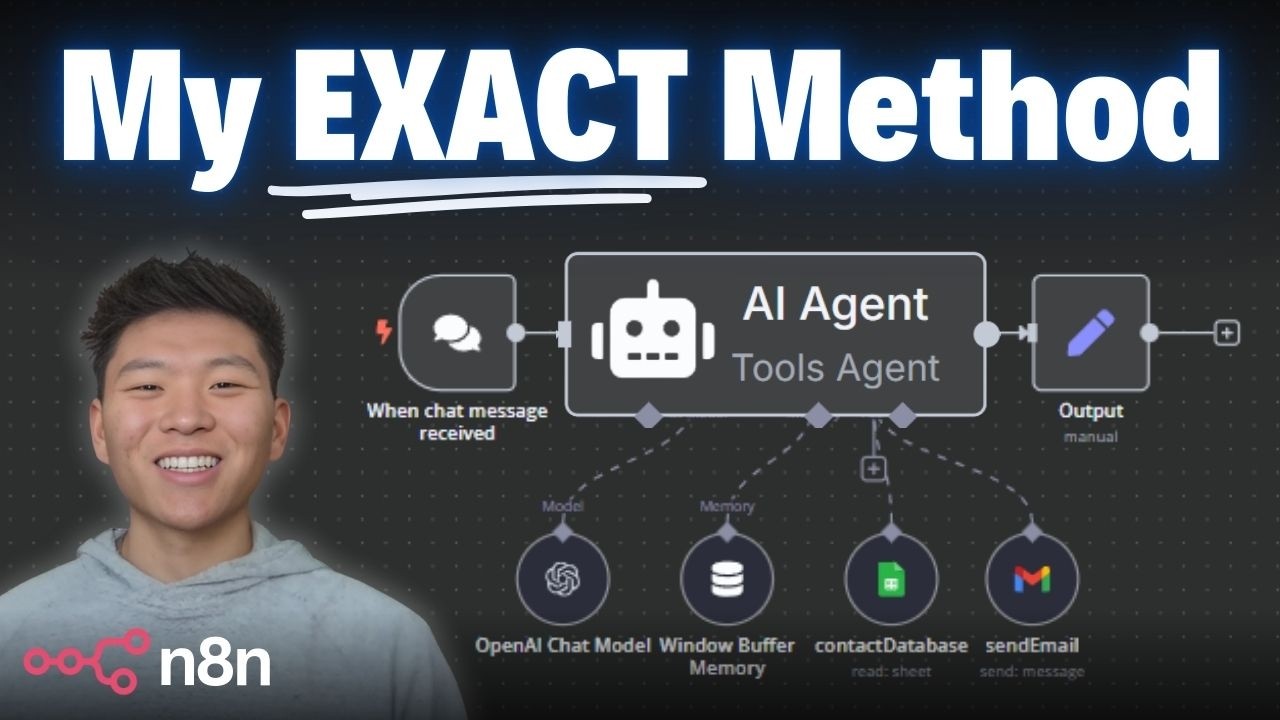
My Proven AI Agent Formula Explained
Keywords
Summary
130 words
Critical Evaluation
Value of the Information & Strength of the Argument
The video provides a clear, structured framework that is immediately applicable for practitioners. The author’s argumentation is logical and supported by practical examples, such as the email support workflow and the comparison between workflows and agents. The emphasis on process mapping and the ‘workflow vs. agent’ distinction is particularly valuable, as it addresses a common pitfall in AI automation. However, the claims about generating $240,000 and the effectiveness of the method are anecdotal and lack verifiable evidence, which weakens the overall argumentation.
Scientific Rigor, Source Quality, Title Accuracy
The video is based on the author’s personal experience and does not cite any external scientific sources. The description links are primarily promotional (courses, community, tools) and do not provide references to academic or technical literature. The title accurately reflects the content, and the video is well-structured with clear chapters. The lack of citations reduces the scientific rigor, but the practical advice is coherent and internally consistent.
164 words
Title / Content Match
The title accurately reflects the content, which is a step-by-step explanation of the author's personal methodology for building AI agents.
Quality & Reliability
7/10
The video presents a practical, experience-based framework for building AI agents, with clear explanations and concrete examples. However, it lacks formal citations or references to scientific literature, and the claims about ROI and effectiveness are anecdotal.
Chapters
Cited Sources
- AI OS Course (free) — Mentioned as the creator's free course for learning AI automation foundations.
- Full courses + unlimited support — Promoted as the paid community and course platform.
- Apply for my YT podcast — Link for applying to the creator's podcast.
- Work with me — Link to the creator's agency/services.
- FREE MONTH voice to text — Affiliate link for a voice-to-text tool.
- Code NATEHERK for 10% off VPS — Affiliate link for VPS hosting.
- LinkedIn profile — Creator's LinkedIn profile.
- Watch next video — Link to a related video on the channel.
Concurring Sources
- Intelligent agent — General concept of AI agents, consistent with the video's description.
- Retrieval-augmented generation — The video's explanation of RAG aligns with this concept.
Contribution & Novelties
The video offers a practical, step-by-step methodology for building AI agents, emphasizing a no-code approach. Its main contribution is the clear distinction between workflows and agents, and the emphasis on process mapping before implementation. This is a valuable perspective for practitioners, though it is not novel in academic terms.
Pour aller plus loin :
- AI agent — Provides a formal definition and background on AI agents.
- Retrieval-augmented generation — Explains the RAG technique mentioned in the video.
- Workflow — Offers a general overview of workflows, relevant to the video’s discussion.
90 words
Radar Profile
The radar profile shows high scores in information quantity and moderate scores in technical depth and reliability. This indicates a content-rich video with practical advice, but with limited scientific rigor and technical complexity.
💬 Très positif. Sur les 30 commentaires analysés, les spectateurs expriment une forte appréciation pour la clarté, la structure et la valeur pratique du contenu, avec des éloges récurrents sur la distinction entre workflows et agents.